Aeroplan vs Aventura: The Ultimate Canadian Travel Points Showdown
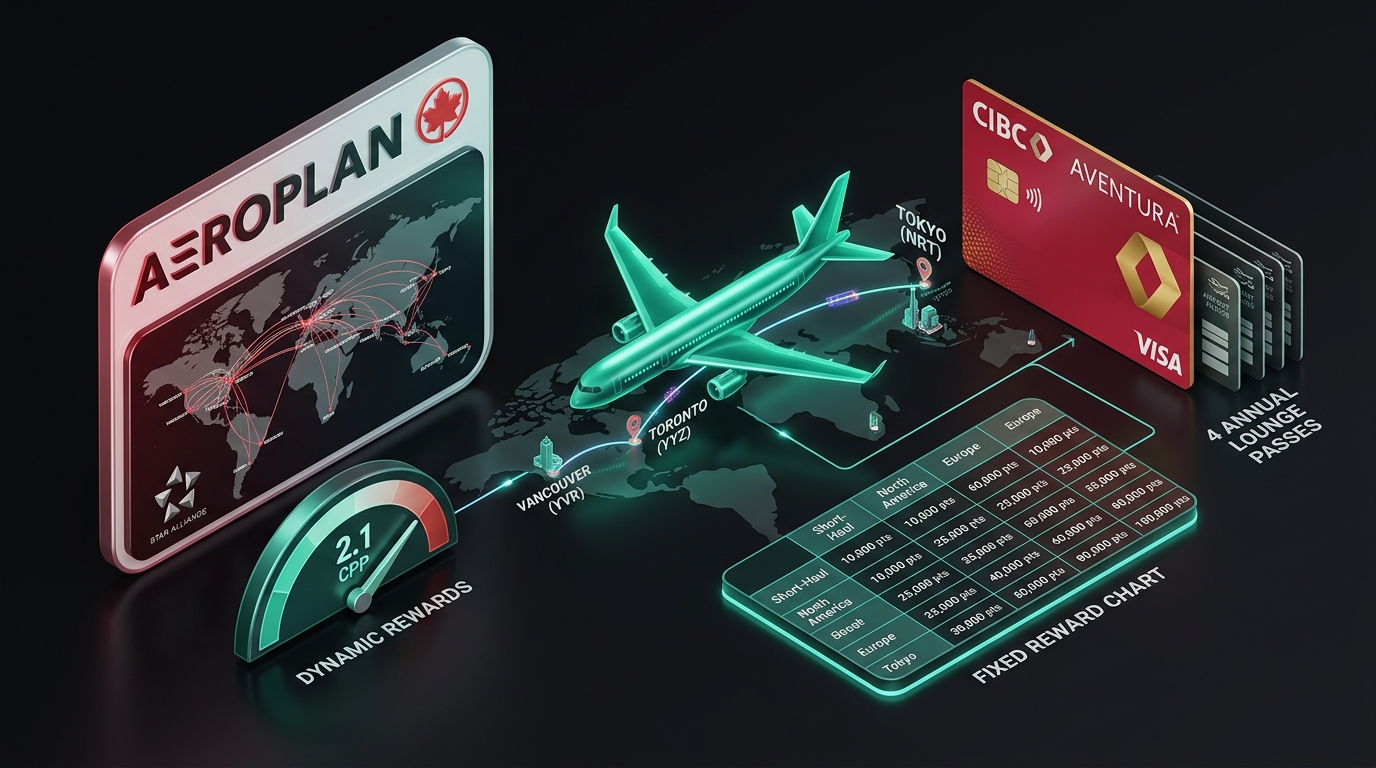
- Point Valuation Winner — Aeroplan (2.0–2.1 CPP vs. 1.25 CPP): Air Canada Aeroplan points deliver an average value of 2.0 to 2.1 cents per point (CPP)—and up to 4.5+ CPP on international Star Alliance business class—whereas CIBC Aventura points average 1.0 to 1.5 CPP.
- Flexibility & Lounge Winner — CIBC Aventura: Aventura points can be redeemed at a flat 1.0 CPP (100 points = $1) against any travel purchase (hotels, Airbnb, WestJet, cruises), and the CIBC Aventura Visa Infinite includes 4 complimentary airport lounge passes per year.
- The Aventura Flight Chart Trap: While CIBC's fixed Airline Rewards Chart advertises up to 2.28 CPP, strict Maximum Ticket Price caps ($800 North America, $1,300 Europe) plus uncovered carrier surcharges typically compress real-world value down to 1.20–1.45 CPP.
- No Direct Transfers: You cannot transfer CIBC Aventura points into Aeroplan. However, CIBC allows you to product-switch between Aventura and Aeroplan credit cards internally with zero hard credit check.
Walk into any CIBC branch in Canada or browse online credit card rankings, and you will immediately face a classic dilemma: should you apply for a CIBC Aventura card or an Air Canada Aeroplan card? Because Canadian Imperial Bank of Commerce (CIBC) co-issues both its proprietary in-house Aventura currency and Air Canada's flagship Aeroplan Visa cards, even seasoned travelers often confuse how the two programs operate.
On the surface, their flagship $139-annual-fee Visa Infinite cards look nearly identical. Beneath the hood, however, Aeroplan and Aventura operate on fundamentally opposite mathematical architectures. In this 2026 head-to-head showdown, we break down fixed vs. dynamic pricing, run real flight simulations from Toronto to London and Vancouver to Tokyo, and reveal which program wins for your wallet.
Head-to-Head Matrix: Air Canada Aeroplan vs. CIBC Aventura (2026)
Before diving into specific flight routes, let's examine the structural rules, point valuations, and card perks of both ecosystems:
| Feature | Air Canada Aeroplan | CIBC Aventura Rewards |
|---|---|---|
| Program Type | Global Airline Loyalty Currency | Proprietary Bank Travel Points |
| Baseline Travel Value | 1.25 – 1.50 CPP (Economy) | 1.00 CPP Floor (Any Travel) |
| Target / Sweet Spot Value | 2.00 – 4.50+ CPP | 1.25 – 1.60 CPP (Flight Chart) |
| Eligible Airlines | Air Canada + 45+ Star Alliance & Partners | Any Airline (via CIBC Portal / 1.0 CPP) |
| Business / First Class Value | World-Class (Fixed Partner Chart) | Poor (Capped by Max Ticket Price) |
| Hotel & Airbnb Redemptions | Poor (~0.8 – 1.1 CPP) | 1.00 CPP (Pending Travel Eraser) |
| Taxes & Carrier Surcharges | Zero fuel surcharges; $39 partner fee | Must pay cash or redeem at 1.0 CPP |
| Flagship Visa Infinite Perks | Free 1st Checked Bag (up to 9 flyers) | 4 Airport Lounge Passes + $100 NEXUS |
| Transfer Partners | Receives 1:1 from Amex MR | None (Closed Loop) |
How Air Canada Aeroplan Works: Dynamic Metal vs. Fixed Partners
Overhauled in late 2020 and refined through 2026, Air Canada's Aeroplan program operates as a hybrid distance-based award chart divided into four global geographic zones (North America, Atlantic, Pacific, and South America). To understand how far your balance will stretch, check our detailed breakdown on how many Aeroplan points you need for a flight and our Aeroplan points value calculator.
The Two Halves of the Aeroplan Award Chart
- Air Canada Operated Flights (Dynamic Pricing): When flying on Air Canada planes, every unsold seat is available for points with zero blackout dates. However, pricing fluctuates dynamically with cash demand. A Toronto–Vancouver economy ticket may cost 12,500 points on a quiet Tuesday or 38,000 points during Christmas week. Holding a co-branded Aeroplan credit card unlocks Preferred Pricing, discounting dynamic Air Canada fares by roughly 5% to 12%.
- 45+ Global Partner Airlines (Fixed Distance Pricing): This is Aeroplan's superpower. When you book partner airlines—such as Lufthansa, Swiss, ANA, Singapore Airlines, Turkish Airlines, United, Emirates, or Etihad—the price in points is strictly fixed based on total miles flown, provided saver award space is available! Furthermore, Aeroplan eliminates all carrier-imposed fuel surcharges (YQ), charging only government taxes plus a flat $39 CAD partner booking fee.
To discover the highest-returning routes on this partner grid, read our guide to Aeroplan sweet spots in Canada and our Aeroplan optimization guide.
How CIBC Aventura Works: The Fixed Chart & The Base Fare Trap
CIBC Aventura points are a bank-owned rewards currency earned exclusively on CIBC Aventura credit cards. As covered in our full CIBC Aventura Visa Infinite review, you can redeem Aventura points in three distinct ways:
- Pay with Points (Travel Eraser — 1.00 CPP Floor): Charge any eligible travel expense (flights on any airline, hotels, Airbnb, car rentals, cruises, or tour packages) directly to your Aventura card, and redeem points against the pending transaction in the CIBC mobile app at 100 points = $1.00 CAD (1.0 CPP).
- Aventura Airline Rewards Chart (1.20 to 1.80 CPP): Book economy round-trip flights through the CIBC Rewards Centre using CIBC's fixed regional grid (e.g., 10,000–20,000 points for Short-Haul, 25,000–35,000 points for North America, or 50,000–60,000 points for Europe).
- Financial Products / Statement Credits (0.62 to 0.83 CPP): Redeem toward CIBC mortgages, TFSA/RRSP investments, or general cash statement credits at a sub-optimal value below 1 cent per point.
Chart Points Cover Base Fare ONLY — Not Taxes or Fuel Surcharges!
On a $1,150 flight to London where $650 is Base Fare and $500 is Taxes/Carrier Surcharges, 60,000 Aventura points only wipe out the $650 Base Fare (1.08 CPP)!
Here lies the catch that trips up many Aventura cardholders: CIBC's Airline Rewards Chart only covers the ticket's Base Fare up to a strict Maximum Ticket Price cap. Modern international airline tickets frequently package a low base fare ($450–$700) alongside massive "Carrier Surcharges" and government airport taxes ($400–$650). Because Aventura's chart does not cover surcharges or taxes, you must pay that $400–$650 out of pocket (or burn extra points at 1.0 CPP), eroding your advertised return.
2 Real-World Flight Scenarios: Toronto to London & Vancouver to Tokyo
Let's put both currencies to the test on two of Canada's most popular international travel corridors:
Scenario 1: Toronto (YYZ) to London Heathrow (LHR) — Economy Round-Trip
- Cash Ticket Breakdown: $1,280 CAD Total ($760 Base Fare + $520 Taxes & Carrier Surcharges).
- Aeroplan Redemption: 70,000 Aeroplan points + $245 CAD in airport taxes (since Aeroplan waives Air Canada carrier surcharges on award tickets). Net value extracted: ($1,280 - $245) ÷ 70,000 = 1.48 CPP.
- CIBC Aventura Chart Redemption: 60,000 Aventura points (covers the $760 Base Fare under Europe's $1,300 cap) + $520 CAD out-of-pocket for taxes and surcharges. Net value extracted: ($1,280 - $520) ÷ 60,000 = 1.27 CPP.
Scenario 2: Vancouver (YVR) to Tokyo (NRT/HND) — Business Class One-Way
- Cash Ticket Breakdown: $4,400 CAD one-way in lie-flat Business Class on All Nippon Airways (ANA) or Air Canada Signature Class.
- Aeroplan Redemption: Because Vancouver to Tokyo measures 4,675 miles (falling cleanly inside the 0–5,000 mile Pacific distance band), a fixed partner award on ANA costs just 55,000 Aeroplan points + $78 CAD in taxes! Net value extracted: ($4,400 - $78) ÷ 55,000 = 7.86 CPP (or ~85,000 points dynamic on Air Canada metal = 5.08 CPP).
- CIBC Aventura Redemption: Aventura's fixed chart has limited utility for long-haul business class because of strict base fare caps. Using Pay with Points at 1.0 CPP requires a staggering 440,000 Aventura points to erase a $4,400 ticket!
| Route & Cabin | Cash Price | Aeroplan Cost & Value | Aventura Cost & Value | Winner |
|---|---|---|---|---|
| Toronto (YYZ) ↔ Montreal (YUL) Short-Haul Economy R/T |
$480 ($360 Base + $120 Tax) |
16,000 pts + $120 2.25 CPP |
20,000 pts + $120 1.80 CPP |
Aeroplan (Both Strong) |
| Toronto (YYZ) ↔ London (LHR) Transatlantic Economy R/T |
$1,280 ($760 Base + $520 Tax/YQ) |
70,000 pts + $245 1.48 CPP |
60,000 pts + $520 1.27 CPP |
Aeroplan |
| Vancouver (YVR) → Tokyo (NRT) Pacific Business Class One-Way |
$4,400 (Lie-Flat Partner Award) |
55,000 pts + $78 7.86 CPP |
440,000 pts (at 1.0 CPP) 1.00 CPP |
Aeroplan (Landslide) |
| Boutique Hotel / WestJet / Cruise Independent Travel ($1,000) |
$1,000 | ~110,000 pts 0.90 CPP |
100,000 pts 1.00 CPP |
CIBC Aventura |
For domestic short-haul comparisons against RBC's fixed grid, see our analysis of Aeroplan vs. RBC Avion for domestic flights.
Card Showdown: CIBC Aventura Visa Infinite vs. CIBC Aeroplan Visa Infinite
Even if you prefer Aeroplan points for flights, the CIBC Aventura Visa Infinite Card remains one of Canada's most popular travel cards because of its standalone hardware perks—and because CIBC lets you product-switch between the two cards effortlessly, as detailed in our Canadian credit card churning rules guide.
- Why Choose CIBC Aventura Visa Infinite ($139/yr): Includes 4 complimentary airport lounge visits per year via the Visa Airport Companion Program (DragonPass), a $100 NEXUS application fee rebate every 4 years, and 1.5x points on groceries, gas, and drugstores.
- Why Choose CIBC / TD Aeroplan Visa Infinite ($139/yr): Grants a free first checked bag for the primary cardholder and up to 8 companions on the same Air Canada reservation (saving a family of four $280 round-trip!), Preferred Pricing on Aeroplan awards, and a $100 NEXUS rebate. Read our in-depth review: TD Aeroplan Visa Infinite Review.
Which Traveler Profile Wins With Each Program?
Choose Air Canada Aeroplan If You:
- Aspire to fly international Business Class or First Class on Air Canada, ANA, Lufthansa, Swiss, Turkish Airlines, or Singapore Airlines.
- Fly Air Canada domestically or transborder at least twice a year and want free checked luggage and priority boarding.
- Want to turbocharge your point accumulation by transferring points 1:1 from the American Express Cobalt Card (earning 5 Aeroplan points per dollar on groceries and dining!).
Choose CIBC Aventura If You:
- Want 4 complimentary airport lounge passes at a mid-tier $139 annual fee without paying $599 for a Visa Infinite Privilege card.
- Frequently book non-Air Canada travel—such as WestJet, Porter Airlines, boutique hotels, VRBO/Airbnb stays, or cruise lines—and want a friction-free 1.0 CPP travel eraser with zero blackout dates.
- Value simplicity over hunting for partner award seat availability 11 months in advance.
How WalletFit Maximizes Both Aeroplan & Aventura Wallets
Many savvy Canadians hold both programs—using Aventura for airport lounge passes and hotel statement credits while hoarding Aeroplan points for high-value transatlantic and transpacific flights. WalletFit brings mathematical precision to your multi-currency travel wallet:
- Real-Time Net Yield Routing: Because 1 Aeroplan point (~2.0¢) is worth more than 1 Aventura point (~1.25¢), a 1.5x multiplier on an Aeroplan card (3.0% return) beats a 1.5x multiplier on an Aventura card (1.88% return). WalletFit calculates these exact CPP-adjusted returns automatically at every checkout.
- Product Switch & Renewal Reminders: Tracks your CIBC card anniversary dates so you know exactly when to use your 4 Visa Airport Companion lounge passes or execute a no-inquiry CIBC product switch.
- Portfolio Benchmarking: Evaluate how your travel cards stack up against our best Canadian travel credit cards for 2026 and credit card net return methodology.
Frequently Asked Questions
Which is worth more in Canada: Aeroplan points or CIBC Aventura points?
Air Canada Aeroplan points carry a higher average valuation of 2.0 to 2.1 cents per point (CPP)—and up to 4.0+ CPP on international Star Alliance business class redemptions. CIBC Aventura points have a baseline travel value of 1.0 CPP via Pay with Points and an average value of 1.25 to 1.50 CPP when using the Aventura Airline Rewards Chart.
Can you transfer CIBC Aventura points to Aeroplan?
No. Standard CIBC Aventura points cannot be transferred to Air Canada Aeroplan (unless you held a legacy grandfathered account opened prior to October 2013). However, CIBC allows cardholders to perform an internal product switch between the CIBC Aventura Visa Infinite and the CIBC Aeroplan Visa Infinite without a hard credit check.
What is the CIBC Aventura Flight Rewards Chart base fare cap trap?
The CIBC Aventura Airline Rewards Chart sets a strict Maximum Ticket Price (base fare excluding taxes and carrier surcharges) for each regional point bracket—for example, $800 CAD for North American flights (35,000 points) and $1,300 CAD for European flights (60,000 points). Any dollar amount above the base fare cap must be paid at 100 points per $1 (1.0 CPP), plus you must pay all taxes and fees separately.
Should I get the CIBC Aventura Visa Infinite or CIBC Aeroplan Visa Infinite?
Choose the CIBC Aventura Visa Infinite if you fly economy across multiple non-Star Alliance airlines (like WestJet or Porter), want 4 complimentary airport lounge passes per year, and prefer simple 1.0 CPP statement credits against any travel expense. Choose the CIBC Aeroplan Visa Infinite if you frequently fly Air Canada (for the free first checked bag for up to 9 travelers) or want to book high-value Star Alliance international business class tickets.
Stop Guessing Your Points Valuation
WalletFit calculates real-time Cents Per Point (CPP) across Aeroplan, Aventura, Avion, and Amex MR so you always swipe the card with the highest net travel return.
Related Canadian Travel & Points Guides
- Amex MR vs RBC Avion comparison: Flexible transfer partners & 30% Avios bonuses.
- CIBC Aventura Visa Infinite review: Deep dive into lounge passes & flight charts.
- How many Aeroplan points for a flight: Distance zones & award chart tiers.
- Aeroplan points value calculator: How to calculate your exact CPP yield.
- Aeroplan sweet spots in Canada: Best partner business class redemptions.
- TD Aeroplan Visa Infinite Review: In-depth breakdown of earn rates and travel perks.
- Aeroplan vs RBC Avion for domestic flights: Short-haul flight comparison.
- Best Canadian travel credit cards 2026: Complete nationwide ranking.
- Top Canadian credit cards overall: Canada's 10 best cards ranked.