CIBC Dividend Visa Infinite Review: 4% Groceries & Gas Math
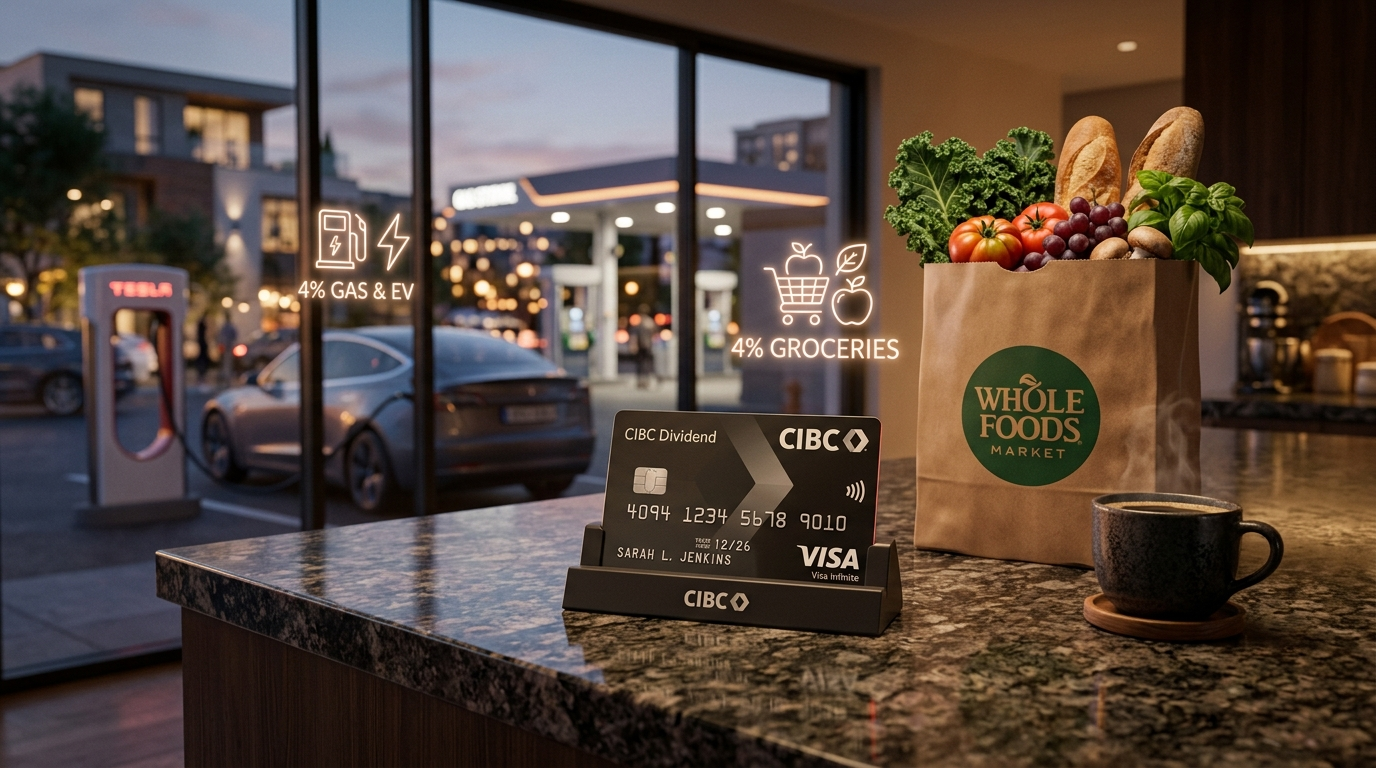
The CIBC Dividend Visa Infinite Card is one of Canada's top cash back products, earning an industry-leading 4% on groceries and gas alongside 2% on dining, transit, and recurring bills. However, its 4% tier is strictly limited to an annual $20,000 spending cap ($800 max return) before plummeting to a 1% base rate cliff. Compared to the Scotia Momentum Visa Infinite ($25,000 cap), CIBC wins for high-mileage drivers needing 4% on gas, while WalletFit tracks category spending to prevent cardholders from hitting the 1% reward cliff.
In a Canadian credit card market crowded with complex points programs and fluctuating frequent flyer charts, cash back represents ultimate liquidity. For consumers who prefer real dollars in their pocket rather than navigating reward redemption schedules, the CIBC Dividend Visa Infinite Card is a perennial heavyweight contender.
By offering an impressive 4% cash back on groceries and gas, the CIBC Dividend card directly targets the two largest variable household expenditures for Canadian families. But behind the headline 4% rate lies an important mechanical reality: a firm $20,000 annual spending cap that creates a dramatic return cliff if unmanaged. In this mathematical review, we analyze the card's full earning structure, compare it against its archrival the Scotia Momentum Visa Infinite, and show how WalletFit prevents cardholders from losing rewards to category limits.
Card Overview: Key Specifications (2026)
Before dissecting the return math, let's examine the foundational terms of the CIBC Dividend Visa Infinite:
CIBC Dividend® Visa Infinite* Card
- Annual Fee: $120 for the primary cardholder, $30 for authorized users. (Commonly rebated in Year 1).
- Income Requirement: $60,000 minimum personal annual income or $100,000 household income.
- 4% Tier: Eligible grocery purchases (MCC 5411) and gas/electric vehicle charging (MCC 5541, 5542, 5552).
- 2% Tier: Eligible dining and restaurants (MCC 5812, 5814), daily transit (rideshares, public transit, taxis), and recurring pre-authorized bill payments.
- 1% Base Tier: All other eligible daily purchases.
- Category Spending Caps: $20,000 annual net spend across 4% categories; separate $20,000 cap across 2% categories per calendar year.
- Redemption Flexibility: On-demand cash back redemption starting at just $25 anytime online or via mobile app.
The Earning Hierarchy & Multiplier Mechanics
The card breaks spending down into distinct Merchant Category Codes (MCCs), creating a structured rewards waterfall:
1. 4% on Groceries & Gas (The Core Accelerators)
Groceries (MCC 5411) and Gas (MCC 5541/5542) represent the cornerstone of the card. Because CIBC operates on the Visa network, it is accepted at supermarkets that reject American Express, including Loblaws, Real Canadian Superstore, No Frills, Metro, and Sobeys. To explore the broader supermarket landscape, consult our guide to the best grocery credit cards in Canada.
For drivers and EV owners, the 4% rate extends across conventional gas stations and designated commercial electric vehicle charging stations. Moreover, linking the card to Journie Rewards provides an automatic 3¢ per litre discount at participating Pioneer, Fas Gas, Ultramar, and Chevron stations, stacking cash back directly on top of pump savings.
2. 2% on Dining, Transit & Recurring Payments
The secondary 2% tier catches substantial secondary spend: restaurant meals, food delivery services, municipal transit passes, Uber/Lyft rides, and automated pre-authorized bill payments (streaming subscriptions, cell phone bills, gym memberships). This category is subject to its own separate $20,000 annual ceiling.
3. 1% Base Cash Back
All non-bonus retail spend, hardware stores, home improvements, and categories exceeding their respective caps default to 1% cash back.
The $20,000 Spending Cap Cliff: Mathematical Breakdown
The most crucial consideration when holding the CIBC Dividend Visa Infinite is the $20,000 annual cap cliff. Once your cumulative spend in the 4% categories (groceries and gas combined) hits $20,000 between January 1 and December 31, your earn rate immediately plunges from 4% down to 1%.
| Cumulative Annual Grocery & Gas Spend | Effective Cash Back Rate | Dollars Earned | Opportunity Cost vs True 4% Floor |
|---|---|---|---|
| First $10,000 ($833/month) | 4.0% | $400.00 | $0.00 (Optimal yield) |
| At Cap: $20,000 ($1,667/month) | 4.0% | $800.00 | $0.00 (Max bonus reached) |
| $25,000 (Exceeding cap by $5,000) | 1.0% on excess | $850.00 (800 + 50) | -$150.00 forfeited |
| $30,000 (Exceeding cap by $10,000) | 1.0% on excess | $900.00 (800 + 100) | -$300.00 forfeited |
For a family spending $1,500 monthly on groceries and $400 monthly on fuel ($1,900/month = $22,800/year), they cross the $20,000 threshold by mid-November. Continuing to swipe the CIBC Dividend card for the final six weeks of the year earns a meager 1% return. Cardholders forfeit $300 or more in cash back every year by blindly using a single card after its bonus cap has expired.
Head-to-Head: CIBC Dividend vs Scotia Momentum Visa Infinite
The defining rivalry in Canadian cash back is between the CIBC Dividend Visa Infinite and the Scotiabank Momentum Visa Infinite. While both cards charge an identical $120 annual fee and share a 4% headline rate, their category allocations and operational rules differ markedly:
| Feature / Parameter | CIBC Dividend Visa Infinite | Scotia Momentum Visa Infinite |
|---|---|---|
| Annual Fee | $120 | $120 |
| Grocery Cash Back | 4% (MCC 5411) | 4% (MCC 5411) |
| Gas & EV Cash Back | 4% (MCC 5541/5542/5552) | 2% (MCC 5541/5542) |
| Recurring Bill Payments | 2% | 4% (Pre-authorized bills) |
| Dining & Daily Transit | 2% dining & 2% transit | 1% dining & 2% transit |
| Top Category Spending Cap | $20,000/year ($800 max) | $25,000/year ($1,000 max) |
| Cash Back Payout Frequency | On-Demand ($25 minimum anytime) | Once Per Year (November statement only) |
| Fuel Discount Program | Journie Rewards (3¢/L savings) | Scene+ Shell partnerships |
| Mobile Device Protection | Up to $1,000 | Up to $1,000 |
For an in-depth breakdown of competing mid-tier cash back options, read our Scotia Momentum vs TD Cash Back comparison and our master rankings of the best Canadian cash back credit cards.
Which Card Wins for Your Spending Profile?
- Choose CIBC Dividend if: You drive frequently, spend over $300/month on gasoline or EV charging, value dining rewards, and prefer accessing your cash back dynamically throughout the year rather than waiting until November.
- Choose Scotia Momentum if: You have large recurring household bills (daycare, home insurance, internet, cell plans, or rent via Chexy) that qualify for 4%, spend heavily on groceries, and need a higher $25,000 category ceiling.
Net Annual Return Simulation (Real Canadian Household)
Let's model the net return of the CIBC Dividend Visa Infinite for a typical Canadian suburban household spending $3,000 per month across various categories:
| Expense Category | Monthly Spend | Annual Spend | Earn Rate | Annual Cash Back |
|---|---|---|---|---|
| Groceries (Supermarkets) | $1,000 | $12,000 | 4.0% | $480.00 |
| Gasoline / Commute | $350 | $4,200 | 4.0% | $168.00 |
| Dining & Restaurants | $400 | $4,800 | 2.0% | $96.00 |
| Recurring Bills & Utilities | $450 | $5,400 | 2.0% | $108.00 |
| General Spend / Retail | $800 | $9,600 | 1.0% | $96.00 |
| Gross Annual Cash Back | $3,000 | $36,000 | — | $948.00 |
| Less: Annual Fee Drag | — | — | — | -$120.00 |
| Net Annual Return | — | — | — | +$828.00 NET PROFIT |
With an effective net return of 2.30% across all spending after deducting the annual fee, the CIBC Dividend Visa Infinite delivers tremendous financial value. The grocery and gas combined spend ($16,200) remains safely under the $20,000 cap, preserving the full 4% velocity throughout the year.
Wholesale Club & Supercentre Merchant Traps
Cardholders frequently run into merchant category code misclassifications that dilute their cash back return:
- Costco Canada Warehouses: Costco Canada only accepts Mastercard at checkout. Visa cards cannot be processed in-store. If you are a dedicated Costco shopper, consider pairing your wallet with a dedicated Mastercard product like the CIBC Costco Mastercard review or a flat 2% cash back card.
- Walmart Supercentres: Most Walmart physical stores in Canada code as MCC 5310/5311 (Department Stores / General Merchandise), not MCC 5411 (Grocery). Consequently, swiping your CIBC Dividend card at Walmart earns only the base 1% cash back rather than 4%.
- Convenience Stores & Corner Markets: Small independent grocers often code as convenience stores (MCC 5499) or bakeries, which may not trigger the 4% accelerator.
How WalletFit Solves the $20,000 Cap Trap
The primary flaw of holding high-multiplier capped credit cards is that cardholders rarely keep track of their cumulative yearly category spend across paper statements. That is where WalletFit becomes indispensable:
- Real-Time Cap Tracking: WalletFit automatically aggregates your transactions and monitors your exact distance from the $20,000 grocery and gas cap.
- Intelligent Multi-Card Cascading: Once your spending trajectory reaches the $20,000 ceiling, WalletFit automatically recommends cascading your grocery transactions to your optimal backup card (such as a 4% or 5% uncapped alternative), preventing the devastating 1% cliff.
- Net Dollar Benchmarking: WalletFit calculates whether pairing your CIBC Dividend with travel cards like the CIBC Aventura Visa Infinite review optimizes your blended return across all Canadian retail categories.
Frequently Asked Questions
How does cash back redemption work on the CIBC Dividend Visa Infinite?
Unlike some Canadian cards that only pay out cash back once per year, the CIBC Dividend Visa Infinite allows on-demand cash back redemption. Once your earned cash back reaches a minimum of $25, you can redeem it anytime as a statement credit through CIBC Online Banking or the CIBC Mobile Banking app.
What is the spending cap on the 4% grocery and gas categories?
The 4% cash back rate applies to a combined annual net spend of $20,000 on eligible gas and grocery purchases per calendar year. Once you reach $20,000 in spend across those categories, subsequent grocery and gas purchases earn the baseline rate of 1% cash back until January 1st.
Which card is better: CIBC Dividend Visa Infinite or Scotia Momentum Visa Infinite?
The CIBC Dividend Visa Infinite is better for commuters and drivers who spend heavily on gas (earning 4% vs Scotia's 2%) and prefer on-demand cash back redemptions ($25 threshold). The Scotia Momentum Visa Infinite is superior for urban spenders with large recurring bills (earning 4% on pre-authorized payments vs CIBC's 2%) and offers a larger $25,000 annual spending cap.
Does the CIBC Dividend Visa Infinite earn 4% at Walmart or Costco?
No. Costco Canada warehouses only accept Mastercard, so the CIBC Dividend Visa Infinite cannot be used at Costco checkouts. Furthermore, Walmart Supercentres code as MCC 5310/5311 (General Merchandise) rather than MCC 5411 (Grocery Stores), meaning Walmart purchases earn the base 1% cash back rate.
Stop Leaving Rewards On The Table
WalletFit automatically tracks spending caps across 50+ Canadian credit cards so you always know the exact card to tap for maximum points and cash back.
Related Canadian Cash Back & Credit Card Guides
- Best credit cards for gas & EV charging in Canada: Complete rankings for fuel and electric vehicle charging spend.
- Scotia Momentum vs TD Cash Back comparison: Battle of Canada's top 4% grocery cards.
- best Canadian cash back credit cards: Complete net yield rankings for everyday spend.
- best grocery credit cards in Canada: Maximum multipliers for supermarkets and food stores.
- CIBC Costco Mastercard review: The essential warehouse companion card analyzed.
- National Bank World Elite Mastercard review: 5x points on Mastercard at Loblaws with an effective $0 fee.
- top Canadian credit cards overall: Complete rankings for Canadian rewards cards.