Best Credit Cards for Groceries US (Earning up to 6% Cashback 2026)
Supermarkets represent one of the largest recurring expenses for US households. Here is how to earn up to 6% cash back or 4x transferrable points on every trip to Kroger, Trader Joe’s, and Whole Foods.
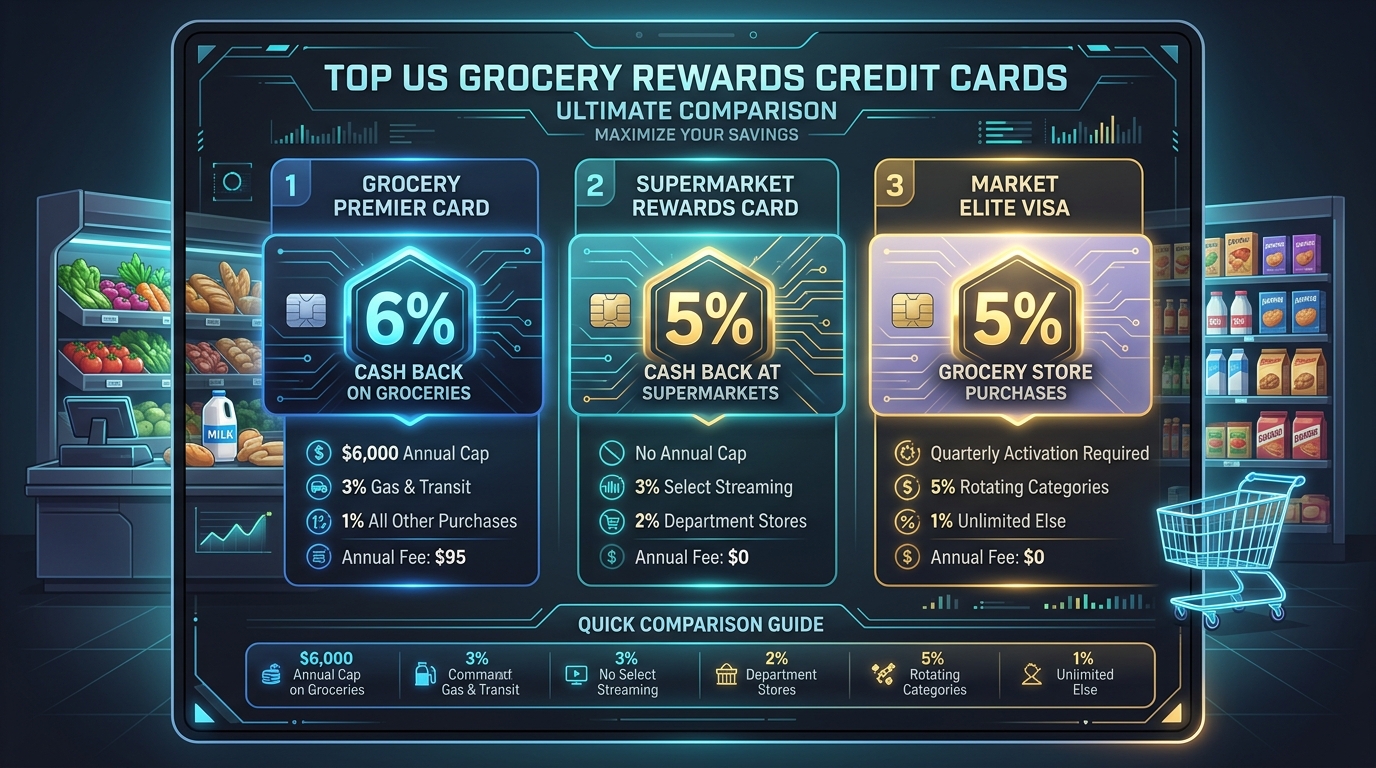
For the average American household spending $600 to $1,000 per month on food, swiping a plain 1% or 2% flat-rate card at checkout leaks hundreds of dollars in unearned rewards every single year.
The US credit card market features specialized grocery cards offering up to 6% cash back or 4x Membership Rewards points. However, choosing the best grocery credit card is not just about the advertised headline rate—it requires calculating annual fee offset thresholds, tracking annual spending caps, and understanding Merchant Category Code (MCC) exclusions (such as Walmart and Target).
In this guide, we break down the top four US grocery credit cards for 2026, analyze the exact mathematical breakeven point between annual fee and $0 fee cards, and show how WalletFit automates card selection at checkout.
Top 4 US Grocery Credit Cards Comparison (2026)
| Card Name | Grocery Multiplier | Annual Cap | Annual Fee | Net Return on $6,000 Annual Spend |
|---|---|---|---|---|
| Amex Blue Cash Preferred® | 6% Cash Back | $6,000/yr (then 1%) | $95 (often $0 1st yr) | $265 Net ($360 - $95 fee) |
| American Express® Gold Card | 4x MR Points (~8% value) | $25,000/yr (then 1x) | $325 | $480+ Value (Transfers to airlines) |
| Citi Custom Cash® Card | 5% Cash Back | $500/mo ($6,000/yr) | $0 | $300 Net (Uncapped top category) |
| Capital One SavorOne | 3% Cash Back | Unlimited (No cap) | $0 | $180 Net |
1. Amex Blue Cash Preferred®: The 6% Supermarket Powerhouse
The American Express Blue Cash Preferred® remains the undisputed cash-back leader for US grocery shoppers. It delivers an industry-leading 6% cash back on US supermarket purchases on up to $6,000 in spend per calendar year.
Key Benefits & Features:
- 6% Cash Back: On up to $6,000 per year at US supermarkets (then 1%).
- 6% Cash Back on Select US Streaming Services: Covers Disney+, Hulu, Netflix, Apple Music, and HBO Max.
- 3% Cash Back on Transit & Gas: Includes taxis, rideshares, parking, tolls, trains, buses, and gas stations.
- Annual Fee: $95 CAD/USD (typically waived for the first year).
2. American Express® Gold Card: 4x Points for Foodies & Travelers
For travelers who prefer valuable airline points over simple cash back, the Amex Gold Card is the premier pick. It earns 4x Membership Rewards® points at US supermarkets on up to $25,000 spent per calendar year, plus 4x points on worldwide dining.
When valued at a conservative baseline of 2.0 cents per point via airline transfer partners (such as Avianca LifeMiles, Flying Blue, or British Airways Avios), 4x points yields an incredible 8.0% effective return on groceries. Read our detailed guide on Amex Membership Rewards Points & Statement Credits.
3. Citi Custom Cash® Card: 5% Flexible Cash Back ($0 Fee)
The Citi Custom Cash® Card is an ultra-smart $0 annual fee card that automatically awards 5% cash back on your highest eligible spending category each billing cycle, up to $500 spent per month ($6,000 annually).
If you designate the card purely for grocery store purchases, you earn $300 in annual cash back with zero annual fee drag (alternatively, pair it with our top-rated US gas & EV charging cards to cover both categories). Furthermore, as covered in our Citi ThankYou Points Optimization Guide, ThankYou points earned on the Custom Cash can be combined with the Citi Strata Premier for 1:1 airline transfers.
4. Capital One SavorOne: Unlimited 3% Rewards ($0 Fee)
For households that spend heavily on groceries (exceeding $500/month or $6,000/year) and want simplicity without spending caps, the Capital One SavorOne delivers unlimited 3% cash back on groceries, dining, entertainment, and popular streaming with $0 annual fee.
SavorOne cash back can also be converted directly into transferrable Capital One Miles if you also hold the premium Capital One Venture X Card.
The Math Breakdown: When Does the $95 Fee Beat a $0 Fee Card?
Cardholders often ask whether paying the $95 annual fee on the Amex Blue Cash Preferred makes mathematical sense compared to a free 3% card like the Capital One SavorOne.
Let's run the exact formula:
⚡ Mathematical Breakeven Formula
Let S be your annual grocery spend at US supermarkets. The net return on Blue Cash Preferred (6% - $95 fee) equals SavorOne (3%):
0.06 × S - $95 = 0.03 × S
0.03 × S = $95 ⇒ S = $3,166.67 per year ($263.89 per month)
- Spend under $264/month ($3,167/year): Pick a $0 fee card like Capital One SavorOne or Citi Custom Cash.
- Spend over $264/month: Amex Blue Cash Preferred wins on pure ROI. At the max $6,000 cap ($500/mo), Blue Cash Preferred returns $265 net vs SavorOne’s $180 net—giving you an extra $85 in profit every year.
Beware of Merchant Category Exclusions: Walmart, Target & Costco
A major trap for grocery cardholders is swiping at superstores or wholesale clubs. Major US issuers explicitly exclude the following from supermarket categories:
- Excluded Stores: Walmart, Target, Super Target, Costco, Sam's Club, and BJ's Wholesale Club.
- Qualifying Stores: Kroger, Trader Joe's, Whole Foods, Safeway, Publix, HEB, ALDI, Stop & Shop, Meijer, and local neighborhood supermarkets.
How WalletFit Eliminates US Grocery Reward Leakage
Managing category caps and merchant exclusions manually is tedious. WalletFit acts as your real-time wallet co-pilot:
- Automatic Geofenced Reminders: When you pull into Trader Joe's or Kroger, WalletFit sends a mobile notification reminding you to swipe your 6% Amex Blue Cash Preferred or 5% Citi Custom Cash.
- Spending Cap Tracking: WalletFit monitors your $6,000 annual spend on Blue Cash Preferred. As soon as you hit $6,000, it automatically prompts you to switch to your fallback SavorOne or 2% card so you never drop to 1%.
- MCC Validation: WalletFit verifies store MCC codes so you never mistakenly use a supermarket multiplier card at Target or Walmart. Explore our companion guides on Best Card for Groceries Rewards and Best Canadian Grocery Cards, or deploy our Credit Card Rewards Optimizer alongside the Citi ThankYou Points Guide to master your wallet setup.
Frequently Asked Questions
Is the $95 annual fee on Amex Blue Cash Preferred worth it for groceries?
Yes, if you spend at least $3,167 per year ($264/month) at US supermarkets. At that spend level, the 6% earn rate on Blue Cash Preferred outperforms a no-annual-fee 3% card like Capital One SavorOne even after subtracting the $95 annual fee.
Do Target and Walmart code as grocery stores on US credit cards?
No. Major issuers like American Express, Chase, and Citi explicitly exclude superstores (Walmart, Target) and wholesale clubs (Costco, Sam's Club) from US supermarket reward categories. You need dedicated cards or store-branded cards for those merchants.
What happens when you hit the $6,000 grocery cap on Amex Blue Cash Preferred?
Once you spend $6,000 in a calendar year at US supermarkets, your cash back rate drops from 6% down to 1%. WalletFit automatically tracks your annual spend progress and alerts you to switch to a fallback 3% or 5% card as soon as the cap is reached.
How does WalletFit optimize US grocery spending?
WalletFit uses real-time merchant category detection and location reminders when you walk into Trader Joe's, Kroger, or Whole Foods. It automatically recommends the highest-yielding card in your wallet while monitoring spending caps so zero rewards leak.
Never Waste 6% Supermarket Cash Back Again
WalletFit tracks grocery category caps, alerts you at checkout, and automatically selects the highest-yielding card in your wallet.