What Is a Credit Card Rewards Optimizer? (Why Spreadsheets Are Dead in 2026)
Manual Excel spreadsheets and static cheat sheets cannot keep up with complex merchant category codes, monthly spending caps, and annual coupon book credits. Here is how modern credit card rewards optimizers capture hundreds in lost value automatically.
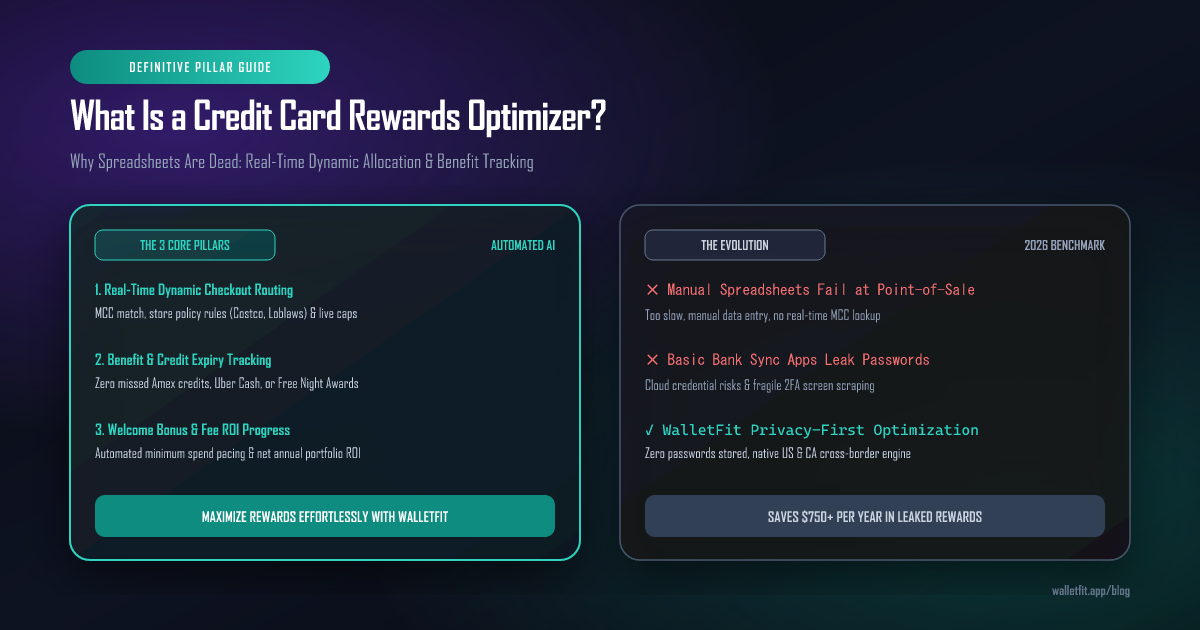
A credit card rewards optimizer is an automated financial intelligence engine that analyzes your credit card portfolio in real time. It solves the three biggest leaks in personal finance: (1) dynamically choosing the highest-yielding card at checkout, (2) tracking statement credits before they expire, and (3) pacing welcome bonus minimum spend requirements—all without manual spreadsheet data entry.
1. The Death of the Credit Card Spreadsheet
For over a decade, credit card optimizers, award travelers, and cash-back enthusiasts tracked their wallets in complex Excel or Google Sheets workbooks. These spreadsheets had tabs for annual fees, columns for multiplier categories (groceries, dining, travel, gas), and color-coded rows for card anniversary dates.
In 2026, the spreadsheet method is officially obsolete. Credit card rewards systems have evolved into highly dynamic, multi-variable ecosystems that static formulas cannot model:
- Complex Merchant Category Code (MCC) Nuances: A grocery store like Whole Foods earns 4x–5x on grocery cards, but Walmart Supercenters or Costco often code as wholesale or general merchandise, dropping your return to 1x unless you hold a specific card like the CIBC Costco Mastercard or a custom MCC-optimized card.
- Rolling Monthly & Annual Spending Caps: The Canadian Amex Cobalt caps 5x eats and drinks at $2,500 CAD/month ($30k/year). The US Citi Custom Cash caps 5% cashback at $500 USD/billing cycle. Once you cross those caps, every subsequent dollar earns only 1x—a detail no static cheat sheet glued to your card can track.
- The "Coupon Book" Credit Model: Premium cards like the American Express Platinum ($695 annual fee) or Capital One Venture X ($395 fee) justify their fees through hundreds of dollars in fractured credits: $20/month Uber Cash, $20/month streaming, $200 airline fee credits, and 35k hotel free night certificates. Missing even two monthly credits turns a profitable card into an expensive liability.
- Point Valuation Discrepancies: Earning 3x transferable airline points (like Air Canada Aeroplan at 2.0 cents per point) yields a ~6.0% return, beating a flat 4% cash-back card. Real-time math requires dynamic Cent Per Point (CPP) conversions.
Financial studies reveal that the average household carrying 3 or more credit cards leaks between $750 and $1,800 annually through sub-optimal card allocation, missed spending cap transitions, and unredeemed perks. A dedicated rewards optimizer automates this math at the point of sale.
2. The 3 Core Pillars of a Credit Card Rewards Optimizer
A true rewards optimizer does not simply list the cards in your wallet; it executes a continuous mathematical optimization cycle across three fundamental pillars:
1 Dynamic Checkout Routing
Identifies the exact merchant category code, store network rules, and category cap status to tell you precisely which card generates the highest net return at checkout.
2 Benefit & Credit Expiry
Tracks recurring statement credits (monthly dining, Uber, streaming, travel portals, free hotel nights) with proactive alerts so zero perks expire unused.
3 Welcome Bonus Pacing
Monitors your progress toward minimum spending thresholds on newly opened cards, ensuring you capture lucrative 60k–100k point bonuses without overspending.
Pillar 1: Real-Time Dynamic Card Selection at Checkout
When you stand in line at a grocery store, gas pump, or coffee shop, you have less than 5 seconds to decide which card to pull from your physical wallet or Apple Pay / Google Wallet. An optimizer solves this instantly by combining:
- Merchant Category Intelligence: Mapping thousands of merchants to their true backend MCC (e.g., distinguishing between a bakery coding as dining vs. retail).
- Store Policy Filters: Instantly filtering out cards that will be rejected at checkout, such as Amex at No Frills in Canada or Visa/Amex inside Costco warehouses (which only accept Mastercards in Canada or Visas in the US).
- Cap-Aware Greedy Routing: If your highest-multiplier card has exceeded its monthly cap, the engine automatically routes that transaction to your optimal secondary fallback card (e.g., moving from Cobalt 5x to Scotiabank Passport or Rogers World Elite 2%).
Pillar 2: Benefit & Statement Credit Expiration Tracking
Banks intentionally structure premium credit card perks as "breakage" models. They know that cardholders sign up for a $550–$695 card for the advertised $1,500 in perks, but over 40% of users forget to use their monthly credits before the 1st of each month.
A credit card rewards optimizer acts as an automated ledger that:
- Maintains an active countdown on monthly dining credits (e.g., $10 Grubhub/Cheesecake Factory on Amex Gold).
- Monitors annual travel portal credits (e.g., $300 Capital One Venture X credit or $300 Chase Sapphire Reserve travel credit).
- Tracks hotel anniversary certificates (e.g., Marriott 35k Free Night Awards on the Marriott Bonvoy Amex).
Pillar 3: Welcome Bonus Progress & Annual Fee ROI
Sign-up bonuses (SUBs) represent the highest hourly return in credit card rewards, often yielding $600 to $1,500 in travel value for spending $3,000 to $6,000 within 90 days. However, miscalculating qualifying spend or missing the deadline by a single day results in losing the entire bonus.
An optimizer tracks your daily required spending velocity, subtracts annual fees from total earned value, and computes your card portfolio's Net Annual Yield. At renewal time, you know with mathematical certainty whether to keep, cancel, or downgrade each card.
3. Evolution: Spreadsheets vs. Legacy Sync vs. Modern Optimizer
To understand why modern tools are superior, consider how card tracking technology has evolved over three generations:
| Feature / Dimension | 1st Gen: Excel / Notion | 2nd Gen: Screen Scraping Apps | 3rd Gen: WalletFit Optimizer |
|---|---|---|---|
| Checkout Accessibility | Unusable (Slow manual lookup) | Slow mobile lists | Instant real-time recommendation |
| Bank Credential Security | 100% Offline | Stores plain bank passwords in cloud | Zero-Knowledge (No bank passwords) |
| Category Cap Awareness | Static formulas (Fails mid-month) | Ignored / Basic estimates | Algorithmic Greedy Cap Engine |
| Cross-Border (US & Canada) | Manual currency conversion | US Only (No Canadian banks) | Full Dual US & Canadian Engine |
| Connection Reliability | N/A | Constant 2FA disconnects | 100% Reliable (Tokenized / Local) |
| Pricing | Free (High labor cost) | $100–$140+/year paywalls | Accessible & High ROI |
4. How Much Money Does an Optimizer Save You? (The Real Math)
Let's run the numbers on a typical household spending $4,500 per month across major categories holding a balanced 3-card wallet (e.g., Amex Gold / Cobalt, TD Aeroplan or Chase Sapphire, and a 2% catch-all card):
Un-Optimized Wallet (Guessing & 1x Leaks)
- Groceries ($1,000/mo on 1x card): $120/yr
- Dining ($600/mo on 2x instead of 5x): $216/yr
- Gas & EV ($300/mo on 1% instead of 4%): $108/yr
- Expired Monthly Dining/Uber Credits: $240/yr
- Overshooting 5x cap into unmonitored 1x: $180/yr
- Total Annual Value Lost: -$864.00
Optimized with WalletFit
- Groceries ($1,000/mo at 5x / 5%): $600/yr
- Dining ($600/mo at 4x-5x): $360/yr
- Gas & EV ($300/mo at 4% CIBC Dividend / Custom Cash): $144/yr
- 100% Captured Monthly & Travel Credits: $440/yr
- Greedy routing to 2% fallback when caps hit: +$120/yr
- Total Annual Rewards Captured: +$1,664.00
By automating the decision process, WalletFit swings the household's annual return by +$800 to +$1,000 in net positive cash and travel value every single year.
5. The Cross-Border Landscape: US vs. Canadian Ecosystems
A major shortcoming of legacy credit card apps like MaxRewards is their near-total neglect of the Canadian credit card market. A comprehensive rewards optimizer must natively understand both ecosystems:
Canadian Rewards Ecosystem
- Points Currencies: Air Canada Aeroplan (2.0 CPP), RBC Avion (1.8 CPP), Amex MR Canada (2.0 CPP), Scene+ (1.0 CPP), and Canadian Tire Money.
- Key Multipliers: Amex Cobalt 5x eats & drinks, Scotiabank Gold Amex 6x Scene+ at Empire stores, and CIBC Dividend 4% gas/groceries.
- Retail Rules: Navigating Loblaws/No Frills (no Amex accepted) and Costco Canada (only Mastercard accepted).
- Rent Optimization: Leveraging Chexy to earn 4% recurring cashback on Canadian rent payments.
US Rewards Ecosystem
- Points Currencies: Chase Ultimate Rewards (2.05 CPP), Amex Membership Rewards US (2.0 CPP), Capital One Miles (1.85 CPP), and Citi ThankYou Points (1.75 CPP).
- Key Multipliers: Amex Gold 4x dining/supermarkets, Blue Cash Preferred 6% groceries, Citi Custom Cash 5% top category, and Capital One Venture X 2x catch-all.
- Rent Optimization: Deploying the Bilt Mastercard for 1x points on rent with $0 transaction fees.
6. Privacy & Security: The Zero-Knowledge Advantage
Financial optimization should never compromise cybersecurity. When choosing a credit card rewards optimizer, the architectural model matters:
WalletFit was engineered so you never have to hand over your banking passwords. By utilizing encrypted read-only tokens, local browser evaluation, and flexible manual portfolio modeling, WalletFit eliminates the risks of credential theft, data breaches, and bank 2FA lockouts.
7. Essential Hub Guides & Next Steps
To master your credit card portfolio, explore our comprehensive strategy guides and individual card reviews:
📚 Strategic Guides
- How to Optimize Credit Card Rewards in Canada
- Why Kudos & Browser Extensions Failed
- WalletFit vs MaxRewards Comparison
- WalletFit vs CardPointers Comparison
- Best Credit Card Tracking Apps
- Cash Back vs Travel Points Math Guide
- Credit Card Spending Cap Strategy
- Annual Fee vs Rewards Calculator
- Are Premium Cards Worth It?
- Best Card for Each Purchase Guide
- Credit Card Spending Categories Guide
- How to Analyze Card Spending
- Credit Card Wallet Score Guide
- Visa Infinite Privilege Fee Trap Math
- How to Track Missed Rewards
8. Frequently Asked Questions (FAQ)
What is a credit card rewards optimizer?
A credit card rewards optimizer is an intelligent software tool that analyzes your entire credit card collection in real time. It recommends the highest-earning card for every purchase based on merchant category codes, tracks category spending limits, alerts you before monthly credits expire, and paces welcome bonus requirements.
Why are manual Excel spreadsheets dead for credit cards?
Manual spreadsheets are completely static. They cannot look up merchant category codes at the checkout counter, fail to track real-time monthly spending caps, cannot notify you when monthly statement credits are expiring, and require tedious manual data entry for every transaction.
How does WalletFit determine which card earns the most at checkout?
WalletFit cross-references merchant category codes (MCCs) with your active credit cards, current spending cap status, and live point valuations (Cent Per Point). In milliseconds, it identifies the card that delivers the highest net monetary return while respecting store payment network rules.
Can a rewards optimizer handle both US and Canadian credit cards?
While most legacy apps are US-only, WalletFit was built with native cross-border intelligence. It seamlessly models US cards (Chase, Amex US, Capital One, Citi) alongside Canadian cards (Amex Cobalt, TD Aeroplan, RBC Avion, Scotiabank Scene+, CIBC Dividend) in a unified multi-currency interface.
How do I start optimizing my credit cards today?
You can start immediately with WalletFit. Simply select the cards currently in your wallet to receive instant point-of-sale checkout recommendations, cap-aware alerts, and statement credit reminders with 100% privacy.
Stop leaving hundreds in credit card rewards on the table
Try WalletFit free — real-time card recommendations, spending cap alerts, and zero bank passwords stored.