Amex Platinum vs Chase Sapphire Reserve: Best Premium Travel Card 2026
A head-to-head mathematical breakdown comparing annual fee structures, 5x flight vs 3x travel multipliers, airport lounge networks, and transfer partner sweet spots.
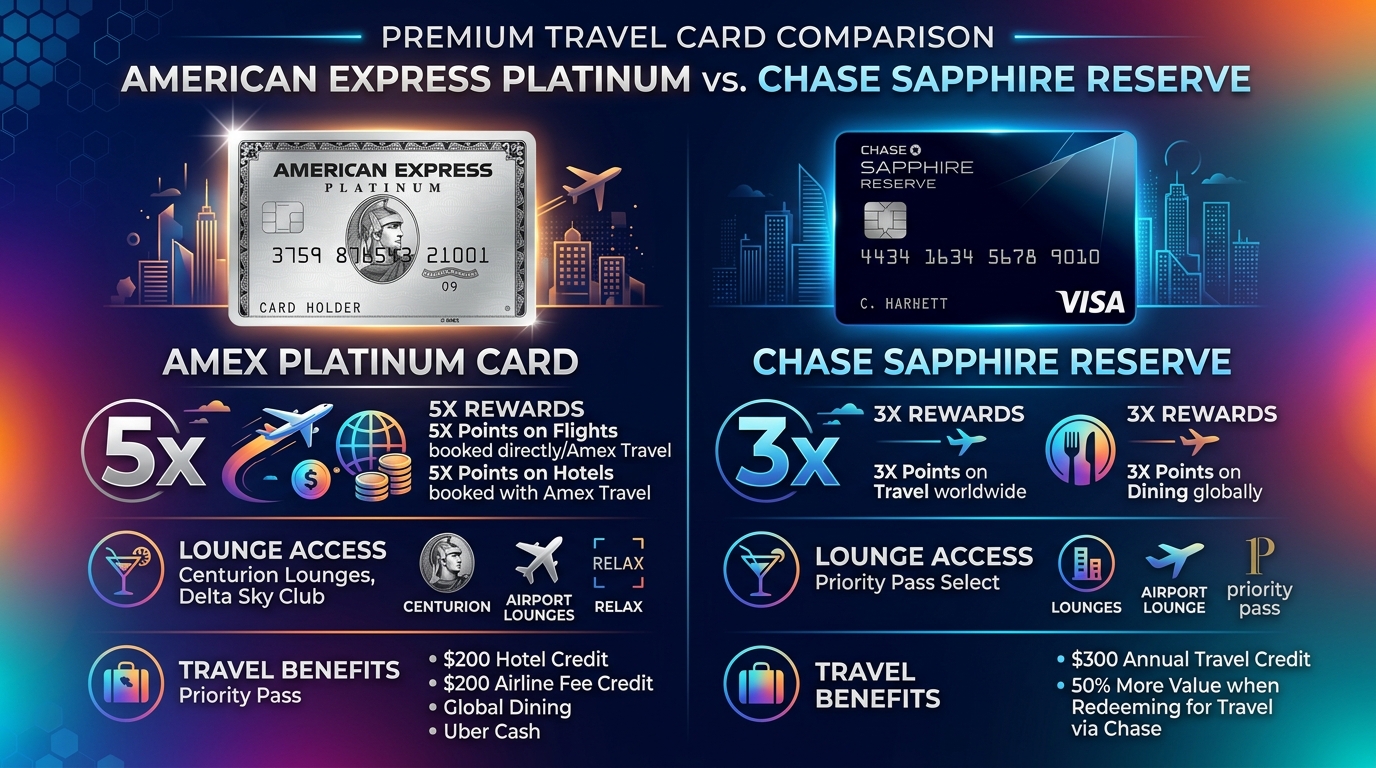
The choice between the The Platinum Card® from American Express ($695 annual fee) and the Chase Sapphire Reserve® ($550 annual fee) boils down to spending habits. The Amex Platinum is an unrivaled luxury travel tool for frequent flyers who maximize airport lounges and 5x flight multipliers. The Chase Sapphire Reserve is a superior daily workhorse that earns 3x on all travel and dining with an effortless $300 annual travel credit. Connecting your portfolio to an automated tool like WalletFit ensures you always swipe the right card at checkout and never let statement credits expire.
1. The Financial Foundation: $695 vs. $550 Annual Fee Math
When evaluating premium travel cards, comparing headline annual fees ($695 for Amex Platinum vs. $550 for Chase Sapphire Reserve) is misleading. The true cost depends on net effective annual fees after factoring in built-in credits.
| Feature / Credit | Amex Platinum Card® | Chase Sapphire Reserve® |
|---|---|---|
| Annual Fee | $695 / year | $550 / year |
| Primary Travel Credit | $200 Airline Incidental + $200 Prepaid Hotel | $300 Flexible Travel Credit (Automatic) |
| Effective Annual Fee | $295 (if travel credits used) | $250 Net ($550 minus $300 credit) |
| Secondary Statement Credits | $200 Uber Cash, $240 Digital Ent., $199 CLEAR+, $100 Saks | $100 Global Entry/TSA PreCheck/NEXUS |
| Credit Expiration Structure | Monthly segmented ("Coupon Book" model) | Annual automatic reimbursement |
The Chase Sapphire Reserve's $300 travel credit is the most flexible in the industry. It automatically reimburses your first $300 in travel purchases each cardmember year—including flights, hotel stays, Airbnb bookings, Uber rides, subways, toll roads, and parking garages. This instantly reduces the Reserve's effective annual fee to just $250.
By contrast, the Amex Platinum card provides over $1,500 in nominal credits, but they are heavily segmented into monthly micro-allowances ($15/mo Uber Cash, $20/mo digital streaming, $50 semi-annual Saks Fifth Avenue). Read our comprehensive Amex Platinum Benefits Guide to learn how to track these monthly coupon book credits without letting them expire.
2. Reward Earn Rates: 5x Flights vs. 3x Everyday Travel & Dining
Earning points efficiently is where these two heavyweights diverge completely. The Amex Platinum is a specialist, whereas the Chase Sapphire Reserve is a generalist.
| Spending Category | Amex Platinum Card® | Chase Sapphire Reserve® |
|---|---|---|
| Flights | 5x MR (Direct with airlines or Amex Travel, up to $500k/yr) | 3x UR (5x via Chase Travel portal) |
| Prepaid Hotels | 5x MR (via AmexTravel.com) | 10x UR (via Chase Travel portal) / 3x General Travel |
| Dining & Restaurants | 1x MR | 3x UR Worldwide |
| General Travel (Transit, Uber, Parking) | 1x MR | 3x UR Worldwide |
| All Other Purchases | 1x MR | 1x UR |
If you spend $10,000 per year on flights booked directly with airlines, the Amex Platinum earns 50,000 Membership Rewards points (worth ~$1,000 when transferred to airline partners). The Chase Sapphire Reserve would earn 30,000 Ultimate Rewards points on those same flights.
However, if you spend $10,000 annually across dining, food delivery, rideshares, and non-prepaid hotels, the Chase Sapphire Reserve yields 30,000 points, whereas the Amex Platinum nets a disappointing 10,000 points. Using WalletFit's Credit Card Rewards Optimizer automatically alerts you at checkout so you never accidentally use the Platinum card for a 1x dining charge.
3. Airport Lounge Networks & Travel Privileges
Both cards grant complimentary lounge access, but the scale and luxury of their networks differ significantly.
Amex Platinum: Global Lounge Collection
- Centurion Lounges: Flagship proprietary lounges in 15+ major US airports and top international hubs, featuring chef-designed dining and cocktail bars.
- Delta Sky Club: Complimentary entry when flying same-day on Delta Airlines (subject to annual visit limits).
- Priority Pass Select: Unlimited visits to 1,400+ independent lounges globally (excludes non-lounge airport restaurant credits).
- Plaza Premium & Escape Lounges: Direct entry with card presentation.
Chase Sapphire Reserve: Priority Pass & Sapphire Lounges
- Sapphire Lounge by The Club: Chase's expanding lounge network (including Boston BOS, New York JFK/LGA, San Diego SAN, and Hong Kong HKG), praised for exceptional culinary offerings and space.
- Priority Pass Select: Full membership including access to participating Priority Pass lounges and select airport relaxation spaces.
4. Point Valuations & Transfer Partner Sweet Spots
Both American Express Membership Rewards (MR) and Chase Ultimate Rewards (UR) points are highly valued by travel enthusiasts, holding baseline valuations of 2.0+ cents per point (CPP) when transferred to partners.
Key Transfer Partner Highlights
Chase Ultimate Rewards Top Advantage: World of Hyatt (1:1). Hyatt points are widely considered the most valuable hotel currency in the industry. Booking luxury Park Hyatt or Andaz stays often yields 2.5 to 3.5 cents per point in value.
Amex Membership Rewards Top Advantage: Delta Air Lines & Frequent Transfer Bonuses. Amex features 20+ airline and hotel partners, frequently offering 15%–30% transfer bonuses to British Airways Avios, Virgin Atlantic, and Air France Flying Blue.
5. Travel Protections & Car Rental Insurance
When travel plans go wrong, card protections matter. The Chase Sapphire Reserve holds a distinct advantage in vehicle coverage:
- Car Rental Coverage: The Chase Sapphire Reserve offers Primary Auto Rental Collision Damage Waiver (up to $75,000), allowing you to decline expensive rental car insurance without filing a claim with your personal auto insurer. The Amex Platinum provides Secondary coverage (Primary requires an add-on enrollment fee).
- Trip Delay Reimbursement: Both cards reimburse up to $500 per ticket for delays exceeding 6 hours or requiring an overnight stay.
- Trip Cancellation & Interruption: Both cards cover up to $10,000 per person ($20,000 per trip) for non-refundable prepaid travel expenses due to illness or severe weather.
6. Verdict: Who Should Pick Amex vs. Who Should Pick Chase?
| Choose Amex Platinum If You... | Choose Chase Sapphire Reserve If You... |
|---|---|
| Book $5,000+ per year in direct airfare and want 5x points. | Want a single card that earns 3x on all travel and dining. |
| Value premium Centurion Lounge and Delta Sky Club access. | Prefer an effortless $300 annual travel credit without tracking monthly expiration dates. |
| Regularly use Uber, Walmart+, CLEAR+, and streaming services. | Want Primary Car Rental Insurance included automatically. |
| Use WalletFit's Benefit Expiration Alerts to prevent coupon breakage. | Love transferring points 1:1 to World of Hyatt for luxury hotel stays. |
7. The "Dual Titan" Setup: Why Smart Optimizers Carry Both
For high-spending travelers, holding both the Amex Platinum and Chase Sapphire Reserve yields maximum return:
- Charge all airfare to Amex Platinum to capture 5x MR points.
- Charge all dining, Uber rides, subways, and non-prepaid hotels to Chase Sapphire Reserve for 3x UR points.
- Use Amex Platinum for Centurion Lounge access and Chase Sapphire Reserve for Primary rental car protection.
Managing multiple premium cards can lead to fee tracking headaches. To learn how to combine these cards with no-fee catch-all multipliers into a complete ecosystem, read our Ultimate Credit Card Trifecta Guide. That is why over 40,000 cardholders use WalletFit to track annual credits, monitor point valuation charts, and receive real-time location reminders at checkout.
Frequently Asked Questions (FAQ)
Is the Amex Platinum or Chase Sapphire Reserve better for everyday spending?
The Chase Sapphire Reserve is significantly better for daily spending because it earns 3x points on all dining and broad travel categories worldwide. The Amex Platinum earns only 1x on dining and general purchases, restricting its 5x rate strictly to flights.
How do the annual fees and credits compare between Amex Platinum and Chase Sapphire Reserve?
The Amex Platinum costs $695/year with over $1,500 in monthly and annual statement credits (Uber, digital entertainment, hotel, CLEAR+). The Chase Sapphire Reserve costs $550/year and provides an automatic $300 travel credit that reduces the net effective fee to $250.
Which card has better airport lounge access?
The Amex Platinum offers a broader lounge network through its Global Lounge Collection, including Centurion Lounges, Delta Sky Clubs, and Priority Pass. The Chase Sapphire Reserve offers Priority Pass Select and access to growing, high-end Sapphire Lounges by The Club.
Can you hold both the Amex Platinum and Chase Sapphire Reserve at the same time?
Yes. Many strategy-minded cardholders carry both in a Dual-Titan strategy—using the Amex Platinum for 5x flights and Centurion Lounges, and the Chase Sapphire Reserve for 3x dining/travel and primary rental car coverage.
Never Swipe the Wrong Premium Card Again
Stop guessing between 5x flights and 3x dining—WalletFit automatically selects the right card at checkout and tracks all your annual credits.