The Ultimate Credit Card Trifecta Guide: 2-Card & 3-Card Wallets That Earn 5%+
Carrying just one credit card costs the average household $800 to $1,800 annually in lost rewards. Discover the exact architecture behind 2-card combos and 3-card trifectas in the US and Canada—and how to capture 5%+ blended returns without the cognitive headache.
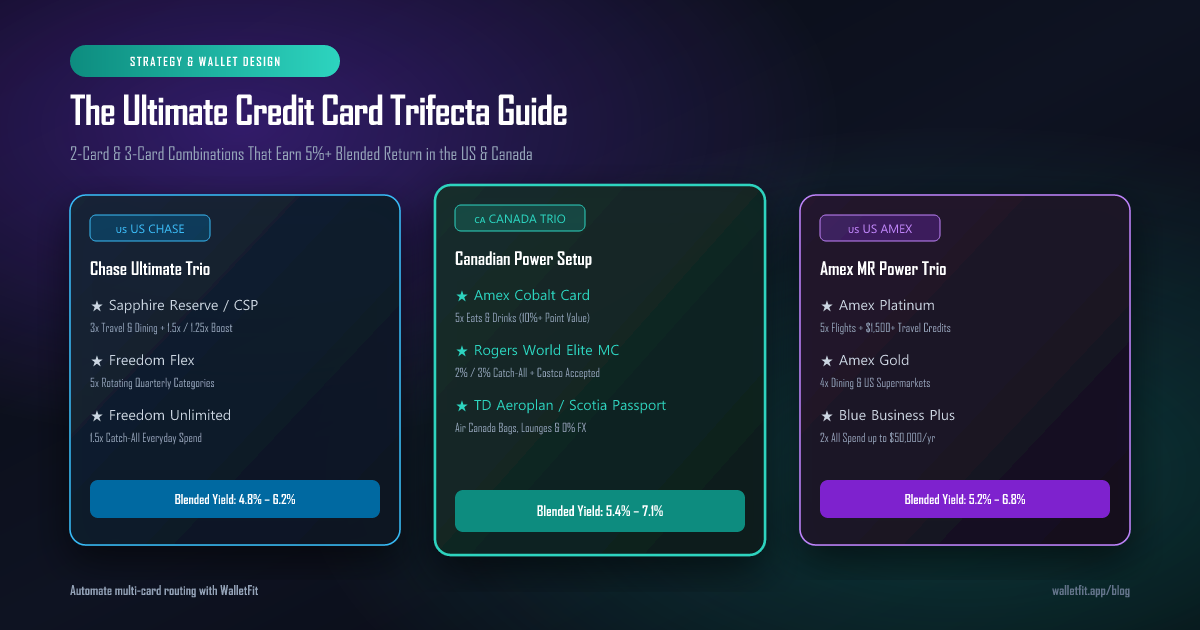
Executive Summary: The Mathematics of Multi-Card Synergy
Most credit cardholders fall into one of two extremes:
- The Single-Card Minimalist: Relies on a single 1.5% cash back or 1x travel card for everything. They enjoy simplicity, but leak hundreds of dollars every month by earning baseline rewards on high-yield categories like groceries, dining, and fuel.
- The Churning Collector: Holds 12 to 20 cards in their drawer. They constantly miss statement credit expiry dates, accidentally exceed monthly spending caps, and suffer from decision paralysis at checkout.
The Credit Card Trifecta is the mathematically proven middle ground. By combining exactly two or three complementary credit cards, you cover 100% of your daily consumer spending categories while maintaining an uncapped floor. The cards pool rewards into a unified points or cash back ecosystem, amplifying redemption values by 25% to 100%.
Every high-yielding credit card trifecta is built on three distinct functional pillars:
1. The Category Multiplier Anchor: Captures 4x–5x points on your largest daily expenses (Groceries & Dining).
2. The Uncapped Catch-All Foundation: Earns 1.5x–2x on all unbonused retail, medical, bills, and auto maintenance.
3. The Travel & Perk Catalyst: Unlocks transfer partners, travel credits, airport lounges, and elevated point redemption multipliers.
Blended Return Simulation: 1 Card vs. 2 Cards vs. 3-Card Trifecta
Consider an average household spending $3,500 per month ($42,000 per year) distributed across standard categories: $900 Groceries, $600 Dining, $350 Gas/EV, $400 Travel/Transit, and $1,250 Miscellaneous/Bills. Here is the mathematical reality of multi-card synergy:
| Wallet Configuration | Cards Held | Blended Return Rate | Gross Annual Rewards | Net Value (After Fees & Perks) |
|---|---|---|---|---|
| 1-Card Basic Setup | Single Flat 1.5% Cash Back Card | 1.50% | $630 / yr | $630 |
| 2-Card Dynamic Duo | 5x Food Card + 2% Catch-All Card | 3.45% (Cash) / 4.80% (Travel) | $1,450 – $2,016 / yr | $1,330 – $1,896 (+112% to +200% lift) |
| 3-Card Ultimate Trifecta | 5x Multiplier + 2x Catch-All + Premium Travel Perk Card | 5.20% – 6.85% (Transfer Value) | $2,184 – $2,877 / yr | $2,350 – $3,200+ (+273% to +408% lift) |
By upgrading from a single card to a calibrated trifecta, the household captures an additional $1,720 to $2,570 in net annual value—enough to fund an international round-trip flight or luxury hotel stay every single year.
The Classic US Chase Trifecta (The Benchmark Ecosystem)
The Chase Trifecta is the most renowned rewards setup in consumer finance. It pairs three cards that pool Ultimate Rewards (UR) points into a single balance, unlocking high-value airline and hotel transfer partners like World of Hyatt, United MileagePlus, and Air France/KLM Flying Blue (evaluated at 2.05+ cents per point).
1. Anchor: Chase Sapphire Reserve / Preferred
Role: Travel Catalyst & Points Booster
• 3x on Dining & Worldwide Travel
• Unlocks 1:1 Airline & Hyatt Transfers
• 1.5x (CSR) or 1.25x (CSP) redemption boost in portal
• $300 Annual Travel Credit + Lounge Access (CSR)
2. Multiplier: Chase Freedom Flex
Role: Rotating Category Booster ($0 Fee)
• 5% / 5x on quarterly rotating categories (up to $1,500 spend/qtr)
• 3% on Dining and Drugstores
• Pairs directly with Sapphire UR points pool
3. Catch-All: Chase Freedom Unlimited
Role: Everyday Floor ($0 Fee)
• 1.5% / 1.5x on every purchase with zero caps
• 3% on Dining and Drugstores
• Eliminates 1x baseline reward leakage
How the Synergy Works: You use the Freedom Flex for quarterly 5x categories (e.g., Amazon, Grocery Stores, Home Improvement), the Sapphire card for travel and dining, and the Freedom Unlimited for everything else. At the end of each billing cycle, you transfer all points to your Sapphire card, instantly boosting their redemption value to over 2.0 CPP when booking premium hotel stays via World of Hyatt.
To compare the high-fee Reserve against other flagships, read our Amex Platinum vs. Chase Sapphire Reserve Head-to-Head Guide.
The US American Express Trifecta (The Premium High-Spend Engine)
For high-earning households and frequent flyers, the American Express Membership Rewards (MR) Trifecta provides the fastest points accumulation rate in the world. It combines consumer luxury benefits with an uncapped small-business catch-all engine.
1. Perk Engine: The Platinum Card®
Role: Flights & Travel Lifestyle ($695 Fee)
• 5x MR on Flights booked direct or via Amex Travel
• Global Lounge Collection (Centurion, Delta, Priority Pass)
• $1,500+ in annual statement credits (Uber, Hotel, Saks, Airline)
2. Multiplier: American Express® Gold Card
Role: Daily Food & Supermarkets ($325 Fee)
• 4x MR at US Supermarkets (up to $25k/yr)
• 4x MR at Restaurants worldwide (up to $50k/yr)
• $240 in annual Dining and Uber credits
3. Catch-All: Blue Business® Plus
Role: Uncapped 2x Everyday Card ($0 Fee)
• 2x MR on all purchases up to $50,000 per calendar year
• $0 annual fee
• Eliminates 1x rewards leakage on all miscellaneous spend
The Math: While the combined annual fee is $1,020, diligent cardholders easily offset $1,740+ through monthly statement credits (Uber Cash, Grubhub, Resy credits, airline incidental credits). If you spend $15,000 on food (Gold), $5,000 on flights (Platinum), and $25,000 on all other purchases (BBP), you generate 135,000 Amex MR points annually—worth over $2,700 in transatlantic business class flights.
Explore our deep dive on balancing these fees: Amex Gold vs. Amex Platinum: Which Card Makes Sense for Daily Spend?
The Canadian Ultimate Trio (The Canada-First Super Portfolio)
Canadian cardholders face unique challenges that US guides ignore: American Express is not accepted at major grocery chains (like Loblaws, No Frills, and Real Canadian Superstore), Costco Canada strictly accepts Mastercard only, and most cards charge a punitive 2.5% foreign transaction fee.
The Canadian Ultimate Trio is the mathematically optimized answer to Canada's banking ecosystem:
🇨🇦 1. The Multiplier King: Amex Cobalt Card
Role: 5x Food & Drinks ($155.88 / yr)
• 5x Membership Rewards on Groceries, Dining, Food Delivery, and Coffee (up to $2,500/mo)
• Transfers 1:1 to Air Canada Aeroplan and British Airways Avios (producing a massive 10%+ return on dining/groceries)
• 2x on Transit, Gas, and Travel
🇨🇦 2. The Catch-All & Costco Shield: Rogers Red World Elite Mastercard
Role: 2% / 3% Everyday & Wholesale ($0 Fee)
• 1.5% unlimited cash back everywhere (boosted to 2.0% cash back for Rogers/Shaw/Fido customers)
• 3.0% cash back when redeemed against Rogers, Shaw, or Fido bills
• Mastercard network: accepted at all Canadian Costco warehouses and No Frills
🇨🇦 3. The Big-5 Travel Anchor: TD Aeroplan Visa Infinite or Scotia Passport
Role: Insurance, Lounges & FX Protection ($139–$150 Fee)
• TD Aeroplan: Free first checked bags on Air Canada, preferred redemption pricing, and NEXUS rebate
• Scotia Passport: 0% foreign transaction fees (saves 2.5% abroad) + 6 free DragonPass airport lounge passes
• Visa network: accepted everywhere Amex is declined
With this trio, you never experience payment friction:
• At Metro, Sobeys, Whole Foods, or restaurants: Swipe Amex Cobalt (5x points = 10% value).
• At Costco, No Frills, or for home repairs: Swipe Rogers World Elite (2% to 3% cash return).
• Booking Air Canada flights or traveling abroad: Swipe TD Aeroplan / Scotia Passport (Free bags + 0% FX).
For more detailed Canadian card analysis, check out our Best Travel Credit Cards in Canada Guide and our Canadian Grocery Card Multiplier Breakdown.
2-Card Minimalist Combinations (For Zero-Friction Optimizers)
If managing three cards feels like too much work, you can capture over 85% of maximum optimization with a high-efficiency 2-Card Dynamic Duo:
🇺🇸 US Minimalist Duo
1. Amex Gold Card ($325 fee): 4x on Dining & US Supermarkets (covers ~45% of consumer spend).
2. Capital One Venture X ($395 fee): 2x on every other purchase, $300 travel credit, 10k bonus miles, and lounge access.
Effective Annual Fee: -$5 (Venture X pays for itself) + $85 (Amex Gold after dining credits) = $80/year net cost for 2x to 4x on everything.
🇨🇦 Canadian Minimalist Duo
1. Amex Cobalt Card ($155.88 fee): 5x on Food, Groceries, and Dining (1:1 Aeroplan transfer).
2. Rogers Red World Elite Mastercard ($0 fee): 2% to 3% cash back on all non-Amex spend, Costco shopping, and telecom bills.
Effective Annual Fee: $155.88/year. Delivers a blended average yield of 5.8% across typical Canadian household spending.
The Hidden Problem: Multi-Currency & Spending Cap Chaos
While credit card trifectas generate massive financial yields on paper, executing them in real life often leads to rewards leakage due to three major friction points:
- Silent Spending Cap Breaches: The Amex Cobalt caps 5x at $2,500/month. The Citi Custom Cash caps 5% at $500/month. The Chase Freedom Flex caps 5% at $1,500/quarter. Swiping past the cap drops your reward yield to a measly 1%.
- Merchant Category Code (MCC) Trap: Buying groceries at a Walmart Supercenter or pharmacy inside a grocery store often codes as "General Merchandise," triggering 1x instead of 5x.
- Currency Fragmentation: Having 40,000 Chase UR points, 35,000 Amex MR points, and 25,000 Aeroplan points makes it difficult to track total net worth and redemption milestones.
How WalletFit Automates Your Credit Card Trifecta
WalletFit's Dynamic Optimization Engine was built specifically to eliminate the mental math and friction of running a 2-card or 3-card wallet.
| Workflow Component | Manual Management / Checklists | WalletFit Autonomous Engine |
|---|---|---|
| Checkout Decision | Guessing merchant MCCs and checking mental checklists | Instant point-of-sale card recommendation by merchant |
| Spending Cap Depletion | Frequently exceeded without noticing until statement closes | Real-time cap meter with automatic secondary card failover |
| Point Valuation Engine | Fixed nominal estimates (ignoring CPP differences) | Dynamic Cents-Per-Point (CPP) conversion across all currencies |
| Annual Statement Credits | $1,500+ in forgotten breakage and expired perks | Automated 14-day expiry alerts for all monthly and annual perks |
| Security & Privacy | Sharing bank passwords with screen-scraping bots | Zero-bank-credential architecture (100% private) |
Comprehensive Trifecta Comparison Matrix
Here is how the top US and Canadian 3-card combinations rank across total cost, reward yield, and target lifestyle:
| Trifecta Portfolio | Market | Total Annual Fees | Blended Reward Yield | Best Suited For |
|---|---|---|---|---|
| Chase Trifecta (CSR/CSP + Flex + Unlimited) |
🇺🇸 US | $95 – $550 | 4.8% – 6.2% | Hyatt loyalists, flexible airline transfers, simple point pooling |
| Amex MR Trifecta (Platinum + Gold + BBP) |
🇺🇸 US | $1,020 (Gross) ($0–$150 Net) |
5.2% – 6.8% | High food spenders, luxury flyers, international business class redeemers |
| Capital One Duo/Trio (Venture X + SavorOne) |
🇺🇸 US | $395 (Gross) (-$5 Net) |
4.2% – 5.5% | Minimalists wanting luxury lounge perks + $0 effective annual fee |
| Canadian Ultimate Trio (Cobalt + Rogers WE + TD Aeroplan) |
🇨🇦 CA | $295 – $305 | 5.4% – 7.1% | Canadian households wanting 5x Aeroplan food returns + Costco coverage |
| Canadian Cash Back Trio (CIBC Dividend + Rogers WE + Simplii) |
🇨🇦 CA | $120 (Gross) | 3.8% – 4.5% | Pure cash back collectors with zero desire to book travel or transfer points |
Step-by-Step: How to Build Your Personal Trifecta
Designing your high-yield portfolio takes four deliberate steps:
- Audit Your Top 2 Spending Categories: Review your last 3 months of bank statements. For over 80% of households, the top two categories are Groceries/Dining ($1,200+/mo) or Gas/Commute ($400+/mo). Choose a card that earns 4x to 5x on those specific categories.
- Secure Your 2% / 2x Catch-All Card: Never let miscellaneous retail, medical bills, or home repairs earn 1x. Lock in a dedicated 1.5x–2x card (Freedom Unlimited, Blue Business Plus, or Rogers World Elite Mastercard).
- Select Your Travel / Benefit Anchor: If you fly at least twice a year, choose a card that provides lounge access, free checked bags, and elevated points transfer ratios (Sapphire Reserve, Amex Platinum, or TD Aeroplan Visa Infinite).
- Load Your Wallet into WalletFit: Sync your cards into WalletFit's free optimizer to eliminate checkout guesswork, track your spending caps automatically, and maximize net returns across all three cards. Explore our companion guides: Best Card for Each Purchase, How to Analyze Card Spending, What a Wallet Score Tells You, and Day-to-Day Spending Optimization in Canada.
Frequently Asked Questions
Will opening three credit cards hurt my credit score?
In the short term, each card application triggers a small hard inquiry (causing a temporary 3 to 5 point dip). However, across 6 to 12 months, holding three cards dramatically increases your total available credit line and lowers your overall credit utilization ratio (which accounts for 30% of your credit score), ultimately strengthening your credit profile.
Can I mix cards from different banks in a trifecta?
Yes. While same-bank trifectas (like Chase or Amex US) allow direct point pooling, hybrid cross-bank setups (such as Canada's Amex Cobalt + Rogers Mastercard + TD Aeroplan) are often superior because they eliminate acceptance gaps at stores like No Frills and Costco.
What is the difference between nominal points and cents-per-point (CPP) return?
A card advertising "5x points" is only as valuable as what those points can buy. If 5x points are redeemed for cash back at 0.5 cents each, your net return is 2.5%. If those same 5x points are transferred to Aeroplan or Hyatt at 2.0+ cents each, your net return jumps to 10.0%. WalletFit dynamically factors in real CPP values when recommending your cards.
How do I keep track of annual fees on three different cards?
WalletFit includes an automated Annual Fee ROI Tracker (model your portfolio in our Annual Fee vs Rewards Calculator). It compares the gross points and redeemed statement credits generated by each card against its annual fee, giving you an objective Keep / Downgrade / Cancel recommendation on your card renewal dates.
Build & Automate Your 5%+ Credit Card Trifecta
Stop guessing which card to swipe at checkout. Track spending caps, optimize reward multipliers, and never leak points again with WalletFit.