WalletFit vs CardPointers: Why Dynamic Optimization Beats Static Checklists
Looking for an alternative to CardPointers? We explore why static category cheat sheets fall short in 2026—and how WalletFit's dynamic cap-aware routing, native Canadian & US reward valuations, and in-person point-of-sale intelligence deliver maximum return on every transaction.
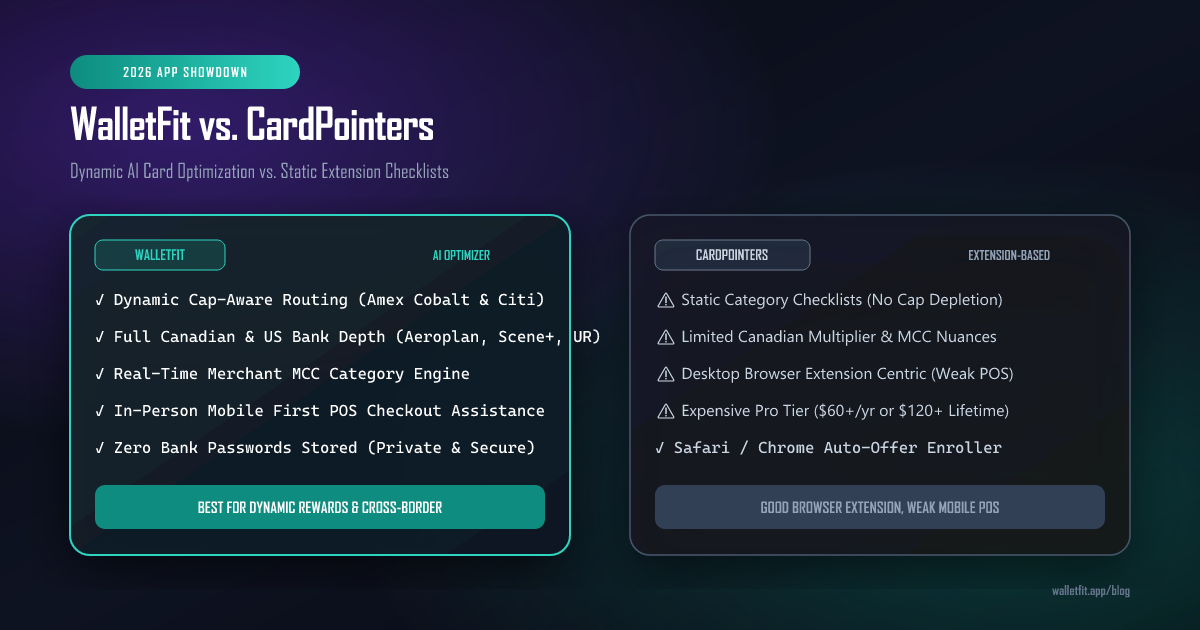
Executive Summary: The Evolution from Checklists to Algorithms
Credit card reward management has undergone a generational shift. In the early 2020s, having a digital reference app that reminded you which card earned 3x on dining or 4x on groceries was considered revolutionary. CardPointers established itself during that era as a popular utility for cataloging cards, managing desktop browser extension pointers, and organizing Apple Wallet passes.
However, credit card rewards programs in 2026 have grown vastly more intricate. Banks have introduced aggressive annual and monthly spending caps, restrictive merchant category code (MCC) exclusions, dynamic rotating tiers, and complex transfer partner point valuations. A card that is "best" on paper on January 1st may actually produce an abysmal 1x return by August once its category cap is silently exhausted.
This is where the fundamental architectural split occurs:
- CardPointers is a static category checklist: It presents fixed category multipliers and browser extension prompts based on nominal reward rates, leaving spend cap tracking, currency conversion, and physical store MCC edge cases to manual user guesswork.
- WalletFit is a dynamic algorithmic rewards optimizer: It continuously tracks cumulative category spend, dynamically recalculates point valuations (cents-per-point ROI), accounts for merchant MCC rules, and guides in-person checkouts so you capture every bonus point without ever dropping into a 1x cap trap.
If you hold cards with spending limits—like the Canadian Amex Cobalt ($30k annual cap) or the US Citi Custom Cash ($500 monthly cap)—a static app will continue telling you to swipe that card even after your bonus yield drops to a meager 1%. WalletFit automatically detects cap depletion and redirects subsequent spend to your optimal backup card.
Comprehensive Feature Comparison Matrix
The following head-to-head comparison evaluates WalletFit against both the free version of CardPointers and the paid CardPointers Pro tier across key functional criteria:
| Core Capability | WalletFit | CardPointers (Free) | CardPointers Pro ($60+/yr or $120+ Lifetime) |
|---|---|---|---|
| Optimization Engine | Dynamic Cap-Aware Greedy Routing | Static Category Multipliers | Static Category Multipliers + Manual Adjustments |
| Category Spend Cap Depletion | Automatic Real-Time Tracking & Auto-Cascade | Not Supported | Manual / Incomplete Automation |
| In-Person POS Guidance | Mobile-First Instant POS & Merchant Matching | Basic Category Lookup | Location Reminders & iOS Widgets |
| Canadian Bank & Program Depth | Full Parity (Aeroplan, Avion, Scene+, Rogers, CIBC) | Limited / Incomplete Multipliers | Partial Canadian Card Database |
| US Bank Ecosystem Depth | Comprehensive (Amex, Chase, C1, Citi, Bilt) | Comprehensive | Comprehensive |
| Point Valuation Engine (CPP) | Real-Time Algorithmic (Cashback vs Airline Yield) | Fixed Nominal Rates | Custom CPP Values (Requires Manual Setup) |
| Annual Statement Credit Tracking | Automated Expiry Alerts & ROI Math | Gated Behind Paywall | Included (Tracked Perks) |
| Financial Privacy Architecture | Zero-Knowledge (No Bank Passwords Required) | Zero Bank Passwords (Extension Based) | Zero Bank Passwords (Extension Based) |
| Pricing & Value | Accessible / Transparent Tiering | Free (Feature Limited) | $60/year or $120–$240 Lifetime Fee |
Battleground 1: Dynamic Cap-Aware Routing vs. Static Checklists
The single greatest cause of rewards leakage among modern cardholders is the spending cap trap. Virtually all high-multiplier cards enforce strict spending ceilings:
🇨🇦 Canadian Spending Cap Traps
Amex Cobalt: 5x points on Eats & Drinks is capped at $2,500/month ($30,000/year). Spend beyond that drops to 1x.
Scotiabank Gold Amex: 6x Scene+ at Empire stores and 5x dining is capped at $50,000 annually across categories.
CIBC Dividend Visa Infinite: 4% cash back on gas and groceries is capped at $20,000 combined annual spend.
🇺🇸 US Spending Cap Traps
Citi Custom Cash: 5% cash back only applies to your highest spend category up to $500 per billing cycle (1% thereafter).
Amex Blue Cash Preferred: 6% cash back on US supermarkets is capped strictly at $6,000 per calendar year.
Chase Freedom Flex: 5% rotating quarterly categories are capped at $1,500 in combined spend per quarter.
When you use a static app like CardPointers, the interface always tells you that the Amex Cobalt is your top dining card and the Citi Custom Cash is your top grocery card. If you spent $600 at supermarkets on your Citi card on day 15 of the month, CardPointers will still tell you to use the Citi Custom Cash for your next $200 grocery haul—earning you 1% cash back ($2.00) instead of the 3% cash back ($6.00) you would have earned on a Capital One SavorOne fallback card.
In contrast, WalletFit's Dynamic Optimization Engine tracks every dollar logged against active caps. The moment your $500 monthly limit is breached, WalletFit's greedy allocation algorithm instantly re-orders your wallet hierarchy, automatically promoting your best uncapped card to the top of your recommendation stack.
Battleground 2: Cross-Border Parity & Canadian Rewards Depth
Many credit card utility apps originate in the United States and treat international markets—especially Canada—as an afterthought. CardPointers has made efforts to incorporate non-US cards, but its database frequently misses the nuanced mechanics of Canadian reward programs:
- Aeroplan Dynamic Redemptions: Air Canada's Aeroplan program does not operate on a flat 1.0 cent-per-point model. WalletFit evaluates Aeroplan points at an average 2.0 CPP travel baseline, properly weighting cards like the TD Aeroplan Visa Infinite against flat cash back alternatives.
- RBC Avion Transfer Multipliers: RBC Avion points have distinct valuation schedules when used on the Air Travel Redemption Grid (up to 2.33 CPP) versus transferring to British Airways Avios during periodic 30% transfer bonus events. WalletFit models these exact transfer vectors.
- Costco Canada Wholesale Rules: Costco warehouses in Canada strictly accept Mastercard only and code under wholesale MCC 5300 (disqualifying standard grocery multipliers). CardPointers frequently causes confusion by suggesting Visa cards for Canadian Costco purchases. WalletFit explicitly isolates warehouse payment networks, directing users to the CIBC Costco Mastercard or Rogers World Elite.
- Foreign Transaction (FX) Surcharge Math: When traveling abroad or making cross-border online purchases, standard cards impose a hidden 2.5% FX fee. WalletFit automatically calculates net returns by deducting FX surcharges unless you hold dedicated zero-FX cards like the Scotiabank Passport Visa Infinite.
Battleground 3: Mobile-First In-Person POS vs. Desktop Browser Extensions
A central pillar of CardPointers' marketing is its browser extension for Safari and Chrome. While browser extensions are useful for e-commerce shopping, they suffer from a major operational limitation: the vast majority of consumer spending happens in person.
Over 78% of household credit card volume—including supermarkets, gas stations, pharmacies, coffee shops, and restaurant bills—is transacted physically at point-of-sale (POS) terminals via Apple Pay, Google Wallet, or physical card chip. A browser extension sitting on your home laptop is completely useless when you are standing in front of a payment terminal at Trader Joe's or No Frills.
WalletFit was engineered from the ground up as a high-speed, mobile-first companion designed specifically for point-of-sale decision making:
- Instant Card Recommendation: Open WalletFit and see your top recommended card in under one second, optimized by category and current cap status.
- Merchant Code Accuracy: WalletFit differentiates between tricky retail MCCs (e.g., Walmart Supercenters vs Walmart Discount stores, or Target vs specialty grocery).
- Zero-Lag Interaction: With native mobile architecture and local calculations, WalletFit works offline and in low-reception grocery basements where heavy web apps fail to load.
Battleground 4: Annual Fee ROI & Benefit Breakage Prevention
Modern premium credit cards—such as the Amex Platinum ($695 annual fee), Chase Sapphire Reserve ($550 annual fee), and Capital One Venture X ($395 fee)—are structured as "coupon books" containing dozens of disparate monthly, semi-annual, and annual statement credits.
CardPointers offers perk tracking, but many advanced reminder features are locked behind its expensive CardPointers Pro subscription tier ($60/year or steep lifetime packages). Users on the free tier are left with basic checklists.
WalletFit treats benefit tracking as a core financial pillar, not an upsell gimmick:
- Automated Breakage Prevention: Proactive alerts remind you when a $20 monthly dining credit, $50 semi-annual Saks credit, or 35k hotel free night certificate is within 14 days of expiration.
- True Net ROI Calculation: WalletFit computes your real net annual return:
(Total Points Earned × CPP) + (Redeemed Credits) − (Annual Fees Paid). If a card ceases to produce positive net value after year one, WalletFit flags it as an upgrade or cancellation candidate.
Privacy Comparison: WalletFit vs CardPointers vs MaxRewards
When choosing a credit card companion app, security and privacy are paramount. Here is how the leading platforms compare on credential handling:
| Security Attribute | WalletFit | CardPointers | MaxRewards |
|---|---|---|---|
| Bank Passwords Stored | Never (Zero-Knowledge) | Never (Zero-Knowledge) | Yes (Plain/Encrypted on Cloud Server) |
| 2FA / Screen-Scraping Breakdowns | 0% (No Screen Scraping) | 0% (No Screen Scraping) | Frequent (Daily Re-logins Required) |
| Local Client-Side Processing | Yes (Privacy-First Engine) | Partial (Cloud Sync) | No (Centralized Cloud Scraping) |
| Bank Account Lockout Risk | Zero Risk | Zero Risk | Moderate (Bot Triggers Fraud Alerts) |
Both WalletFit and CardPointers maintain a safe zero-credential posture compared to MaxRewards (which stores raw online banking logins). However, WalletFit pairs this uncompromising privacy stance with dynamic algorithmic depth that CardPointers lacks.
The Verdict: Which App Should You Choose?
Choose CardPointers If:
- You primarily want an auto-enroller browser extension to click "Add Offer" on hundreds of Amex/Chase online portal deals simultaneously.
- You spend heavily online via desktop Safari or Chrome and rarely shop at physical retail POS terminals.
- You have an exclusively US-based card portfolio and do not hold cards with active spending caps.
Choose WalletFit If:
- You want real-time cap protection: You never want to accidentally earn 1x on an Amex Cobalt, Citi Custom Cash, or Freedom Flex after exceeding a monthly/annual limit.
- You hold Canadian or Cross-Border cards: You need flawless support for Canadian banks (RBC, TD, Scotia, CIBC, BMO, Rogers) alongside US cards, with accurate point valuations (CPP).
- You want an in-person POS companion: You want instant, zero-lag card recommendations when tapping your phone at checkout.
- You refuse expensive subscription paywalls: You want transparent, powerful card optimization without paying $60+/year or $120+ lifetime upgrades just to track your perks.
Frequently Asked Questions
Is WalletFit a better alternative to CardPointers in 2026?
Yes. While CardPointers was built as a static checklist and browser extension, WalletFit is engineered as a dynamic rewards optimizer. As explained in our analysis of why desktop credit card reward extensions fail, WalletFit actively calculates real-time spending caps, factors in true transfer partner point valuations, and delivers instant in-person mobile guidance where over 78% of retail spending occurs.
How does CardPointers compare to WalletFit for Canadian cards?
CardPointers is predominantly centered around the US banking market. Its support for Canadian institutions like RBC, Scotiabank Scene+, TD Aeroplan, and Canadian Tire Triangle is limited, and it frequently lacks accurate Canadian merchant categorization rules (like Costco Mastercard rules or Loblaws vs Sobeys MCCs). WalletFit offers complete native parity for both Canadian and US credit card ecosystems.
Why is dynamic cap-aware routing so important?
Cards with top multipliers (like 5x on groceries or dining) almost always enforce strict monthly or annual spending caps. A static app will keep advising you to use that card even after the cap is exhausted, costing you hundreds of dollars in lost rewards. WalletFit automatically detects cap depletion and promotes your best backup card to maximize continuous net yield.
Do I have to enter my bank login or password in WalletFit?
No. WalletFit utilizes a zero-bank-credential architecture. You never have to share your bank username or password. All optimization calculations run locally and securely, eliminating the risk of credential leaks, bank bot triggers, or 2FA lockouts.
Can I use WalletFit alongside my existing credit cards immediately?
Yes. Setting up your portfolio in WalletFit takes less than 60 seconds. Simply select the cards currently in your wallet, and WalletFit's algorithmic engine will immediately begin calculating your optimal checkout cards, cap schedules, and benefit expiration timelines.
Upgrade to Dynamic Credit Card Optimization
Never hit a hidden spending cap or swipe the wrong card again. Join thousands of smart cardholders using WalletFit.