Credit Card Benefits Tracker Guide: Never Miss an Annual Credit Again
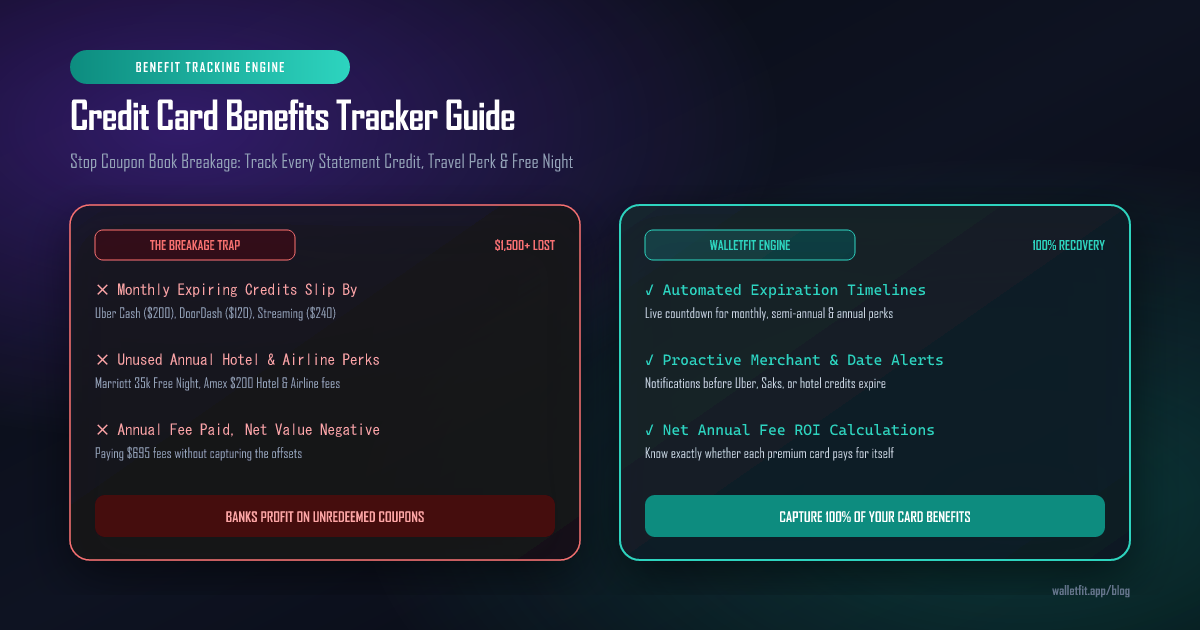
In 2026, premium and mid-tier credit cards are no longer simple payment instruments that deliver points on swipe. They have evolved into complex, fragmented "coupon books."
Whether you hold the American Express Platinum Card ($695 annual fee), the Capital One Venture X ($395 fee), the Marriott Bonvoy American Express Canada ($120 CAD fee), or the Chase Sapphire Reserve ($550 fee), credit card issuers justify steep annual fees by promising hundreds—or even thousands—of dollars in built-in statement credits, annual hotel night certificates, airport lounge passes, and merchant rebates.
However, behind glossy marketing brochures lies a cold mathematical reality known in the banking industry as "breakage."
Financial studies and issuer earnings reports reveal that 40% to 65% of credit card statement credits expire unused. Banks intentionally divide $200+ annual credits into restrictive $15/month or $50/half-year chunks knowing that busy cardholders will forget to redeem them. The average multi-card household quietly forfeits over $1,500 every single year in unredeemed perks.
This comprehensive guide breaks down how a modern credit card benefits tracker works, exposes the hidden expiration timelines engineered by banks, and demonstrates how an automated rewards optimizer like WalletFit guarantees you capture 100% of the value you pay for.
1. The Anatomy of Modern Credit Card "Breakage"
Why do card issuers love "coupon book" benefits over simple cash back or upfront discounts? Because it fundamentally shifts the financial burden onto the consumer.
When an issuer offers a $200 flat fee discount, that cost is 100% realized by the bank on Day 1. But when an issuer offers a "$200 Uber Cash Credit" delivered as $15 per month (plus $35 in December) that expires on the last day of each calendar month at 11:59 PM, the bank relies on human friction:
- Use-It-or-Lose-It Expiration: Unlike gift card balances that carry over by law, monthly statement credits vanish into thin air if you fail to take a ride or order delivery within the 30-day billing window.
- Activation Barriers: Many credits require manual enrollment within obscure online portal sub-menus (e.g., Amex Saks Fifth Avenue, Hilton quarterly credits, or dining credits). If you don't click "Enroll," you receive $0 despite spending at the merchant.
- Merchant Category Code (MCC) Gotchas: A $200 airline fee credit rarely covers airfare tickets; it requires specific incidental coding (checked bags, seat selection, lounge passes) on a pre-selected airline.
- Unsynchronized Billing Cycles: Some credits follow the calendar year (Jan 1 – Dec 31), others follow your card anniversary year (the date you opened the account), and others follow quarterly or monthly schedules.
Without an automated tracking system, managing 3 or more premium cards requires holding dozens of arbitrary expiration dates and merchant rules in your head.
2. The Master Credit Expiration Schedule (US & Canada)
To understand the sheer complexity of modern card perks, examine the expirationcadence across the most popular cards in North America:
| Cadence | Card / Program | Benefit Description | Nominal Value | Breakage Risk |
|---|---|---|---|---|
| Monthly | Amex Platinum (US) | Uber Cash ($15/mo, $35 Dec) | $200 / yr | High (Monthly expiry) |
| Monthly | Amex Gold (US) | Dining Credit (Grubhub, Cheesecake, etc.) | $120 / yr | High (Requires specific vendors) |
| Monthly | Amex Platinum (US) | Digital Entertainment (Disney+, Hulu, NYT) | $240 / yr | Medium (Auto-billable) |
| Semi-Annual | Amex Platinum (US) | Saks Fifth Avenue ($50 Jan-Jun, $50 Jul-Dec) | $100 / yr | High (Enrollment + 6mo window) |
| Annual | Marriott Bonvoy Amex (CA) | Annual Free Night Award (up to 35,000 pts) | $250 - $350 CAD | High (Strict 1-yr expiry) |
| Annual | Capital One Venture X | Travel Portal Credit & 10k Anniversary Miles | $400 / yr | Medium (Portal booking required) |
| Annual | Chase Sapphire Reserve | Flexible Annual Travel Statement Credit | $300 / yr | Low (Auto-applies to all travel) |
| Annual | Scotiabank Passport (CA) | 6 Free DragonPass Airport Lounge Passes | $210 CAD | Medium (Resets every 12 months) |
| Annual | TD Aeroplan Visa Infinite (CA) | NEXUS Application Fee Rebate | $100 CAD | Medium (Every 48 months) |
3. How an Intelligent Benefits Tracker Works (Interactive UI Mockup)
A true credit card benefits tracker is not a static notes app or a messy Google Sheet. It is an intelligent state engine that models every card's unique perk lifecycle, monitors your transaction history, calculates days until forfeiture, and prompts timely action.
Here is what an automated tracking dashboard looks like inside WalletFit:
4. The Real-World Household Math: Tracking vs. Leaking
Let's examine the financial trajectory of two identical households holding the same four popular cards: Amex Platinum ($695), Amex Gold ($325), Marriott Bonvoy Amex Canada ($120 CAD), and Capital One Venture X ($395).
Household A: Un-Tracked (Manual Guesswork)
Relies on memory, logs into banking portals infrequently, misses monthly coupon drops.
- Total Annual Fees Paid: $1,535.00
- Uber Cash Redeemed (only 5 of 12 months): +$75.00
- Amex Gold Dining Credits (forgotten): +$0.00
- Saks $50 Credits (missed H1 window): +$50.00
- Marriott 35k Free Night (expired unused): +$0.00
- Venture X $300 Portal (booked outside portal): +$0.00
- Multipliers & Everyday Cash Back: +$620.00
- Net Household Return: -$790.00 (Massive Loss)
Household B: Tracked with WalletFit
Receives automated expiration alerts, routes purchases to high multipliers, executes 100% of credits.
- Total Annual Fees Paid: $1,535.00
- Uber Cash Redeemed (100% captured): +$200.00
- Amex Gold Dining Credits (100% captured): +$120.00
- Saks $50 Credits (H1 & H2 claimed): +$100.00
- Marriott 35k Free Night (booked resort stay): +$280.00
- Venture X $300 Portal + 10k miles: +$400.00
- Multipliers & Greedy Routing: +$1,140.00
- Net Household Return: +$705.00 (Highly Profitable)
By simply ensuring statement credits and hotel certificates are redeemed before expiration, Household B creates a +$1,495.00 net annual swing compared to Household A. The annual fees stay identical—the only difference is active, automated benefit tracking.
5. The 4 Essential Pillars of a Professional Benefits Engine
When selecting or configuring a benefits tracking solution, make sure it covers these four vital capabilities:
1 Dynamic Expiration Timelines
Different perks expire on monthly, quarterly, semi-annual, calendar-year, or cardmember-anniversary schedules. A capable tracker aligns these schedules automatically without requiring manual calendar reminders.
2 Merchant Enrollment Prompts
Certain credits require one-time enrollment in issuer portals (such as Amex Saks, airline incidental selection, or Hilton credits). Your tracker must alert you to activate perks before swiping.
3 Hotel Certificate & Lounge Pass Tracking
From Marriott 35k and Hyatt Category 1-4 Free Night Awards to Scotiabank DragonPass visits and Air Canada Maple Leaf Lounge passes, annual travel assets must be visible alongside cash credits.
4 Net Annual Fee ROI Calculator
An optimizer must aggregate all captured credits against total annual fees paid, showing you whether each individual card is delivering a positive net return or should be downgraded.
6. Privacy & Architecture: Why Zero-Knowledge Tracking Wins
Many legacy rewards apps like MaxRewards attempt to track benefits by requesting your raw online banking usernames and passwords, storing them on centralized servers to execute automated screen-scraping.
This approach comes with severe downsides in 2026:
- Security Vulnerabilities: Storing your primary bank credentials on a third-party server exposes you to catastrophic credential-stuffing breaches.
- Fragile 2FA Breakdowns: Banks frequently flag automated scraper bots, resulting in daily 2FA text prompts, locked accounts, and broken trackers.
- Zero Canadian Bank Compatibility: US-centric cloud scrapers frequently fail to connect to Canadian institutions (TD, RBC, Scotiabank, CIBC, BMO).
WalletFit never asks for or stores your online banking passwords. By combining pre-configured issuer benefit rules, encrypted read-only API connectors, and local on-device evaluation, WalletFit tracks your entire US and Canadian credit card portfolio with 100% reliability and military-grade privacy.
7. Essential Card Reviews & Strategic Guides
To optimize every card in your wallet and master category spend, explore our deep-dive reviews and optimization blueprints:
💳 Premium Card Reviews
8. Frequently Asked Questions (FAQ)
What is a credit card benefits tracker?
A credit card benefits tracker is an intelligent software engine that monitors statement credits, annual perks, free hotel night awards, lounge passes, and fee offsets across your entire credit card collection. It provides countdown alerts before monthly, quarterly, and annual perks expire so you never forfeit benefits you paid for.
What does "breakage" mean in credit card rewards?
Breakage is the industry term for unredeemed rewards and statement credits. Banks offer generous-sounding coupon-book credits (like $200 in Uber Cash divided into $15 monthly chunks) knowing that over 50% of cardholders will miss the tight expiration windows, allowing the issuer to profit from steep annual fees while paying out minimal benefits.
Which credit card perks expire on a monthly basis?
Common monthly expiring perks include Uber Cash on the Amex Platinum ($15/mo) and Amex Gold ($10/mo), Amex Gold dining credits ($10/mo), Amex Platinum digital entertainment credits ($20/mo), DoorDash DashPass credits on Chase cards ($5-$10/mo), and monthly wireless bill credits.
Can I track both US and Canadian credit cards in WalletFit?
Yes. WalletFit is natively engineered for cross-border multi-card households. It models US statement credits (Amex, Chase, Capital One, Citi) alongside Canadian cards (Marriott Bonvoy Amex CA, Scotiabank Passport, TD Aeroplan, RBC Avion) in a unified multi-currency interface.
How do I start tracking my card perks today?
You can get started right now with WalletFit. Add your cards in seconds to unlock real-time benefit expiration timelines, point-of-sale checkout multipliers, and zero-bank-credential privacy.
Stop letting banks profit off your unused card perks
Try WalletFit free — track monthly statement credits, free night awards, and point-of-sale multipliers with 100% privacy.