WalletFit vs MaxRewards — Honest Comparison & Feature Showdown (2026)
Looking for an alternative to MaxRewards? We dissect the core architectural differences: zero-credential local privacy vs. cloud screen-scraping, cross-border US & Canadian card support, 2FA sync reliability, and why smart cardholders are switching in 2026.
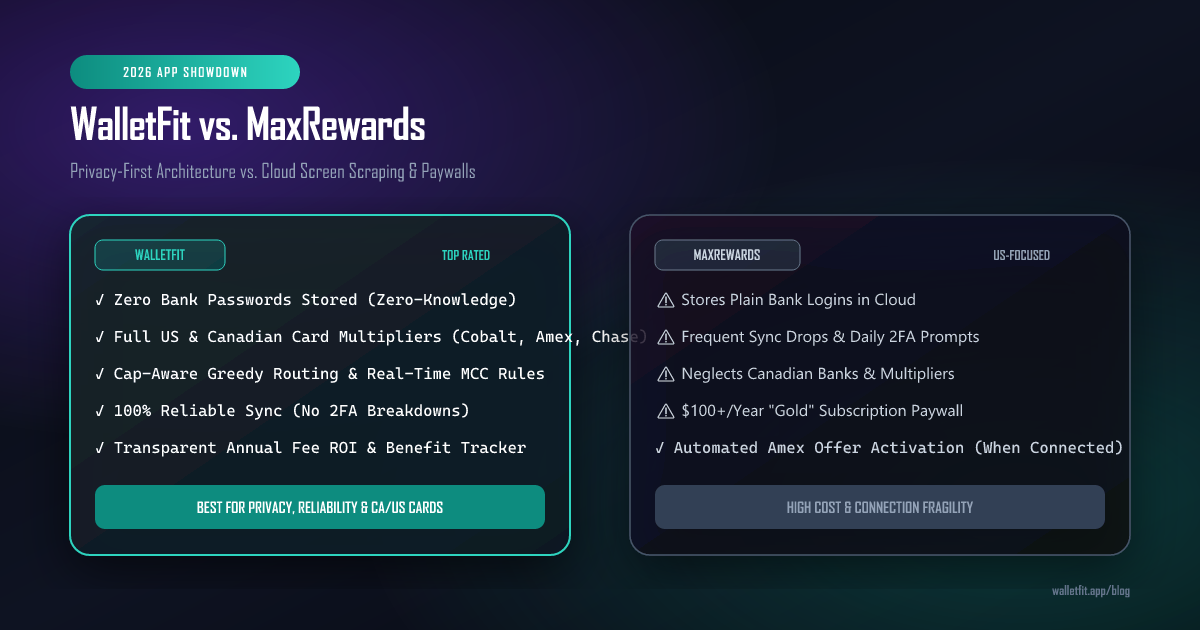
If you value financial privacy, zero bank password storage, 100% sync reliability, or carry Canadian credit cards (like the Amex Cobalt, TD Aeroplan, or Scotiabank Passport), WalletFit is the definitive winner. MaxRewards pioneered automated offer clipping for US cards, but its cloud credential storage model, constant 2FA disconnects, $100+/yr subscription paywall, and lack of Canadian banking support make it obsolete for modern cardholders.
1. The State of Credit Card Trackers in 2026
Managing multiple credit cards used to mean maintaining complex Excel spreadsheets, memorizing Merchant Category Codes (MCCs), and manually tracking monthly coupon book statement credits across Amex, Chase, Capital One, and Canadian Big-5 banks.
As reward structures became increasingly convoluted—with rotating categories, merchant-specific merchant coding traps, and strict annual spending caps—a new generation of credit card optimization apps emerged. Among them, MaxRewards gained early popularity for its ability to auto-activate American Express and Chase merchant offers.
However, by 2026, the credit card landscape shifted dramatically. Users became acutely aware of cybersecurity risks, bank login screen-scraping vulnerabilities, and the annoyance of daily two-factor authentication (2FA) sync drops. Simultaneously, thousands of cross-border travelers and Canadian cardholders realized MaxRewards offered zero support for Canada's lucrative reward ecosystem.
Enter WalletFit: built from the ground up on a privacy-first, zero-knowledge architecture designed to deliver instant checkout recommendations, mathematical cap-aware routing, and full cross-border card intelligence without ever asking for your online banking password.
2. Head-to-Head Feature Comparison Matrix
Here is how WalletFit and MaxRewards compare across every major technical, financial, and user experience metric:
| Feature / Dimension | WalletFit | MaxRewards |
|---|---|---|
| Bank Credential Storage | ZERO Passwords Stored (Zero-Knowledge) | Stores Plain Bank Logins in Cloud |
| Connection Reliability | 100% Stable (No Screen Scraping) | Frequent Sync Drops & Daily 2FA Prompts |
| Canadian Bank & Card Engine | Full Native Support (Amex CA, RBC, TD, Scotia, CIBC, BMO) | Virtually Non-Existent (US Bias) |
| US Bank & Card Engine | Comprehensive (Amex, Chase, Citi, CapOne, Bilt) | Comprehensive (Amex, Chase, Citi, CapOne, Bilt) |
| Spending Cap & Fallback Routing | Algorithmic Greedy Cap Engine (Auto-Rerouting) | Basic Static Multipliers |
| Real-Time Merchant MCC Matching | Instant Merchant-Level Categorization | General Category Estimations |
| Annual Fee ROI & Credit Expiry | Dynamic Expiration Alerts & Net Yield Math | Basic Credit Tracking (Behind Paywall) |
| Auto Offer Activation | Targeted Offer Reminders | Automated Cloud Bot Clicking (Gold Only) |
| Cross-Border / Multi-Currency | CAD & USD Dual Portfolio Optimization | USD Only |
| Pricing & Value | Transparent & Accessible (No Predatory Paywalls) | MaxRewards Gold: $11.99/mo or $119+/yr |
3. Deep Dive: Security & The Bank Login Dilemma
To automate card syncing and offer activation, MaxRewards requires you to input your actual online banking username and password into their application, which is then stored on centralized cloud servers. If those servers are compromised, or if a bank flags repeated unauthorized headless browser logins, your bank account can face security freezes or terms-of-service violations.
The fundamental divide between WalletFit and MaxRewards comes down to security philosophy:
How MaxRewards Works (Screen-Scraping & Cloud Logins)
MaxRewards operates by deploying background automated browser bots that pretend to be you. Every few hours, their cloud servers launch automated scripts that log into your Chase, American Express, or Citi portals using your stored credentials to scrape balances, transactions, and available Amex Offers.
The consequences of this architecture are severe:
- 2FA Notification Fatigue: You receive sudden SMS or app verification codes at 3:00 AM while the bot attempts to scrape your account.
- Frequent Account Lockouts: Major financial institutions actively combat headless bots. Whenever Chase or Amex updates their bot detection or CAPTCHA defenses, MaxRewards connections break for days or weeks.
- Terms of Service Breaches: Storing banking credentials with third-party screen scrapers directly violates the online banking agreements of several major banks, potentially waiving fraud protection warranties.
How WalletFit Solves This (Zero-Knowledge Architecture)
WalletFit operates on a zero-bank-credential security model. We believe your banking passwords belong exclusively to you. WalletFit never asks for, captures, or stores your online banking passwords.
Instead, WalletFit empowers users with:
- Read-Only Tokenized Bank Sync: Utilizing industry-standard, bank-approved OAuth APIs (explore our complete guide on how Plaid secures credit card tracking) where you authenticate directly on the bank's encrypted portal. WalletFit only receives cryptographically signed read-only transaction tokens—never your login credentials.
- Manual Portfolio Modeling: For maximum privacy, you can model your entire card collection, spending habits, and monthly budgets with zero bank connections required to see how to track missed rewards.
- Local In-Browser Processing: The recommendation algorithm evaluates your card combinations and merchant category assignments directly on your device.
4. Cross-Border & Canadian Card Ecosystem
If you live in Canada, travel frequently between the US and Canada, or maintain a cross-border banking setup, MaxRewards is virtually unusable.
🍁 Canadian Cards in WalletFit
WalletFit has complete, deeply researched reward logic for the entire Canadian credit card market, including:
- Amex Cobalt (5x eats & drinks up to $30k)
- TD & CIBC Aeroplan Visa Infinite
- Scotiabank Passport (0% FX fees)
- CIBC Costco Mastercard (Costco rules)
- Triangle World Elite (Property taxes)
🇺🇸 US Cards in WalletFit
WalletFit simultaneously manages all major US reward ecosystems with live Cent Per Point (CPP) valuations:
- Amex Gold & Platinum (4x dining / 5x flights)
- Chase Sapphire Reserve & Preferred
- Capital One Venture X ($395 ROI loop)
- Citi Strata & Custom Cash (5x top category)
- Bilt Mastercard (1x rent with $0 fee)
MaxRewards fails to account for Canadian store acceptance quirks (such as Costco Canada's Mastercard-only policy or Loblaws/No Frills rejecting Amex). In contrast, WalletFit's greedy allocator prevents you from ever swiping an unsupported network at checkout.
5. Algorithmic Intelligence: Cap-Aware Greedy Routing
Most credit card trackers display static multipliers. For example, they tell you the Amex Cobalt earns 5x on groceries or the Citi Custom Cash earns 5% on your top spending category.
However, static lists fail in the real world because the best cards have spending caps:
- The Amex Cobalt caps 5x points at $2,500 CAD/month ($30,000/year). Swiping it on dollar $2,501 yields only 1x.
- The Citi Custom Cash caps 5% cashback at $500 USD/month. Subsequent spending earns only 1%.
- The Amex Blue Cash Preferred caps 6% at U.S. supermarkets at $6,000 USD/year.
WalletFit models your spending sequentially across the billing cycle. When your primary card approaches or hits its bonus category cap, WalletFit automatically shifts your checkout recommendations to your highest-yielding fallback card (e.g., transitioning from Cobalt 5x to Scotiabank Gold 6x or Rogers World Elite 2%). MaxRewards simply leaves you to guess.
6. Pricing: The $100+ Paywall vs. Transparent Value
MaxRewards offers a barebones free tier, but aggressively pushes users toward its MaxRewards Gold tier, which costs $11.99 per month or over $100 to $140+ per year. Essential features like custom credit card valuations, credit trackers, and automated offer activation are trapped behind this expensive subscription.
Ask yourself: Does it make sense to spend $120/year on an app just to optimize an extra $150 in credit card cashback? The high subscription cost drastically diminishes your net annual rewards yield.
WalletFit provides an accessible, high-ROI approach. You get comprehensive portfolio optimization, cap-aware allocation, merchant category lookups, and multi-currency tracking without paying hundreds in subscription fees.
7. The Verdict: Who Should Choose What?
Choose WalletFit If:
- You demand a zero-bank-password security model that never puts your credentials at risk.
- You want rock-solid reliability without 2FA disconnects or broken screen-scrapers.
- You hold Canadian credit cards or cross-border US/CA portfolios.
- You want cap-aware optimization that knows when your 5x caps expire.
- You want an intuitive mobile-first experience designed for in-person checkouts.
Choose MaxRewards If:
- You are strictly a US-only cardholder.
- Your primary objective is having a cloud bot automatically click hundreds of Amex Offers on your behalf.
- You don't mind providing your online banking passwords to third-party cloud servers.
- You are comfortable paying $100+/year for a Gold subscription.
8. Frequently Asked Questions (FAQ)
Is MaxRewards safe to use with bank logins?
While MaxRewards claims to use encryption, storing your actual online banking credentials on third-party cloud servers creates inherent security liabilities. If their servers are breached, your banking logins are exposed. Furthermore, automated screen-scraping violates many banks' Terms of Service. WalletFit bypasses this risk entirely by never collecting your bank passwords.
What is the best alternative to MaxRewards in 2026?
WalletFit is widely regarded as the best alternative to MaxRewards in 2026. It provides zero-credential privacy, robust US and Canadian card catalogs, real-time merchant category detection, and spending cap tracking without expensive subscription paywalls.
Does MaxRewards support Canadian banks like RBC, TD, or Scotiabank?
No. MaxRewards focuses almost exclusively on US credit cards and major US banks. Canadian institutions, reward currencies (Aeroplan, Avion, Scene+), and store network rules (such as Costco Canada's Mastercard rule) are not natively supported. WalletFit provides complete, native support for all Canadian financial institutions.
How does WalletFit know which card I should use at checkout?
WalletFit pairs a rich database of merchant category codes (MCCs) with your specific wallet portfolio and real-time spending cap status. When you shop at a supermarket, restaurant, gas station, or travel site, WalletFit instantly tells you which card produces the highest net return after accounting for category multipliers, caps, point valuations, and merchant network acceptance.
Where can I learn more about credit card rewards optimization?
Check out our foundational guides on What Is a Credit Card Rewards Optimizer?, our analysis on Why Kudos & Browser Extensions Failed, our WalletFit vs CardPointers Showdown, How to Optimize Credit Card Rewards, and our analysis of the Best Credit Card Tracking Apps in Canada to build a mathematically flawless wallet strategy.
Ready to optimize your wallet with 100% privacy?
Try WalletFit today — zero bank passwords stored, real-time card recommendations, and maximum reward yields.