BMO CashBack World Elite Mastercard Review
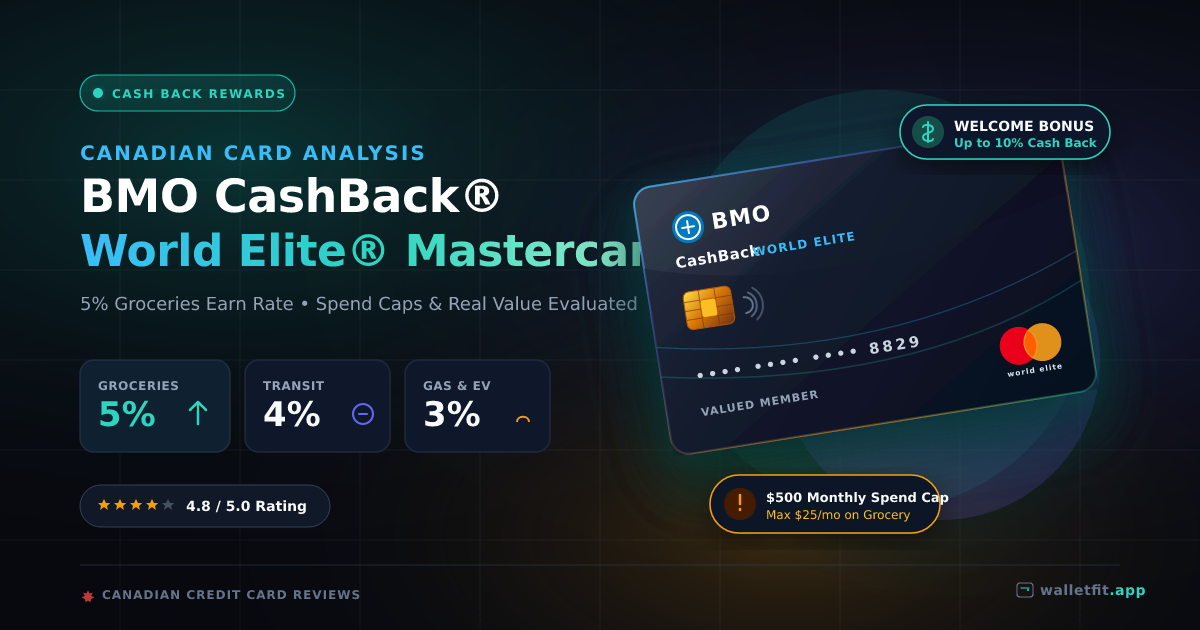
The BMO CashBack World Elite Mastercard delivers an industry-leading 5% return on groceries and 4% on transit, but strictly limits those rates to tight monthly spending caps ($500/month for groceries). For solo spenders who stay within these thresholds, it produces top-tier cash returns, but families spending over $500 monthly will see their effective earn rate drop sharply to 1% without automated tracking.
If you are searching for a high-earning bmo cash back credit card, the BMO CashBack World Elite Mastercard immediately jumps out with headline-grabbing numbers: 5% cash back on groceries and 4% on transit. On paper, those numbers rival almost every premium rewards card in Canada, including top-tier travel programs.
However, the real-world value of this card hinges entirely on the fine print. Unlike competing cards that set generous annual category limits, BMO enforces strict monthly spending caps. Spend $501 on food in a single statement period, and your return on that extra dollar instantly falls by 80%. Here is the complete breakdown of how the math works, who benefits, and how to optimize your spending.
Earning Structure: High Rates Trapped Behind Monthly Caps
The BMO CashBack World Elite Mastercard uses a tiered acceleration model across five specific spending categories. While the top rates are among the highest in Canada, each comes with an individual monthly limit:
- 5% Cash Back on Groceries: Capped at $500 spend per statement period (Maximum reward: $25/month).
- 4% Cash Back on Transit: Includes rideshares, taxis, trains, and public transit; capped at $300 spend per statement period (Maximum reward: $12/month).
- 3% Cash Back on Gas & Electric Vehicle Charging: Capped at $300 spend per statement period (Maximum reward: $9/month).
- 2% Cash Back on Recurring Bill Payments: Automatic pre-authorized charges; capped at $500 spend per statement period (Maximum reward: $10/month).
- 1% Cash Back on All Other Purchases: Unlimited baseline earn rate, which also applies to any spend exceeding the monthly caps above.
Because BMO issues this card on the Mastercard network, it enjoys universal acceptance across Canadian grocery stores—including discount retailers like No Frills and Real Canadian Superstore that reject American Express. However, warehouse clubs like Costco code as wholesale clubs rather than grocery stores (MCC 5411), meaning your Costco purchases only generate the baseline 1% return.
The $500 Monthly Cap Math: Where the Strategy Breaks Down
The biggest pitfall of this card is the $500 monthly cap on groceries. According to Canada's Food Price Report, an average Canadian household of four spends well over $1,200 per month on food. If you put that entire spend on the BMO CashBack World Elite Mastercard, your effective return plummets:
- First $500 spent at 5% = $25.00 cash back
- Remaining $700 spent at 1% = $7.00 cash back
- Total return on $1,200 spend = $32.00 (2.67% effective earn rate)
When you account for the $120 annual fee, that diluted return makes the card far less competitive against the best Canadian cash back credit cards or cards featuring annual rather than monthly caps. To see how to manage category ceilings across multiple cards, review our playbook on beating credit card spending caps.
| Card | Annual Fee | Top Category Rate | Spending Cap Structure | Net Value on $1,000/mo Groceries |
|---|---|---|---|---|
| BMO CashBack World Elite Mastercard | $120 | 5% Groceries, 4% Transit | $500/mo per category | $240 net / year |
| TD Cash Back Visa Infinite* | $139 | 3% Groceries, Gas, Bills | $15,000 annual cap per category | $221 net / year |
| Scotia Momentum Visa Infinite | $120 | 4% Groceries & Recurring Bills | $25,000 annual combined cap | $360 net / year |
Card Deep Dive: BMO CashBack World Elite Mastercard
BMO CashBack World Elite Mastercard
- Annual Fee: $120 (often waived for the first year with introductory welcome bonuses).
- Income Requirement: $80,000 personal or $150,000 household annual income.
- Redemption Flexibility: Redeem cash back directly into a BMO chequing, savings, or InvestorLine account in increments as low as $1, or set up automated monthly deposits.
- Included Roadside Assistance: Free complimentary Dominion Automobile Association (DAA) roadside assistance membership (an approximate $100/year standalone value).
- Travel Insurance: Up to $5 million in out-of-province emergency medical coverage for up to 8 days (for cardholders under 65).
How to Optimize the BMO CashBack Strategy
If you want to extract maximum return from this card, you cannot treat it as an "all-in-one" daily driver. Instead, deploy it as a specialized tactical tool:
1. Stop Spending at Exactly $500 on Groceries
Once you hit $500 in grocery purchases during a billing cycle, immediately re-route subsequent grocery spend to a secondary card—such as the TD Cash Back Visa Infinite or an accelerated rewards card. Continuing to swipe your BMO card at 1% generates a severe opportunity cost.
WalletFit alerts you when you hit your BMO $500 monthly cap so you can seamlessly switch cards at the checkout counter and preserve maximum returns.
2. Maximize the 4% Transit Allowance
Because transit encompasses public transit passes, train tickets, Uber, Lyft, and parking meters, using this card for daily commuting costs yields up to $144 in pure cash back per year on just $300 of monthly transit spend.
3. Factor in the DAA Roadside Benefit
If you currently pay out-of-pocket for CAA or Canadian Tire Roadside assistance, the complimentary DAA coverage bundled with the BMO CashBack World Elite completely offsets the $120 annual fee on its own. For drivers who need basic towing and lockout support, this feature turns the card into a mathematical net-positive even before accounting for grocery cash back.
Cash Back vs. Travel Points: The Trade-off
Before locking into a dedicated cash back portfolio, evaluate whether fixed cash beats transferable points for your lifestyle. While a 5% cash return is rock-solid and impervious to award chart devaluations, travel programs like Aeroplan or American Express Membership Rewards can yield 2.0 to 2.5 cents per point when redeemed for premium cabin travel. Explore our comprehensive breakdown on cash back vs travel points to see which model produces higher net value for your annual spending profile.
The Verdict: Is the BMO CashBack World Elite Worth It?
The BMO CashBack World Elite Mastercard is an exceptional earner for low-to-moderate grocery spenders, solo professionals, couples without dependents, and urban commuters. If your monthly grocery bill falls between $400 and $500, you are capturing the maximum 5% return without spilling into the 1% penalty tier.
Conversely, for larger families or households that routinely spend $800 to $1,500 monthly on food, the restrictive $500 cap makes this card inefficient as a standalone option unless paired with automated tracking to shift spending the moment the cap is reached.
Frequently Asked Questions
What happens when I spend more than $500 on groceries in a month with this card?
Any grocery spending beyond the $500 monthly cap drops from the 5% accelerated rate to the card's baseline 1% cash back rate until your next monthly statement period begins.
Can I redeem my BMO cash back whenever I want?
Yes. You can redeem your accrued cash back on demand starting at just $1, or set up an automatic recurring redemption into an eligible BMO bank account or directly as a statement credit.
Does Costco count toward the 5% grocery category on the BMO CashBack World Elite?
No. While Costco warehouses accept Mastercard, they are classified under wholesale club Merchant Category Codes (MCC) rather than grocery stores (MCC 5411), earning the standard 1% baseline rate.
Stop Leaving Rewards On The Table
WalletFit automatically tracks spending caps across 50+ Canadian credit cards so you always know the exact card to tap for maximum points and cash back.
Start Optimizing Free →