Cash Back vs. Travel Points: How to Value Points and Achieve Outsized Redemptions
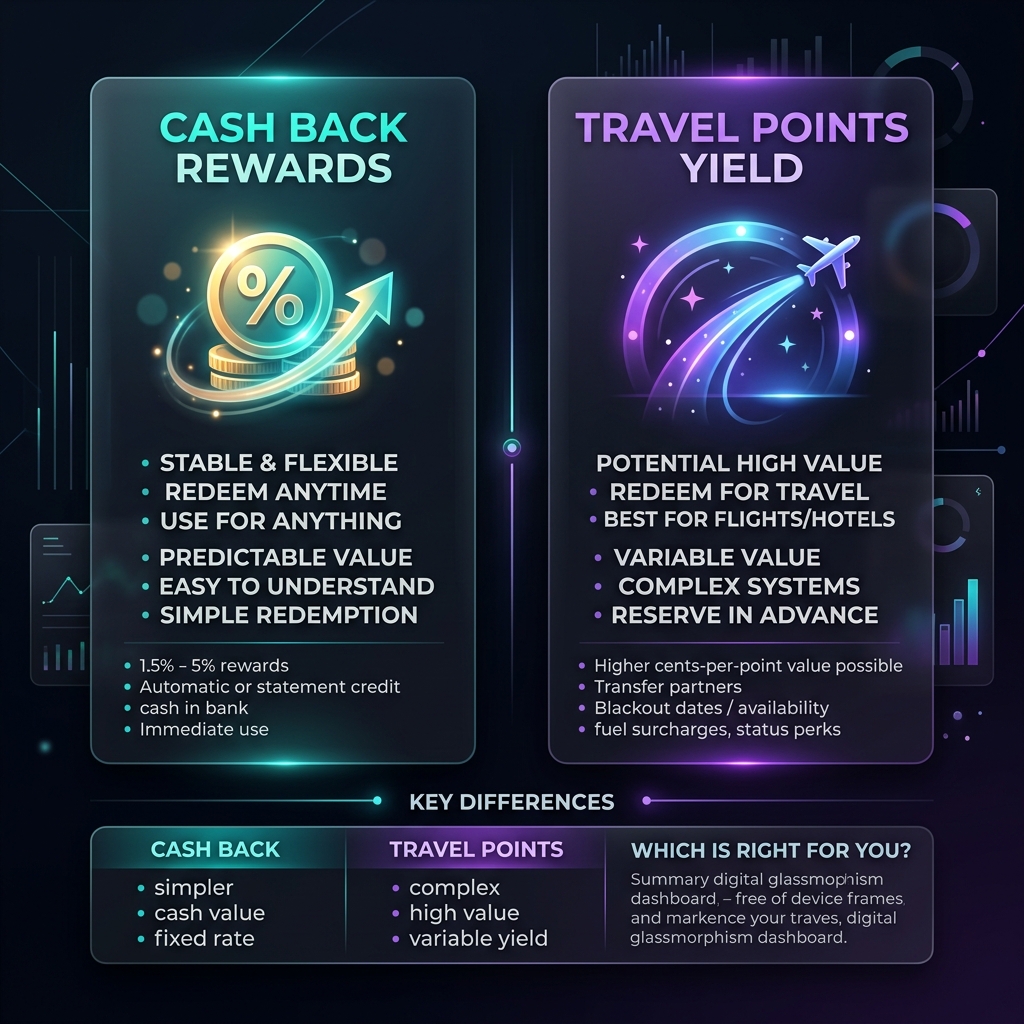
When optimizing your credit card setup, you face a fundamental strategic crossroads: **Should you earn Cash Back or Travel Points?** This is the most fiercely debated topic in personal finance circles. Cashback advocates praise the simplicity of cold, hard cash, while points enthusiasts brag about flying business class around the world for a fraction of the retail cost.
The truth is that neither strategy is universally superior. The right choice depends on your household budget, your travel goals, and your willingness to play the redemption game. However, when executed with algorithmic precision, travel points can unlock an order of magnitude more value than cash back ever could.
In this guide, we will analyze the cash-versus-points debate, establish baseline valuations for major Canadian reward programs, explain the mechanics of points arbitrage, and show you how to build a high-efficiency hybrid wallet.
1. The Debate: Simplicity vs. Outsized Value
The choice between cash back and points comes down to a trade-off between certainty and yield:
Cash Back: The Certainty Path
Cash back is simple. If you earn 2% cash back, a $100 purchase yields exactly $2.00. The purchasing power of that cash is stable and fully liquid. You can use it to pay off your statement, buy groceries, or invest. There are no blackout dates, no transfer tables, and no devaluations. However, the upside of cash back is strictly capped: 1 cent of cash back will never be worth more than 1 cent.
Travel Points: The Yield Path
Travel points are proprietary, bank-issued currencies (like AMEX Membership Rewards) or airline miles (like Aeroplan). Points do not have a fixed dollar value. Instead, their value depends entirely on how you redeem them. By transferring points to airline partners and booking premium cabins, you can achieve redemption valuations of 2.0¢, 3.0¢, or even 4.0¢ per point. This variability allows for **point arbitrage**, turning a standard 5x card multiplier into a 10% to 20% net return on spend.
2. Valuing the Points: Canadian Program Baselines
To compare points cards to cashback cards, you need a baseline valuation. At Wallet Fit, we calculate valuations in **cents-per-point (c/p)**. Below are the current market valuations for Canada's major rewards currencies:
| Reward Program | Baseline Value (Floor) | Target Value (Optimized) | Outsized Value (Premium Cabin) | Redemption Sweet Spots |
|---|---|---|---|---|
| Air Canada Aeroplan | 1.0¢ (Statement Credits) | 1.5¢ - 1.8¢ (Economy Flight) | 2.0¢ - 3.0¢+ (Business Class) | Partner airlines (EVA Air, ANA, Lufthansa), short-haul flights |
| AMEX Membership Rewards (MR) | 1.0¢ (Statement Credits) | 1.5¢ - 2.0¢ (Aeroplan Transfer) | 2.5¢ - 4.0¢ (British Airways Avios) | Transferring 1:1 to Aeroplan, British Airways Executive Club |
| Scotiabank Scene+ | 1.0¢ (Fixed Travel/Retail) | 1.0¢ (Statement Credit for Travel) | 1.0¢ (Fixed) | Booking travel via Scene+ travel portal, Cineplex, grocery partners |
| RBC Avion | 1.0¢ (Fixed Flight Schedule) | 1.2¢ - 1.5¢ (Air Travel Grid) | 2.0¢+ (BA Avios Transfer Promo) | Transferring to Avios during 30% bonus promotions |
3. Points Arbitrage: How to Earn a 10%+ Return on Spend
Point arbitrage occurs when you earn points at a high multiplier and redeem them for a high cents-per-point valuation. Let's look at a real Canadian example using the AMEX Cobalt Card:
Suppose you spend $10,000 annually on groceries, dining, coffee, and drinks. Earning 5x AMEX MR points on this spend yields 50,000 MR points. Because AMEX MR points transfer 1:1 to Aeroplan, you can instantly turn these into 50,000 Aeroplan points.
Now, let's look at three redemption paths:
- Path A (Cash Value): You redeem the points for a statement credit at a flat 1.0¢ per point. You receive **$500 in value** (a 5.0% return on spend).
- Path B (Standard Travel): You book a round-trip economy flight from Toronto to Vancouver that retails for $750 by using 50,000 points. You get **1.5¢ per point** of value, yielding **$750 in value** (a 7.5% return on spend).
- Path C (Outsized Arbitrage): You book a one-way business class flight from Montreal to Frankfurt on a Star Alliance partner (e.g., Lufthansa). The retail cost of this ticket is $3,000, but you book it for 60,000 points (using 50,000 points plus 10,000 points from other spend). This redemption yields **5.0¢ per point** of value. The 50,000 points generated from your dining budget are worth **$2,500 in value**—representing a **25% net return on spend**!
4. The Math: When Does a Points Card Beat a No-Fee Cashback Card?
Many consumers shy away from points cards because they carry high annual fees. To determine if a points card makes financial sense, you must calculate the **minimum spending threshold** required to outvalue a no-fee cashback card (like the Rogers Red Mastercard, which yields a flat 2.0% return for Rogers/Fido customers).
Let's compare the AMEX Cobalt ($155.88 annual fee, earning 5x eats/drinks) to a flat 2% cashback card. Let's assume you value Aeroplan points at a conservative 1.5¢ each (giving the Cobalt a 7.5% gross return rate on food). Let x represent your annual food spend:
To find the point where the Cobalt beats the cashback card, we solve for x:
This means if you spend just **$236 per month ($2,834.18 annually)** on groceries and dining, the AMEX Cobalt's net rewards will outvalue a flat 2% cashback card, even after paying the $155.88 annual fee. If you value your points at 2.0¢ (business class redemptions), that threshold drops to just **$162 per month ($1,948 annually)**.
5. The Hybrid Solution: The Ultimate Wallet Combo
You do not have to choose strictly between cash back and travel points. The highest-yielding wallet setups are **hybrids** that combine both worlds to eliminate annual fee drag and category multiplier limitations.
- Primary Points Card (AMEX Cobalt): Use for all grocery, dining, food delivery, and coffee purchases. Earning 5x transferable points yields a 7.5% to 10%+ return.
- Secondary Categories Card (Scotiabank Gold AMEX): Use for gas, transit, streaming, and entertainment. Earning 3x to 5x Scene+ points yields a 3% to 5% return.
- Catch-All Cashback Card (Rogers Red World Elite Mastercard): Use for all Costco purchases, dentist appointments, car repairs, and online shopping where AMEX is not accepted or categories only yield 1%. Earning a flat 2.0% cash back (or 1.5% regular) ensures no transaction ever earns a sub-optimal rate.
6. Quick-Reference Cap & Fallback Matrix
To keep your hybrid stack running at maximum efficiency, keep this quick-reference table bookmarked. It maps out Canada's primary cards, their respective category caps, and the mathematically optimal fallback card to use once you breach those limits.
| Primary Card | Primary Multiplier & Category | Spending Cap & Reset Cycle | Recommended Fallback Card | Fallback Return Rate |
|---|---|---|---|---|
| AMEX Cobalt | 5x Eats & Drinks (Groceries/Dining) | $2,500 per month (Calendar) | Scotiabank Gold AMEX | 5x Scene+ points (5% return) |
| AMEX Cobalt | 5x Eats & Drinks (Groceries/Dining) | $2,500 per month (Calendar) | CIBC Dividend Visa Infinite | 4% cash back on Groceries |
| Scotiabank Gold AMEX | 5x Groceries & Dining | $7,500 per year (Calendar) | TD Cash Back Visa Infinite | 3% cash back on Groceries / Gas |
| CIBC Dividend Visa Infinite | 4% Groceries & Gas | $20,000 per year combined (Calendar) | Rogers Red World Elite Mastercard | 2.0% cash back (Rogers/Fido customers) |
| Tangerine Money-Back | 2% cash back (Up to 3 Chosen Categories) | No cap (but lower rate) | Rogers Mastercard | 2.0% cash back (Rogers/Fido customers) |
📅 Weekly Optimization Series
Thank you for following our 4-week credit card optimization series! Review all the guides in the series:
Getting Started
How to sync your credit card transactions securely and discover missed rewards.
Week 2 • June 27Demystifying the Wallet Score
A deep dive into how your score is calculated and how to raise it above 90.
Week 3 • July 4Beating Spending Caps
How to set up fallback strategies to maintain maximum rewards after breaching caps.
Cash Back vs. Travel Points
How to value Aeroplan and Scene+ points against straight statement credits.
Frequently Asked Questions
Is cash back or travel points better for Canadian cardholders?
Cash back provides guaranteed, fixed value with zero redemption friction, while travel points offer higher potential upside (2c-4c+ per point) for frequent travelers redeeming for flights and hotels.
How do you calculate net annual return on annual fee cards?
Net annual return equals total rewards earned minus annual card fees. A $150 annual fee card earning $500 in rewards yields a net return of $350.
How does WalletFit evaluate cash back vs travel points?
WalletFit standardizes point valuations using Cents Per Point (CPP) benchmarks and calculates your exact net return after fees across both cash back and points portfolios.