How Points Credit Cards Work in Canada
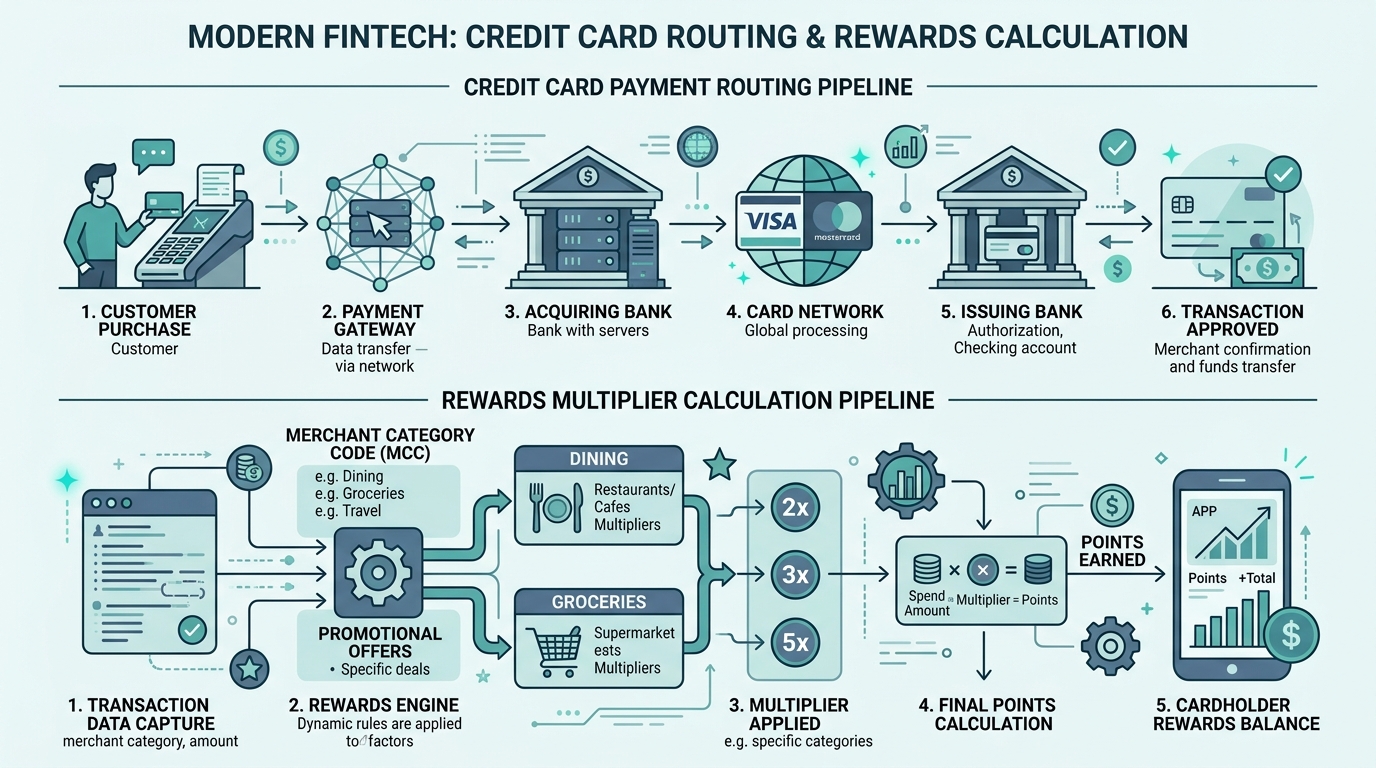
Points credit cards operate on an ecosystem where transaction interchange fees (1.4%–2.4% paid by merchants) fund bank reward currencies. Your net return depends on Merchant Category Codes (MCCs) triggering multiplier earn rates and your Cent Per Point (CPP) valuation at redemption. Optimizing rewards requires pairing high-multiplier cards with high-value transfer partners or fixed redemptions.
Every time you tap a points credit card at a store in Canada, a complex financial mechanism kicks off behind the scenes. Millions of Canadians collect Aeroplan points, Amex Membership Rewards, Scene+ points, or RBC Avion points daily—yet few understand where these rewards actually come from, how banks profit from offering them, or how to calculate their true monetary value.
Understanding how credit card reward ecosystems operate is the fastest way to turn passive spending into thousands of dollars in annual travel or cash value. Whether you are weighing cash back vs travel points or trying to optimize your wallet, this guide breaks down the underlying economics, billing mechanics, and valuation math that govern points cards in Canada.
The Engine: How Interchange Fees Fund Credit Card Rewards
A common misconception is that credit card points are funded entirely by interest paid by cardholders who carry balances. While interest charges and annual fees contribute significantly to bank revenues, the core engine powering everyday reward generation is the interchange fee.
When you purchase groceries, dining, or retail goods using a credit card, the merchant does not receive 100% of the sale price. Instead, a processing fee known as the Merchant Discount Rate (MDR) is deducted from the transaction before funds reach the merchant's bank account. A major portion of this fee is the interchange fee, which flows directly to the card-issuing bank (e.g., RBC, TD, Scotiabank, or Amex).
The Math Behind the Swipe
In Canada, interchange rates are regulated but vary based on the network (Visa, Mastercard, American Express) and card tier:
- Standard Credit Cards: Typically incur interchange fees around 1.00% to 1.40%.
- Premium & Ultra-Premium Cards (World Elite / Visa Infinite Privilege): Charge merchants higher interchange rates, ranging from 1.60% to 2.25% or more.
- American Express: Operates a closed-loop network, directly negotiating merchant acceptance fees that historically averaged between 2.00% and 2.50%.
Because premium cardholders generally have higher average spending, banks collect higher interchange revenue on those accounts. The bank allocates a percentage of that fee to purchase points from airline loyalty partners or fund their proprietary rewards program, returning a portion back to you as rewards.
How You Earn Points: Earn Rates, MCC Codes, and Billing Cycles
Earning points is not as simple as spending $1 and getting 1 point. Your earning power is determined by three interconnected components: base earn rates, category multipliers, and Merchant Category Codes (MCCs).
1. Base Earn Rate vs. Multipliers
Every points card has a baseline earn rate—usually 1 point per $1 spent on uncategorized purchases. Premium rewards cards introduce category multipliers (e.g., 5x points on dining, 3x on groceries, 2x on transit) to incentivize you to use their card for specific daily expenses.
2. The Role of Merchant Category Codes (MCC)
How does the card issuer know you bought groceries instead of hardware? Every business that accepts credit cards is assigned a 4-digit Merchant Category Code (MCC) by its payment processor (e.g., MCC 5411 for Grocery Stores, MCC 5812 for Restaurants). When you swipe your card, the payment terminal transmits its MCC to your card issuer.
If the MCC matches one of your card's multiplier categories, your issuer applies the accelerated earn rate. If a store is incorrectly categorized (such as a grocery store operating under a general merchandise code), you will only receive the base rate. Cardholders looking to maximize returns should review our comprehensive Canadian points valuation table to verify how specific category multipliers impact real-world yields.
3. Billing Cycles and Points Posting
When you complete a transaction, points are recorded as "pending." They do not become available for redemption immediately. Points earned during a monthly billing cycle typically post to your rewards account 24 to 48 hours after your official monthly statement generates. If you cancel a card before statement generation, pending points from that cycle may be forfeited.
How Points Work at Redemption: Cent Per Point (CPP) Math
Earning points is only half the equation. The true value of a points credit card depends entirely on redemption efficiency, measured in Cents Per Point (CPP).
The standard benchmark formula to evaluate any redemption is:
CPP = (Cash Value of Redemption in CAD − Taxes/Fees Paid) ÷ Total Points Redeemed × 100
Fixed-Value vs. Dynamic Rewards
Canadian reward programs generally fall into two distinct structural models:
| Program Type | Example Programs | Average Valuation | Redemption Flexibility |
|---|---|---|---|
| Fixed-Value Rewards | Scene+, CIBC Aventura, Cash-Equivalent Systems | 1.00¢ per point | High flexibility; points directly offset travel expenses or purchases. |
| Dynamic Loyalty Programs | Air Canada Aeroplan, Transferrable Amex MR | 1.50¢ – 2.20¢+ per point | Variable value; redemptions scale significantly higher for premium cabins. |
| Fixed Flight Schedules | RBC Avion Travel Grid | 1.00¢ – 2.33¢ per point | Set point charts for economy flights with capped ticket price limits. |
For example, if you redeem 50,000 Aeroplan points for a business class flight that would otherwise cost $1,200 cash (after subtracting $100 in taxes paid), your redemption yield is:
($1,100 ÷ 50,000) × 100 = 2.20 CPP
Comparing this to a fixed statement credit where 10,000 points equals $100 (1.00 CPP) illustrates why flexible points programs are favoured by strategic spenders evaluating the best travel credit cards in Canada.
Top Canadian Points Card Deep-Dives
To see how these underlying mechanics operate in practice, let's examine two of the most popular points-earning cards in Canada.
American Express Cobalt® Card
- Primary Mechanism: Industry-leading 5x multiplier on eligible eats and drinks in Canada (up to annual caps).
- Point Type: Amex Membership Rewards (MR) - Select Tier.
- Valuation Range: 1.00¢ to 2.00¢+ per point when transferred to 1:1 airline partners like Aeroplan.
- Interchange Advantage: Utilizes Amex's closed network to fund aggressive 5x multipliers on food and dining.
For a detailed analysis of how to leverage Amex MR transfers, read our dedicated American Express Cobalt Card guide.
Scotiabank Gold American Express® Card
- Primary Mechanism: Earns 5x Scene+ points on eligible grocery and dining, 3x on streaming.
- Point Type: Scene+ Points (Fixed-Value Currency).
- Valuation Rate: 1.00¢ per point flat rate across all travel redemptions.
- Key Advantage: Zero foreign transaction fees, allowing cardholders to save the standard 2.5% FX surcharge on international purchases.
How to Optimize Your Points Strategy
Now that you understand the mechanics of interchange, MCC tracking, and CPP valuation, follow these golden rules to optimize your returns:
- Align Cards with Your Largest Category Spend: Pick cards offering 3x to 5x multipliers on your top expenses (groceries, dining, transit) rather than relying on a flat 1x card.
- Never Pay Interest: Credit card interest rates in Canada range from 19.99% to 25.99%. Carrying a balance immediately wipes out any 2% to 5% return earned from points.
- Watch for Transfer Partners: Convert transferrable reward currencies to airline loyalty programs during bonus promotion periods to inflate your point valuations above 2.0 CPP.
- Track Spend Caps: Many multiplier categories carry annual or monthly spend limits. Once hit, the earn rate drops back to the baseline 1x.
Frequently Asked Questions
How do credit card companies in Canada afford to give points?
Credit card issuers fund reward programs primarily through transaction interchange fees (ranging from 1.0% to 2.4%) charged to merchants on every purchase, as well as annual card fees and interest revenue from carried balances.
Do credit card points expire in Canada?
Under Canadian provincial regulations, points general programs do not expire due to age as long as your account remains open and in good standing. However, continuous inactivity (typically 12 to 18 months without earning or redeeming) can lead to account closure and point forfeiture in programs like Aeroplan or Scene+.
What is the difference between fixed-value points and flexible points?
Fixed-value points (like Scene+) have a set cash redemptions rate (usually 100 points = $1 CAD). Flexible points (like Amex Membership Rewards or Aeroplan) have variable valuations depending on how you redeem them, offering higher potential value when redeemed for flights or transferred to partner programs.
How do credit card issuers know which multiplier to apply to my purchase?
Issuers track the 4-digit Merchant Category Code (MCC) assigned to the merchant processing terminal. If the merchant's MCC matches an eligible category (e.g., Grocery Stores), the bank automatically applies the higher multiplier rate to your transaction.
Stop Leaving Rewards On The Table
WalletFit automatically tracks spending caps across 50+ Canadian credit cards so you always know the exact card to tap for maximum points and cash back.
Recommended Next Reading
- 0% APR balance transfer credit cards in Canada: Why carrying debt destroys rewards value.
- Best credit cards for Canadian students: Starting your credit & points journey with $0 fees.
- top Canadian credit cards overall: Canada's 10 best cards ranked.
- best Canadian credit cards for rewards: Points vs cash back breakdown.
- Amex Membership Rewards guide Canada: Guide to Canada's top transferable currency.
- are store credit cards worth it: Evaluating Canadian retail cards.