How to Build a Credit Card Portfolio for Couples: Double Your Category Caps
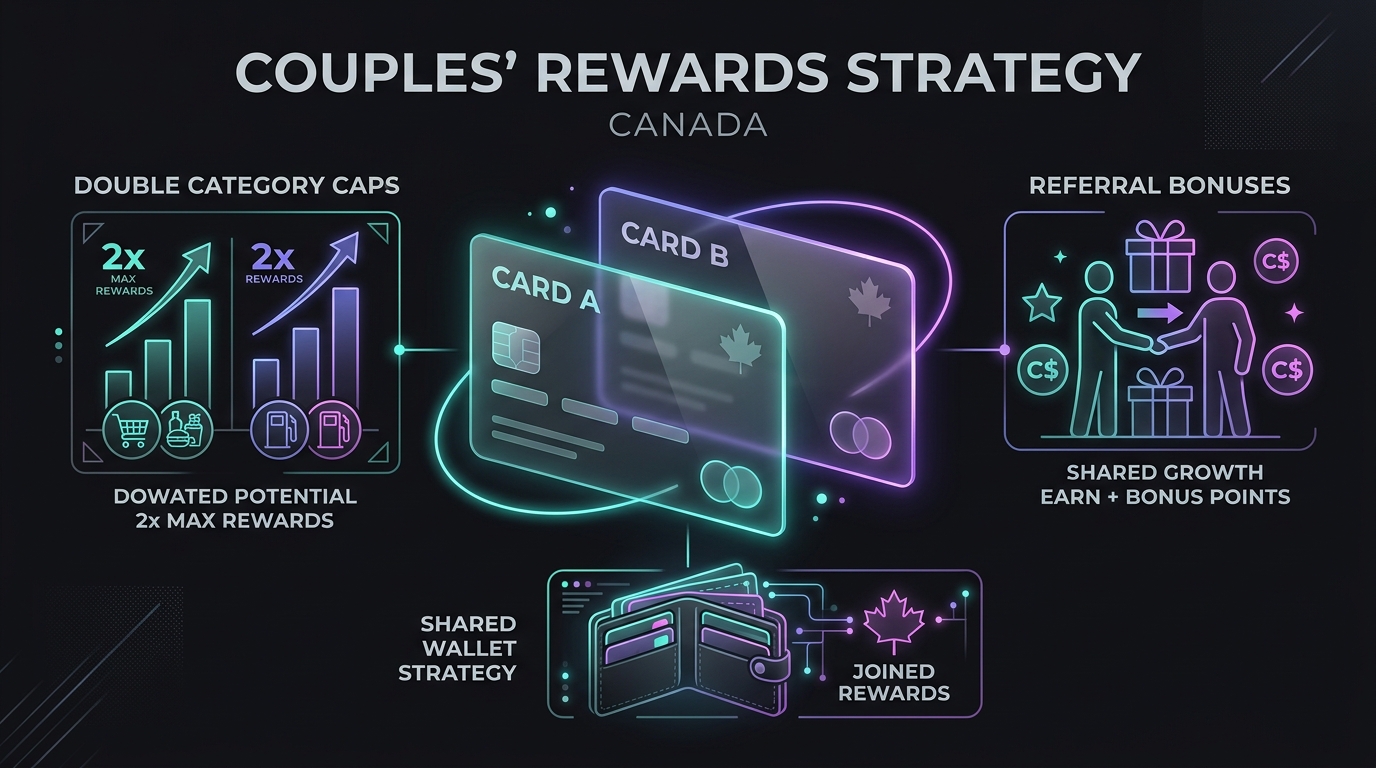
When couples decide to merge their finances, the default move is usually to streamline: one partner opens a credit card account, and the other is added as an "Authorized User" (or supplementary cardholder). While this is convenient for tracking expenses, it is mathematically inefficient. Sharing a single credit card account means you are throwing hundreds of dollars in rewards on the table every year.
In credit card rewards optimization, executing a "two-player strategy" is a massive multiplier. By coordinating card applications and holdings, a couple can double their category spending caps, capture multiple welcome bonuses, and refer each other for extra points. In this guide, we break down the economics of building a joint credit card portfolio in Canada.
Authorized User vs. Two-Player Setup: The Cost of Convenience
When you add your partner as an Authorized User (AU) on your credit card:
- You share a single category cap: Premium credit cards impose annual spending limits on high-multiplier categories (e.g., the Amex Cobalt limits 5x points to $30,000 annually). If you both swipe cards linked to the same account, you hit that cap twice as fast.
- You miss welcome bonuses: Authorized users do not receive sign-up bonuses. If you open separate primary accounts, you both qualify for welcome offers.
- No referral bonuses: You cannot refer an authorized user. But you can refer a partner to open their own account, earning thousands of referral points.
The table below outlines the net reward difference for a couple spending $3,500 monthly ($42,000 annually) on groceries and dining using the **American Express Cobalt Card** (5x eats & drinks category):
| Setup | Annual Spend | Eats & Drinks Cap | Points Earned (at 1 cent/pt) | Welcome & Referral Bonuses | Total Annual Reward Value |
|---|---|---|---|---|---|
| Authorized User Setup (1 Account) | $42,000 | $30,000 | 162,000 pts ($1,620) | 30,000 pts ($300) | $1,920 |
| Two-Player Setup (2 Accounts) | $42,000 | $60,000 (Combined) | 210,000 pts ($2,100) | 70,000 pts ($700) | $2,800 |
By simply holding separate primary cards, the couple earns **an extra $880 in value** in the first year alone on the exact same grocery bills. This easily offsets the second card's monthly fee of $12.99 ($155.88 annually).
Step 1: Player-to-Player (P2P) Referral Loops
The first rule of a couples rewards strategy is to never apply for a credit card directly if your partner already has it. You should leverage player-to-player referral links. Here is how to execute a referral loop:
- Player 1 applies for a card (e.g., the Amex Cobalt or Scotiabank Gold American Express) and earns the initial welcome bonus.
- Once approved, Player 1 generates a referral link from their online banking portal.
- Player 2 applies for the card using Player 1's referral link.
- The Double Earn: Player 1 receives a referral bonus (often 5,000 to 10,000 points), and Player 2 gets the standard (or sometimes boosted) welcome bonus.
Step 2: Designing Your Portfolio
A couple does not necessarily need two of every card. A successful portfolio divides the roles between partners to cover spending categories without overlapping annual fees. Here are two highly effective couples strategies:
Strategy A: The Cross-Supplementary Setup (Maximum Coverage)
If you want to maximize multiple categories but keep annual fees low, you can hold different primary cards and add each other as authorized users on those cards. For example:
- Partner A opens a primary account for the **Amex Cobalt** (5x eats & drinks) and gets a supplementary card for Partner B.
- Partner B opens a primary account for the **Scotiabank Momentum Visa Infinite** (4% recurring bills, 4% groceries at Sobeys/Safeway) and gets a supplementary card for Partner A.
- The Wallet: Both partners carry one Cobalt and one Momentum card. They use the Cobalt for restaurants and dining, and the Momentum for recurring bills and Sobeys. They cover every major multiplier category with only one annual fee per card type.
Strategy B: The Double-Primary Setup (For High Spenders)
If your combined household spend exceeds the category limits of a single card, you should both hold primary accounts of the **same** card. For example, if you spend over $2,500 monthly on groceries and dining, you should both hold primary Amex Cobalt cards. This doubles your combined annual 5x cap to $60,000.
Step 3: Staggering Welcome Bonuses
To meet minimum spend requirements for welcome bonuses without stretching your budget, you should stagger your applications. If a card requires $3,000 of spending in three months, do not apply for two at the same time. Instead:
- Partner A applies for Card 1. Shift all household spending (groceries, insurance, utilities, rent) to Card 1 to hit the minimum spend.
- Once the bonus is secured (usually in month 3), Partner A refers Partner B to Card 1, or Partner B applies for Card 2. Shift spending to the new card.
- This allows you to constantly earn welcome bonuses throughout the year using your everyday bills. Refer to our Rent Payment Guide to see how to use rent to meet these targets easily.
Important Guardrails
1. Credit Score Impact
Applying for a new credit card triggers a "hard inquiry" on your credit file, which temporarily dips your credit score by a few points. Staggering applications by 3 to 6 months gives your credit score time to recover. Additionally, both partners must maintain good credit habits (paying statement balances in full every month) to qualify for premium cards. Check our guide on Auto-Paying Bills to avoid late payments.
2. Tracking Caps Collaboratively
Holding two primary accounts means you have to monitor two separate category caps. If Partner A hits their $30,000 cap in September, they must start using Partner B's card for grocery purchases. Using an algorithmic optimizer like Wallet Fit helps by automatically tracking your caps and recommending which card to swipe based on your active balances and remaining category limits. For more on cap tracking, read Beating Spending Caps.
Summary: How to Start Tonight
- Calculate your household's total monthly spending by category (Groceries, Dining, Recurring Bills, Transit).
- Identify if you are currently hitting any category caps on your existing cards.
- If you spend heavily on food or travel, have one partner refer the other to open a separate primary account instead of adding an authorized user.
Frequently Asked Questions
Why should couples use a two-player credit card strategy instead of just adding an authorized user?
While adding an authorized user is convenient, a two-player strategy (where both partners open separate primary accounts) allows couples to double their category spending caps, capture multiple welcome bonuses, and earn referral points.
What is a player-to-player referral loop in credit card strategy?
A referral loop is when one partner opens a credit card and then generates a referral link to invite the other partner. The first partner earns a referral bonus, while the second partner still gets the standard welcome bonus.
How can couples maximize different spending categories without paying too many annual fees?
Couples can use a cross-supplementary setup, where each partner opens a different primary card (e.g., one for groceries, one for recurring bills) and adds the other as an authorized user. This covers all categories while minimizing annual fees.
How does WalletFit help couples coordinate their credit card strategies?
WalletFit automatically tracks category caps across both partners' accounts and recommends which card to swipe at checkout, helping you avoid missing out on rewards when one partner hits their limit on a Canadian credit card.
Maximize Your Rewards with WalletFit
Never guess which card to swipe. WalletFit optimizes your rewards in real time, tracks spending caps, and alerts you before statement credits expire.