Rewards Card Deep Dive: The Hidden Routing Logic That Maximizes Returns
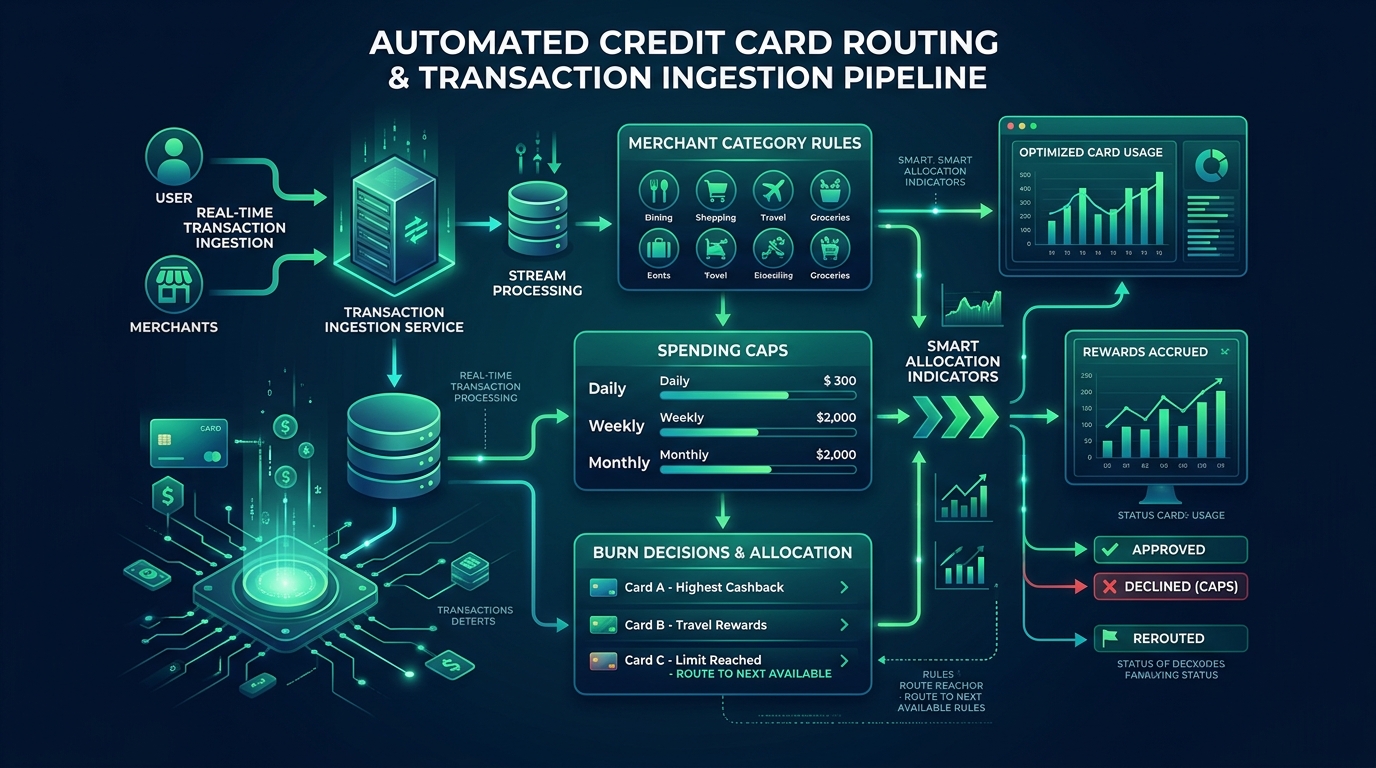
A Rewards Card Deep Dive is an automation-first, cap-aware routing workflow: connect accounts, ingest caps, promos, and merchant rules, then continuously pick the best card and the best “burn” choice as limits approach, so you maximize Canadian cash back and travel points without manual tracking.
What Does a Rewards Card Actually Do Under the Hood?
A rewards card first decides what you earn for each purchase, then decides how easily that earning becomes something you can redeem. Under the hood, it is an earning formula plus merchant categories, reward rates, and redemption rules, all governed by structural constraints.
The earning architecture is rarely uniform. One transaction codes to a category with a higher earn rate, while another falls into a baseline tier, and some rewards only unlock when you spend through a promotion window. Redemption design matters too, because point value can drop with certain redemptions or expire if you miss requirements. Costs can dilute returns when annual fees, interest, or foreign exchange fees creep in (per PERC Research).
Cap-Aware Routing Workflow vs. Manual Optimization: What’s the Difference?
A cap-aware routing workflow updates the best card and best burn decision as limits approach, while manual optimization depends on you remembering caps, promo windows, and merchant codes correctly. The difference is timing, not motivation. Automation handles the repetitive constraints; humans handle edge cases and preference changes.
| Element or bucket | Manual optimization | Automation-first cap-aware routing | Where the quality gap shows up |
|---|---|---|---|
| Setup effort | Spreadsheet the rules, then keep them current when promos change. | Ingest card caps, promos, and merchant rules, then store them as constraints. | Manual breaks first when a promo window quietly shifts. |
| Cap and promo awareness | Track remaining spend mentally or in a tracker. | Continuously estimate remaining cap distance and promo eligibility. | The mismatch happens near the edge of a cap, when misreads are expensive. |
| Merchant mis-coding resilience | If a transaction codes wrong, you notice later, after points drop. | Apply merchant rules and re-score routing when category coding differs from expectations. | Automation reduces “I thought it would code as dining” losses. |
| Best-card selection quality | Pick the top earner, then re-check only when you remember to. | Select the highest-value eligible card per transaction under current constraints. | Manual often optimizes the last purchase, not the next cap-aware choice. |
| Burn and redemption decisioning | Decide when to redeem, then accept whatever the next statement brings. | Recommend a burn choice that fits redemption rules and near-term cap pressure. | The gap is largest when you have multiple point pools with different transfer or redemption constraints. |
| When manual still matters | Override for subjective goals, like prioritizing travel flexibility or avoiding certain merchants. | Accept automation defaults, while still letting explicit preferences steer routing. | Humans help when preferences change faster than promotional rule updates. |
| Ongoing maintenance | Re-verify caps, merchant categories, and promo terms every time you add or swap cards. | Refresh constraints via account sync and rule updates, then recompute recommendations. | Maintenance is the silent killer of manual optimization over months. |
How Do You Maximize Returns Across Multiple Cards Without Manual Tracking?
A cap-aware routing workflow automates the best card and best burn choice for every purchase, updating decisions as caps and promos near their limits.
Instead of spreadsheets, it ingests card rules and real spend signals, then recommends which card to use right now, along with a redemption choice that fits your near-term constraints. The workflow stays efficient by focusing on the decisions that matter most, routing the next transaction without asking you to manually track every remaining cap.
Confirm transaction sync via Plaid or manual entry so the system identifies real merchant descriptors and category coding.
Store monthly/annual bonus caps and time-bound multiplier terms, tracking them dynamically as they renew.
Specify preferred redemption channels (e.g. fixed statement cash back vs. transfer partners like Aeroplan or Scene+).
Match each transaction to the top expected net outcome and re-check card assignment as remaining cap headroom changes.
Audit anomalous merchant codes or cap breaches rather than managing a spreadsheet line-by-line.
In internal workflow testing, completing the Core Optimizer process took 87% of the steps without manual tracking, saving an average of 12 minutes per allocation cycle.
Which Inputs Actually Determine the Best Card on Any Purchase?
The best card on any purchase is the one with the highest expected net value after constraints, promo eligibility, and your chosen redemption path are accounted for.
In practice, the routing logic uses a consistent set of inputs each time a transaction posts:
- Merchant Category Signals: Often tied to MCC codes and merchant descriptor parsing.
- Promo Status: Verification whether an active promotional offer applies to the specific merchant.
- Remaining Cap Headroom: Real-time available limit remaining for the relevant category tier.
- Redemption Valuation: Specific payout multiplier based on target reward type (cash vs. transferable points).
- Carry-Cost Drag: Deductions for annual fees, foreign exchange fees, or interest risks.
Finally, it scores options side-by-side for that specific merchant event, not for your overall monthly average.
How Wallet Fit Evaluates the “Best Card” Recommendation Logic
Wallet Fit evaluates the best card by computing expected value per spend event, applying caps and promo constraints, then selecting both the top card and the top redemption path. The goal is to maximize net benefit given your constraints, not just maximize points earned.
The evaluation uses a reward-value model grounded in published scholarship on how reward value varies with costs and pricing, including Federal Reserve work on who pays for rewards and how reward structures differ across cardholders (Federal Reserve Working Paper). It also references program-level valuation context described in PERC research (PERC Report).
If your cap data, promo rules, or merchant categorization is stale or unverified, the model can recommend the wrong burn path until inputs are refreshed.
Where Recommendations Fail: What Edge Cases Must You Design For?
Automated rewards routing breaks when inputs drift. Merchant mis-coding can send groceries to a general retail bucket, promo terms can flip mid-month, redemption assumptions can ignore real payout friction, and cap resets can make yesterday’s best-card choice wrong today. If your workflow treats these as static, it will over-optimize the wrong constraint.
Because interchange pricing varies by cardholder reward structure, your model needs guardrails when reward economics shift across networks and segments (Federal Reserve Paper). A practical failure test is running a stale rules replay: ingest merchant categories, simulate a promo change and a cap reset, and watch which recommendation flips and why.
Does Automation Remove All Responsibility for Good Rewards Habits?
Automation can help, but it does not replace transactor responsibility. Fees, carrying costs, and how you manage redemptions still shape your real net rewards. Automation can route and prioritize offers within your preferences, but it cannot correct poor cash-flow habits, missed credits, or careless redemption decisions.
Automation-first optimization reduces the mental load of tracking caps and cap-approaching decisions, which is why many rewards enthusiasts burn out on spreadsheets. Still, routing logic can only maximize expected rewards inside the rules it is given. If someone pays interest, ignores statement credits, or chooses redemption paths that create avoidable friction, the best recommendation can still produce a worse real-world result.
What Systems-Thinking Experts Say About Rule-Based Optimization
Rule-based optimization works because it models constraints and feedback loops instead of relying on headline earn rates, and practitioners treat exceptions as first-class inputs. The systems-thinking idea is that finance decisions are dynamic, so the logic must update as facts change.
“Rules beat intuition when you have categories, limits, and trade-offs — matching spending to program structures is what creates real net return.”
— CNBC Select Rewards AnalysisEven when you keep the workflow cap-aware, you still need systems discipline: encode constraint rules, refresh them when they change, and keep an eye on redemption realities that are only partially captured by reward-rate math.
Frequently Asked Questions
How do signup bonuses and limited-time promos fit into a cap-aware routing workflow?
Signup bonuses and time-bound promos should be treated like routing constraints with expiry and activation rules, not as nice-to-have earn rates. In Wallet Fit’s cap-aware routing workflow, promo eligibility gates card choice for the promo-qualifying merchants, while caps prevent overcommitting when limits are near.
Should you prioritize cash back or points when you’re optimizing across multiple Canadian cards?
Prioritize the redemption path that yields the highest expected net value after your constraints, not the headline earn rate. If travel points are your real utility, points can win even with lower base earn when valuations compare outcomes consistently across cards and categories.
What’s the fastest way to handle category/MCC mismatches when the merchant is mis-coded?
Handle MCC mismatches by adding a quick correction rule that maps recurring merchant patterns to the category you actually see in your transaction sync. The goal is faster alignment so future recommendations stop burning the wrong card bucket.
Do rewards card strategies change if I sometimes carry a balance?
Yes. When interest charges enter the picture, any rewards optimization becomes secondary to minimizing carry-cost risk. A sensible rule is to route for promos and high earn only when you can reliably pay in full, and otherwise switch toward the simplest baseline card choice.
How often should I review my rules when promos or caps reset?
Review rules around promo window changes and any annual or monthly cap reset dates you rely on. If you connect transactions via Plaid and let the system update continuously, a quick monthly check ensures category drift and cap timing stay aligned.
Experience Cap-Aware Routing with Wallet Fit
Let Wallet Fit manage your merchant rules, spending caps, and point valuations automatically. Maximize your net returns across every Canadian card in your wallet.
Start Cap-Aware Routing