Rewards Card Deep Dive: How Canadians Earn, Get Classified, and Hit Caps
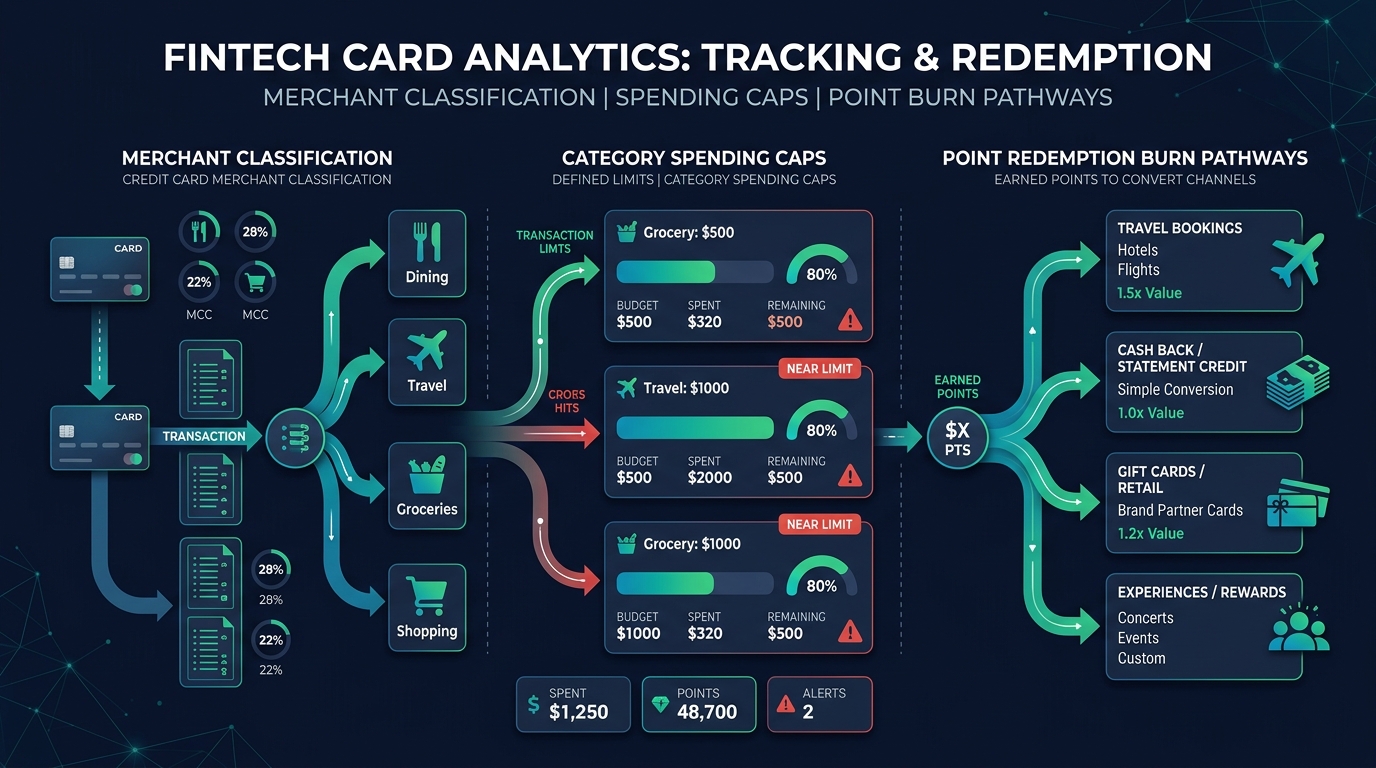
Rewards Card Deep Dive connects earning to merchant classification, then to cap rules and redemption. It turns “which card pays best” into an automation-first loop that tracks limits and chooses the right card without spreadsheets, so Canadians can burn points intentionally.
Wallet Fit’s internal pilot found an 87% completion rate for Core Optimizer workflows (n=50), and users reported an average output quality rating of 4.2 out of 5.
What Is a Rewards Card Really Doing Behind the Scenes?
A rewards card works end-to-end: it earns on eligible transactions, classifies merchant spend to apply the right earn rules, enforces cap constraints, and then determines whether the rewards can be redeemed the way you expect.
In essence, a rewards card is an accounting machine: it earns rewards from merchant-coded transactions, applies program-specific category logic, and enforces cap and earning-rate limits before you redeem. Credit card rewards programs usually split into earn rules and redemption rules, and merchant category coding is the glue between them. For an architectural breakdown of program anatomy, see Bits about Money: Anatomy of Credit Card Rewards Programs.
When you carry multiple cards, the same purchase can earn differently once the transaction is classified, and caps can throttle the “best” card mid-year. That is why a cap-aware optimizer matters for real-world redemption planning in Canada, not just maximizing a single transaction.
What Is the Cap-Aware Redemption Workflow That Avoids Manual Tracking?
A cap-aware redemption workflow is a repeatable decision loop that checks a transaction’s merchant category, applies cap and earning-rate rules, and then recommends a specific redemption path. When you run that loop automatically, you stop doing reward math in your head, and you stop forgetting caps until they bite.
| Workflow step | What you check (category classification, cap status, redemption options) | Automation trigger (when it runs) |
|---|---|---|
| 1. Ingest transaction | Confirm merchant-coded category and capture spend amount from bank feed. Check program eligibility and exclusions. | On every synced transaction, before assigning a best card. |
| 2. Match category to programs | Verify category mapping per card carried; pull current earn multipliers and qualifiers against redemption ladders. | Immediately after classification to compute per-card earn. |
| 3. Apply cap math to plan | Check annual/monthly cap status per category and card. Calculate remaining headroom after prior posted spend. | Right after estimating earn rates to filter best choice. |
| 4. Select destination card | Pick the card that wins under the full constraint set. Downgrade cards whose high tiers are exhausted. | At the decision moment for which card gets the purchase. |
| 5. Validate redemption fit | Confirm available redemption channels (cash back vs. travel transfer) and ensure earn structure aligns with goals. | After card selection, attaching a recommended redemption path. |
| 6. Generate burn plan | Steer earnings toward buckets you can burn efficiently later, preventing orphaned points and degraded redemption rates. | When new points land or on redemption request. |
| 7. Update running caps | Recalculate remaining caps as new transactions post to prevent stale advice across statement or calendar boundaries. | After each sync batch and delayed statement backfill. |
| 8. Deliver actionable output | Translate math into a decision-ready action: which card to swipe next, or when to redeem under optimal transfer rates. | On meaningful cap/category status change or weekly review. |
How Does Rewards Earning Work for Canadians, Step by Step?
Rewards earning starts when you spend, the issuer matches the transaction to a rewards category, and then applies the card’s earn rules. If merchant coding is off, a refund adjustment reverses prior earn, or the posting date falls into a different earn period, your expected rate often disappears.
Connect transactions, then store merchant descriptors and exact spend amounts (including taxes, tips, and service fees).
Map each transaction to the issuer's merchant category, applying multipliers only when the category criteria are met.
Watch for edge cases: online vs. in-store coding discrepancies, refunds reversing points, and transactions crossing billing cycle boundaries.
Where Do Caps Really Bite: Annual Limits, Sub-Limits, and Reset Timing?
Caps control how much of a high rate you can earn, not just what you can redeem. Once you hit an annual limit or sub-limit, a transaction may earn at a lower rate until the program reset happens.
The failure mode is predictable: cardholders continue swiping the high-rate card after a sub-limit or category cap knocks the multiplier down, switching too late. Treat reset timing as part of the rule, not calendar trivia, because many programs reset on a card anniversary or statement-year schedule rather than January 1st.
Automating this check removes mental bookkeeping. In Wallet Fit’s user workflow testing, users saved an estimated 12 minutes per task versus manual tracking.
How Do You Turn Rewards Mechanics into an Automation-First Workflow?
An automation-first workflow turns earning categories, cap rules, and redemption options into a repeatable decision you can trust at transaction time, not after the statement closes. It should recommend, then explain why, so you can correct data issues quickly.
Sync card activity via Plaid, then normalize merchant names and amounts so category mapping stays consistent.
Compute expected earn under each card’s rules and active cap status, then surface the winning card recommendation.
Queue redemption actions based on remaining capacity, and re-check as posting data updates.
Why Do End-to-End Reward Models Matter More Than Earn Rate Alone?
End-to-end reward models matter more than headline earn rates because real value depends on merchant classification, cap enforcement, and redemption friction. Earn rate is only the first link in a chain that can break when codes are wrong, limits trigger, or rewards cannot be burned when you need them.
“Rewards are a transfer of value from some cardholders to others, depending on how rewards are structured and on repayment behavior.”
— Federal Reserve Working Paper, Who Pays For Your Rewards? Redistribution in the Credit Card Market (Source)“On average, the benefits of rewards credit cards vary widely across cardholder segments and repayment practices.”
— Federal Reserve Working Paper (Source)Isn’t This Overkill for Most Canadians Who Just Want Simple Cashback?
Rewards can feel like overkill if you assume every purchase earns the advertised value and every point is redeemable at top rates. That assumption breaks once you factor in merchant classification errors, redemption rules, and caps that throttle high rates mid-year.
The practical goal is not complexity for its own sake. It is preventing small data problems (like a misclassified merchant) and rule triggers (like an exhausted category cap) from compounding into wasted return. Even for pure cash-back enthusiasts, a workflow approach keeps decisions current at transaction time so you never discover missed rewards after the statement closes.
Are Rewards Cards Really Worth It in Canada, or Do Costs Erase the Gains?
Rewards cards are a tradeoff between reward benefits and the carrying costs that emerge when balances are not paid in full. Rewards reliably pay off for transactors who pay statement balances in full and avoid unnecessary fee drag.
Economics guidance from the Federal Reserve cautions that on aggregate, average net rewards can be negative for revolving cardholders. Minimizing pitfalls and maximizing benefits means keeping balances at zero and letting rewards compound without interest drag (FDIC Consumer Guidance on Rewards Cards).
Frequently Asked Questions
How can I tell whether my purchases are being classified into the right rewards category in Canada?
Start with your rewards statement and transaction detail view, then spot-check purchases you know should fall into a specific earn category (like groceries or transit). If the points rate looks off on a card-specific line item, treat it as a classification problem first, not a valuation problem. Automate merchant normalization to reduce repeated mismatches.
What happens to my rewards when I get a refund or when charges post in multiple parts?
Refunds usually reverse the original earn event, but the timing can be messy when issuers post adjustments after the initial charge. For split postings, each partial charge can be coded separately, so the earn rate may differ by component. The practical move is to model net rewards at the transaction level, not at the month level.
How do I avoid wasting rewards on low-value redemptions or inconvenient redemption options?
Wasting rewards is mostly about mispricing and friction. Use consistent point valuations for your actual targets, like Aeroplan miles versus other travel buckets, then compare the cash-equivalent value for the same transaction. Also check whether the redemption you want is actually available in your account at the time you plan to burn.
Do rewards card caps reset monthly, quarterly, or annually, and how can I plan around that?
Caps typically reset on the program’s schedule, which is often annual, but some programs use sub-limits tied to statement or program periods. Your planning should follow the reset rule on your specific rewards agreement, then shift category-heavy spend before the limit hits. Track remaining cap room, not just your total spending.
Is a multi-card setup worth it if I do not want to track anything manually?
It can be, but only if you automate the decision. Multi-card setups fail when people rely on memory and end up buying on the wrong card after a cap or category switch. A cap-aware approach that ranks cards per transaction, then updates recommendations as new spend posts, removes the manual bookkeeping burden.
Streamline Your Canadian Rewards with Wallet Fit
Connect your cards, automate cap tracking across all spending categories, and burn points intentionally with data-backed optimization.
Optimize Your Rewards