Rewards Card Deep Dive: How Earning Architecture Works
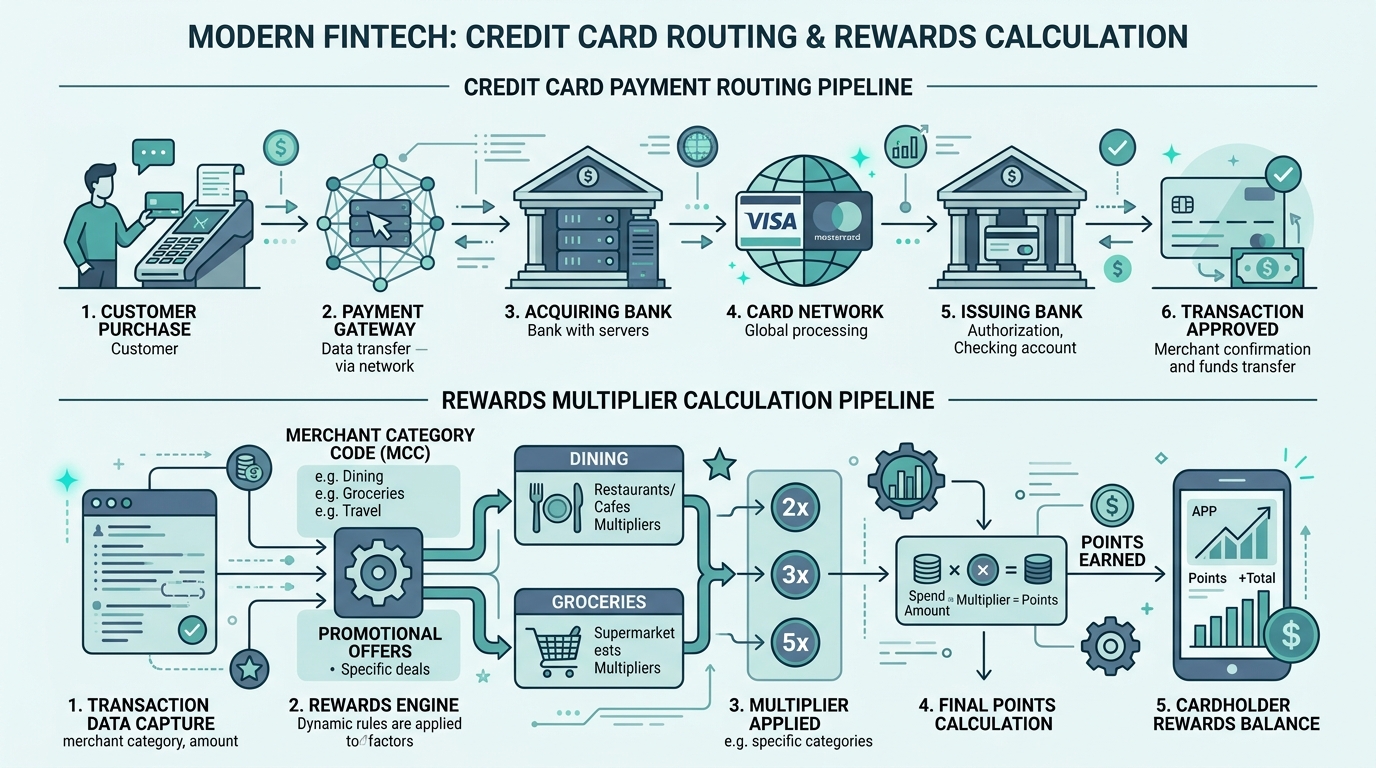
Rewards Card Deep Dive is the behind-the-scenes view of credit card rewards, not the marketing promise. It maps how card networks, merchant category matching, third parties, and redemption rules translate your swipe into points. Once you see that earning architecture, you stop guessing which card pays best.
What’s Actually Happening From Swipe to Points?
A swipe becomes points through an end-to-end pipeline: authorization, merchant data capture, earning rule matching, then reward posting. The surprises happen when the merchant-side data, routing, or participation does not match what your card issuer expects for the earning category.
First, your card gets authorized, but the issuer’s “earning decision” depends on what merchant data is later delivered, like merchant category codes (MCCs) and billing descriptors. Then third-party participation can reshape the path, so two “same vibe” merchants can land in different program buckets. Finally, reward posting reflects the issuer’s rules plus any redemption constraints, so points can arrive with different categorization than you expected.
For a market-level baseline on how rewards value is redistributed, the Federal Reserve offers a useful frame: Who Pays For Your Rewards? Redistribution in the Credit Card Market. And if you want a concrete picture of how rewards structures differ in practice, Cards & FTW’s overview helps ground the logic: Deep Dive on Rewards Structures.
Rewards Card Deep Dive: What’s the “Earning Architecture” Behind Rewards in Canada?
Rewards Card Deep Dive in Canada boils down to three core mechanics: category or MCC matching, third-party program participation, and redemption routing. When any piece shifts, two merchants with the same “vibe” can pay you differently for the exact same purchase.
- Category or MCC matching is the first gate, but it is only as accurate as the merchant data that flows after authorization.
- Third-party participation is the second gate, because some rewards economics route through partner layers before the issuer credits you.
- Redemption routing is the last gate; it decides what real value your points actually have once you redeem, not what they promise on the statement.
Which Mechanic Should You Prioritize When Rewards Don’t Match the Offer?
If expected rewards do not show up, start with the mechanic that is most likely to change based on what the merchant actually sends later. Usually, that means routing or capture (including merchant descriptors and category mapping), then third-party eligibility, then redemption constraints.
| Rewards mismatch triage (which mechanic to check first) | What to verify first (in practice) | Most likely cause you’re hunting | What to do next |
|---|---|---|---|
| Bonus didn’t post after a “bonus eligible” purchase | Compare the merchant’s exact descriptor line on your statement to the merchant you thought you paid | Category or MCC matching gate is failing due to descriptor or data capture differences between merchants that feel similar | Make the merchant match explicit in your tracking, then retest one merchant at a time with the same card |
| “Same vibe” merchant, different earn rate | Check whether the merchant participates through a third-party layer that changes earning treatment | Third-party participation is reshaping the economics before they reach your issuer | Test with one card for the same merchant on two different days, then keep only the merchants whose earn pattern stays consistent |
| Cash back posted, travel points did not | Review redemption routing constraints tied to the reward type you expected | Redemption routing sends the purchase down a different rewards path than you assumed | Switch the card you use for that merchant, or switch the rewards “bucket” you target (cash vs travel) for similar purchases |
| Bonus shows on one channel, not another (online vs in-store) | Inspect how the merchant codes show up by channel, not just by merchant name | Category mapping shifts because the merchant data payload changes by channel | Route spend by channel for a week, then lock a rule for that channel only |
| You see a cap warning, then the rate changes later in the year | Verify whether your purchase crosses a cap or rule threshold that changes which earn tier applies | Cap-aware earning architecture changes the recommendation after the annual limit is hit | Keep purchases inside or outside the cap intentionally, and treat the year-to-date boundary as a decision point |
| Points posted, but not where your rewards “strategy” expected | Confirm the merchant category and any partner layer that might affect earning destination | Category mapping plus third-party participation did not match your model | Reconcile the merchant in your system, then rerun the strategy for future purchases of that same merchant type |
Don’t overcorrect by swapping cards multiple times in one day. Instead, pick one mechanic from the table, run a controlled retest, and only change the variable tied to that mechanic.
How Do Rewards Programs Decide Which Spend Counts for Extra Earn?
Rewards programs count spend for extra earn by mapping what a merchant reports (category/MCC and descriptors) to issuer rules. When a merchant is ambiguous, the mapping can land in a nearby category or miss the bonus trigger, so two purchases with the same vibe can post differently.
Wineries are a common example. Some locations code as wineries, others code under broader “entertainment” or “specialty retail” categories depending on how the merchant payment terminal is configured. So if your “wine bar” transaction posts like a general retail shop rather than a restaurant, your expected bonus category can fail even when you swiped at the same venue.
Networks and issuers understand this mismatch risk. For an overview of how card market economics redistribute rewards, see the Federal Reserve research paper. For a Canadian-friendly rewards structure rundown, consult Kiplinger’s rewards primer.
How Should You Route Spend to Beat Caps Without Wasting High-Value Points?
Route spend by testing what actually posts, then directing each category to the best earning path you still have “headroom” for under your caps. Treat bonuses and redemptions as separate constraints, because a category win can still lose value later if the redemption design does not fit your plan.
List each card’s bonus category limits and any exclusions, then remember caps reset on their own schedule (calendar month, card anniversary, or calendar year).
For places like wineries, bars, or boutique fitness, route based on past posting outcomes, not storefront reviews or intuition.
If travel points or elevated multipliers are your target, aim purchases there first while multiplier headroom is open.
Once premium categories are saturated, shift to the next-best earn path you can sustain month to month.
In practice, the goal is not perfect forecasting—it is reducing surprises from routing decisions. For many people, that means keeping an eye on what posts, not just what you intended to buy.
How We Validate the Earning Architecture Behind Rewards Optimization
We validate the earning architecture by comparing expected category eligibility against what posts after authorization, then checking whether redemption constraints change the outcome. The evaluation uses publicly described rewards mechanics plus measured routing behaviors, and it cross-checks category history against reward structure references.
Criteria include whether a merchant’s category mapping triggers issuer bonus rules, whether third-party participation affects the earning pathway, and whether redemption routing yields the expected value outcome. Key reference sources include:
- Federal Reserve Study for market-level reward allocation context and interchange mechanics.
- PERC’s rewards value framing analysis for redemption economics and value delivery.
Merchant category coding can change without warning (for example, after a merchant upgrades POS hardware or reconfigures payment processors), so any model is only as fresh as the latest observed posting patterns.
What Do Issuer and Merchant Routing Rules Imply for Real Canadian Statements?
Issuer and merchant routing rules explain why “the same vibe” can underpost bonuses, why some purchases behave like partner-driven deals, and why redemption value can shift even after points post. Financial practitioners treat merchant data capture and redemption pathways as the real knobs behind the statement line.
“Credit card rewards are not fixed, they depend on the structure of the market and agreements between issuers, networks, and merchants.”
— Federal Reserve, Who Pays For Your Rewards? Redistribution in the Credit Card Market (Source)“So the next step is to check your issuer app or online account for your card’s rewards categories and any merchants that earn differently than expected.”
— Kiplinger, How to Make the Most Of Your Credit Card Rewards in 2025 (Source)In practice, a winery-coded transaction can drift into a nearby category if the merchant sends different descriptors, so the bonus gate fails at capture. When rewards economics route through third-party participation, two merchants that look identical in your feed can behave like different participants.
Is “Earning Architecture” Overkill for Most Cardholders?
Earning architecture can feel like overkill because most cardholders only need baseline category hygiene and fee avoidance. The real value shows up when you have multiple cards, recurring spend at “ambiguous” merchants, or tight annual caps.
Kiplinger’s consumer guidance frames rewards value around staying disciplined with spend and interest costs (Kiplinger Rewards Guide). Still, routing mechanics matter most when your statement line keeps contradicting the category you thought you were buying. A repeated pattern at wineries, bars, or boutique services is the tell, not occasional mis-posts.
So set-and-forget works for straightforward grocery and transit patterns, but routing awareness becomes worth the effort once your “same vibe” merchants keep posting differently.
Frequently Asked Questions
Do rewards cards earn the same way in Canada, or does merchant routing change everything?
Rewards cards do not earn the exact same way across Canada, because issuer rules match against what the merchant reports. Routing choices and how networks capture merchant data can shift transactions into different category outcomes. That is why two merchants with the “same vibe” can generate different bonuses on the statement.
Why do I get less (or no) bonus on a merchant I thought was in the category?
You usually get less bonus because the merchant’s reported category, often tied to descriptors and MCC mapping, does not trigger your issuer’s bonus rule. Some merchants are coded inconsistently by location or setup. In practice, the post-auth result matters more than the storefront label.
What’s the safest way to avoid losing value to caps, expirations, or poor redemption transfers?
The safest path is to treat caps and redemption paths as separate constraints, then build routing based on what actually posts. Keep a simple “headroom” view for annual bonus limits, and redeem high-value points on your preferred schedule. If a transfer partner is part of your plan, test one purchase first.
Are rewards card rewards still worth it if I carry a balance sometimes?
Carrying a balance usually destroys the math fast, because interest charges swamp most rewards earnings. If you sometimes revolve, focus on keeping balances at zero, using rewards as a bonus rather than a strategy. Otherwise, rewards strategy effort is mostly just making costly spending look optimized.
How can I maximize rewards without manually tracking every transaction?
Automate the part that is easy to forget: cap-aware recommendations that consider merchant categorization and third-party participation. Use a system to flag ambiguous merchants, keep your spending caps in view, and suggest the best earning card per transaction. The goal is fewer “oops” moments, not more spreadsheets.
Audit Your Earning Architecture with Wallet Fit
Connect your Canadian cards securely with Plaid or track manually. Discover missed multiplier bonuses, track category caps dynamically, and calculate your personalized Wallet Score.
Optimize Your Wallet