Rewards Card Deep Dive: The Hidden Rewards Anatomy That Determines Real Return
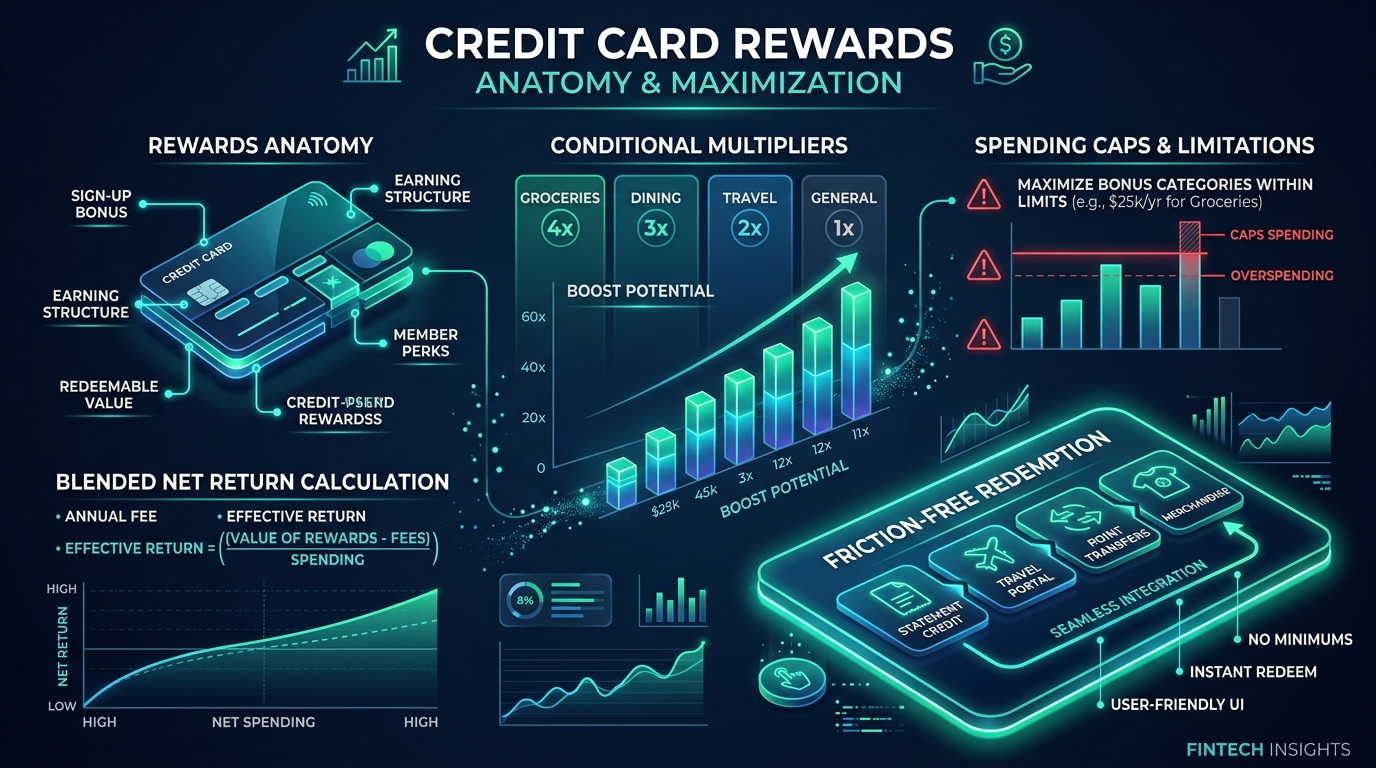
Rewards Card Deep Dive is the end-to-end way to calculate your blended return in Canada, not just the headline rate. It traces rewards anatomy from where points or cash back are earned (including conditional multipliers), to how they are capped, restricted, and finally redeemed, factoring in the practical friction that reduces net value.
What Does “Real Value” Mean in a Rewards Card Deep Dive for Canadians?
In a Rewards Card Deep Dive, “real value” means your net blended return—the rewards you actually earn and redeem after the program’s friction and drag. Headline percentages are marketing. You must adjust for caps, category limits, redemption difficulty, and transfer rules, because those factors drastically change value by cardholder type.
For Canadians, the “net” part is where spreadsheet habits break down. Caps, category eligibility, and redemption options interact, so the best card for groceries can be a worse card for travel points after constraints. In beta testing, Wallet Fit’s Core Optimizer output quality was rated 4.2 out of 5, reflecting that users want guidance that accounts for program constraints rather than a flat list of headline rates.
How Does the Rewards Program Anatomy Determine Your Blended Earning?
The rewards program anatomy determines blended earning by controlling when you actually get the advertised rewards units. Headline rates matter, but conditional rates only apply if you meet the issuer’s eligibility rules, and caps limit what “high earning” means over a calendar year.
Financial architect Patrick McKenzie explores rewards anatomy in detail, breaking it into earn rules and program structures: Bits about Money: Anatomy of a Credit Card Rewards Program.
So the real optimization question becomes: “Where do my spend patterns intersect with the issuer’s earn rules?” For example, a category multiplier might only apply to certain merchant codes, or bonuses might require enrollment. When those conditions are not met, your blended earning drops below the headline rate.
In one Savings Project experiment, reducing clicks and framing redemptions to savings as the default doubled the share of cardholders who redeemed into savings (Savings Project Case Study). That proves redemption design is part of earning too, because it determines whether rewards convert to real financial value.
How Do Cards Actually Structure Earning Categories, Bonuses, and Eligibility in Canada?
Category multipliers in Canada are only half the picture—the other half is eligibility. Issuers build earning paths with category definitions, conditional multipliers, rotating or targeted bonuses, and annual caps. Those rules decide which spend earns headline rates versus discounted baseline earning.
| Optimization lens | Likely pattern of fit | What to watch for when it fails |
|---|---|---|
| Transactor (paid in full) |
Earns rewards on everyday categories when consistently meeting merchant eligibility definitions. | If you pay interest, rewards math flips negative even when multipliers look strong. |
| Revolver (carries a balance) |
Conditional multipliers may still pay out, but effective value is erased by carry costs. | Interest and fees outweigh points, especially when high rates subsidize credit risk. |
| Mixed spending | Best results come from guardrails, not a single “always max” card. | Eligibility and caps mean the right card changes month to month; hero-month plans are fragile. |
| Simplicity-first | Clear, instant redemption pathways ensure points convert to cash without friction. | Complex transfer ladders and blackout windows create delays and unredeemed balances. |
| Alignment check | Works best when real merchant spend maps cleanly to the issuer’s category taxonomy. | If merchants switch POS terminals or MCC coding, blended earning drops unexpectedly. |
| Workflow strategy | Treat conditional multipliers as conditional, planning around what can be consistently executed. | Automate tracking to eliminate manual spreadsheet bookkeeping. |
Here is the core takeaway: cards structure earning categories like branching decision trees. First, the issuer checks whether your merchant fits its category definition. Then it checks whether the transaction qualifies for the multiplier. Finally, it checks whether an annual or monthly cap limits what you earn. If any branch fails, your headline category rate collapses to the baseline.
Federal Reserve research confirms that on aggregate, net outcomes vary drastically by user behavior (Federal Reserve Study: Who Pays For Your Rewards?). Eligibility and redemption friction are not footnotes—they are structural inputs to the return equation.
What Do Caps and Eligibility Rules Quietly Do to Your Effective Rate?
Caps and eligibility rules quietly lower your effective rate by limiting when the best earn rate actually applies. Even a 5% headline multiplier averages out lower if your spend exceeds caps or you miss conditions tied to merchant categories, card tier, or payment methods.
1. Category caps (e.g. $2,500/mo on Cobalt or $7,500/yr on Scotia Gold AMEX).
2. Per-transaction conditions (e.g. minimum spend thresholds or portal entry).
3. Merchant exclusions (e.g. wholesale clubs or non-qualifying supercentres).
Kiplinger’s guidance on rewards programs shows why making the most means matching your real purchases to issuer rules, not chasing generic multiplier charts (Kiplinger Rewards Guide).
How Does Redemption Friction Alter the Value of Points in Practice?
Redemption friction reduces your points’ real value by turning “earned rewards” into a harder-to-cash-out benefit. Minimum thresholds, multi-step transfer processes, seat blackout windows, and clumsy portal interfaces all add friction that converts planned value into downgraded value.
If a program requires specific thresholds before you can move points to travel partners, you may sit on a balance until it is “worth the hassle.” If transfers are complex, you either delay redemption or redeem at a lower cash-out rate. For a fundamental primer on card mechanics, see Investopedia’s Rewards Card Basics.
Step-by-Step: How to Maximize Rewards Without Manual Tracking in Canada
Maximizing rewards without spreadsheets comes down to building a repeatable loop: capture transactions, map them to the card’s earning architecture, and follow a guided redemption workflow.
Keep statement sync consistent via Plaid so category matches reflect real merchant descriptors and network acceptance.
Route purchases based on your actual merchant spend and the active rules and cap limits that apply.
Review card assignments so exceptions and fallback switches are clearly explained, not guessed.
For complex points transfers, use a guided workflow to ensure you capture peak value and avoid orphaned balances.
In Wallet Fit product benchmarks, the average time saved versus a manual workflow was 12 minutes per task, driven entirely by eliminating manual tracking.
Are Rewards Cards Worth It for Canadians, or Only for Certain Spending Styles?
Rewards cards are worth it for Canadians who reliably pay statement balances in full, but they can quietly lose money for cardholders who revolve balances.
| Spending style | Likely outcome | Why it happens |
|---|---|---|
| Transactor (paid in full) | Net-positive | Points and cash back outweigh carry costs; rewards compound without interest drag. |
| Revolver (carries balance) | Net-negative | High interest rates (19.99%–24.99%) immediately overwhelm 2%–5% reward gains. |
| Mixed month-to-month | Variable / Guardrailed | Requires strict guardrails to prevent accidental interest charges from erasing months of points. |
When “Blended Maxing” Backfires, and What Should You Do Instead?
Pursuing one single “blended” multiplier across every swipe backfires when caps, eligibility windows, and redemption friction break the math. The fix is narrower, purchase-driven planning: prioritize the card that wins net value per merchant, then reroute spending when you hit limits or terms.
Treat conditional multipliers as conditional, not guaranteed. Verify merchant categories before reshuffling strategies, and let automated cap tracking handle the switching logic.
Frequently Asked Questions
How do I calculate my blended rewards rate in Canada without tracking every purchase?
You do it by weighting each card’s earn rate using your real category mix, then applying the card’s cap and eligibility rules to those categories. Start with a category-level view from your statements, not per-transaction notes, then model “best card per category” outcomes instead of a daily spreadsheet.
Do rewards points have the same value as cash back when redeemed to different options?
No. Cash back is usually a flat, predictable value, while points value changes with how you redeem, for example travel partners versus statement credit. Redemption friction can also reduce effective value if you miss thresholds or take less efficient options, even when you earned the points.
How do caps and eligibility rules usually affect category multipliers?
Caps and eligibility rules shrink the time your multiplier is actually available. A high headline rate only matters up to the cap, and eligibility can require qualifying spend types, merchant coding, or account status. Once you cross those boundaries, the “effective” earn rate drops.
What redemption choices minimize friction and avoid undercutting the value of points?
Choose redemptions that match your goals without adding extra steps or waits, since friction is where plan value often disappears. Use options with fewer thresholds and clearer conversion paths when you want simplicity, and only switch to complicated travel redemptions when you can execute them reliably.
Are sign-up bonuses worth it if my spending categories do not match the promoted offers?
They can still be worth it, but only if your actual spend can meet the bonus requirements without forcing inefficient spending. If your categories rarely align with the promo’s intended spend, the bonus’s “effective value” often falls after you account for missed multipliers and redemption constraints.
What’s the biggest reason rewards cards feel “not worth it” even when I earn rewards?
Most people experience underwhelming returns when redemption friction, caps, and conditional multipliers break the simple “headline rate” story. Even if you earn points, the real blended outcome can drop when you redeem late, take lower-value options, or hit limits where the best earn rules stop applying.
Calculate Your Real Blended Return with Wallet Fit
Stop guessing your effective return. Connect your Canadian credit cards and let Wallet Fit model fees, caps, and redemption paths for maximum net return.
Calculate Your Real Return