US Credit Card Points Valuation Table 2026 (Amex MR, Chase UR, Capital One)
The definitive benchmark for valuing US credit card rewards. Compare baseline Cents-Per-Point (CPP) values, transfer partner multipliers, cash-back floors, and discover how to optimize every checkout transaction.
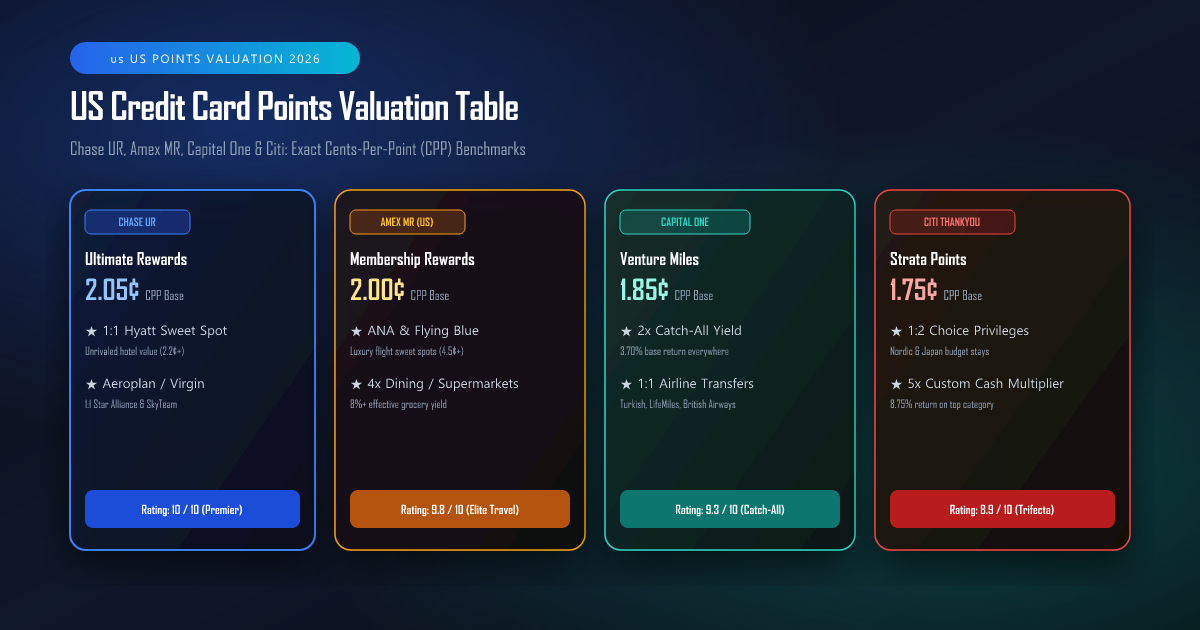
In 2026, not all points are worth 1 cent. Transferable travel currencies significantly outperform flat cash back: Bilt Rewards (2.10¢) and Chase Ultimate Rewards (2.05¢) lead the US market thanks to 1:1 World of Hyatt and Star Alliance transfers. American Express Membership Rewards (2.00¢) delivers elite flight sweet spots (ANA, Flying Blue, Virgin). Capital One Miles (1.85¢) pairs a 2x catch-all base with 1:1 international partners, while Citi ThankYou Points (1.75¢) shines with 1:2 Choice Privileges transfers. Flat cash back sits at a fixed 1.00¢ floor.
Why Point Multipliers Mean Nothing Without Cents-Per-Point (CPP)
Credit card issuers spend billions advertising eye-popping multipliers: "Earn 4x on Dining!", "5x on Custom Categories!", or "3% Everywhere!" However, comparing raw multipliers without knowing what those points are worth in real-world currency is the #1 mistake credit cardholders make.
Consider this mathematical comparison:
- Standard 3% Cash Back Card: Earns $3.00 per $100 spent (Fixed 1.00¢ CPP = 3.00% net return).
- Chase Sapphire Preferred (3x Dining): Earns 300 Chase UR points per $100 spent. Transferred 1:1 to World of Hyatt or Aeroplan at a 2.05¢ baseline valuation, that equals a 6.15% net return.
- American Express Gold Card (4x Dining): Earns 400 Amex MR points per $100 spent. Transferred to international airline sweet spots at a 2.00¢ valuation, that yields an 8.00% net return.
All three cards are held for restaurant spending, yet the Amex Gold generates more than double the dollar-for-dollar rewards value of the cash-back card. To make mathematically optimal decisions at checkout, you must calculate Multiplier × Cents-Per-Point (CPP).
The Mathematical Formula for Calculating Cents-Per-Point (CPP)
Whenever you evaluate whether to redeem points or pay cash for a flight, luxury hotel, or statement credit, use this universal valuation formula:
Real-World Example: Booking Hyatt Regency Maui (Hawaii)
Let's calculate the real CPP value when booking a luxury resort stay with Chase Ultimate Rewards points transferred 1:1 to World of Hyatt:
- Cash Retail Room Rate: $680.00 USD / night (including resort fees and taxes)
- World of Hyatt Award Cost: 25,000 Hyatt points / night ($0 resort fees on award nights)
- Net Dollar Value Captured: $680.00 USD
- CPP Calculation: ($680.00 ÷ 25,000) × 100 = 2.72¢ per point
Because 2.72¢ is well above our 2.05¢ Chase baseline, transferring Chase points to Hyatt produces exceptional value. If you had instead cashed out those 25,000 Chase points at 1.00¢ each, you would only receive $250—leaving $430 of real value on the table.
Master 2026 US Credit Card Points Valuation Table
Below is the complete, comprehensive reference benchmark for all major US credit card rewards currencies in 2026. These numbers are established through rigorous algorithmic analysis of award availability, transfer partner ratios, and historical cash redemption floors by WalletFit's research team.
| Reward Program / Currency | Tier | Baseline Valuation (CPP) | Aspirational Sweet Spot (CPP) | Best Redemption Pathway | Worst Trap to Avoid |
|---|---|---|---|---|---|
| Bilt Rewards | Tier S+ | 2.10¢ | 4.50¢+ | 1:1 World of Hyatt, Alaska Airlines, Rent Day 100% Transfer Bonuses | Amazon 1-Click Checkout (0.70¢) & Rent Credit (0.55¢) |
| Chase Ultimate Rewards (UR) | Tier S | 2.05¢ | 4.50¢+ | 1:1 World of Hyatt Stays, Air Canada Aeroplan, Virgin Atlantic | Statement Credits & Amazon Checkout (0.80¢ – 1.00¢) |
| Amex Membership Rewards (US) | Tier S | 2.00¢ | 5.00¢+ | 1:1 ANA First/Business Class, Flying Blue Promo Rewards, Avios | Statement Credits (0.60¢) & Amazon Shop with Points (0.70¢) |
| Capital One Miles | Tier A | 1.85¢ | 3.50¢+ | 1:1 Turkish Miles&Smiles (7.5k domestic/Hawaii), Avianca LifeMiles | Cash Back Statement Credits outside travel (0.50¢) |
| Citi ThankYou Points (TYP) | Tier A | 1.75¢ | 3.50¢+ | 1:2 Choice Privileges (Nordic/Japan hotels), Flying Blue, Avianca | Merchandise Catalog & Retail Gift Cards under face value |
| World of Hyatt Points | Tier S | 2.10¢ | 3.80¢+ | Category 1–8 Standard Award Nights (No Resort Fees on Awards) | Dining / Spa Incidentals folio cash-outs (1.00¢) |
| Marriott Bonvoy Points | Tier B | 0.80¢ | 1.40¢ | Stay 4 Nights, Get 5th Night Free award redemptions | Merchandise, Gift Cards, and Amazon 1-Click |
| Hilton Honors Points | Tier C | 0.55¢ | 1.00¢+ | 5th Night Free Award stays at luxury Waldorf Astoria / Conrad resorts | Amazon Checkout (0.20¢) & Non-hotel merchandise |
| Flat Cash Back (Wells Fargo, Discover, Apple) | Tier B | 1.00¢ | 1.00¢ (Fixed) | Direct Statement Credit or Bank Account Deposit | Letting rewards sit uninvested without earning yield |
Deep Dive: The Big 4 US Flexible Point Programs
1. Chase Ultimate Rewards (2.05¢ Baseline — The Hotel & Airline Powerhouse)
Chase Ultimate Rewards (UR) points remain the most accessible and consistently rewarding currency in the United States. Earned on cards like the Chase Sapphire Reserve, Chase Sapphire Preferred, and Freedom Flex / Freedom Unlimited via the Chase Trifecta, UR points provide unrivaled versatility.
Top Chase UR Sweet Spots
- World of Hyatt (1:1 Ratio): Hyatt’s standard award chart makes 20,000 to 25,000 points redeemable for $500–$800+ luxury nights. No other major hotel transfer partner comes close.
- Air Canada Aeroplan (1:1 Ratio): Book Star Alliance partner business flights across Europe and Asia with zero fuel surcharges.
- Virgin Atlantic Flying Club (1:1 Ratio): Fly Delta One across the Atlantic or ANA Business to Japan for as low as 47,500 points one-way.
- Guaranteed Floor: Points can always be redeemed through the Chase Travel portal at 1.25¢ (Sapphire Preferred) or 1.50¢ (Sapphire Reserve).
2. American Express Membership Rewards (2.00¢ Baseline — Maximum Aspirational Luxury)
Amex Membership Rewards (MR) points are the undisputed leader for international business and first-class flight redemptions. When paired with high-earning cards like the American Express Gold Card (4x on dining and US supermarkets up to $25,000/yr) and the American Express Platinum Card (5x on flights), MR points generate massive returns.
Key transfer partners include ANA Mileage Club (round-trip business class to Japan for 75k–88k points), Air France-KLM Flying Blue (frequent 25% promo awards to Europe for 15k–50k points), and British Airways Avios (short-haul American Airlines and Alaska Airlines domestic flights from 8,250 Avios).
3. Capital One Miles (1.85¢ Baseline — The Ultimate 2x Catch-All)
Capital One completely disrupted the rewards landscape with the Capital One Venture X and Venture Rewards cards. Because the card earns an uncapped 2x miles on every single purchase, your baseline return on non-category everyday spend is an effective 3.70%.
Capital One features full 1:1 airline transfer partners including Turkish Airlines Miles&Smiles (book United domestic flights across the US, including Hawaii, for just 7,500 to 10,000 miles each way) and Avianca LifeMiles (cheap Star Alliance transcontinental and business awards). Explore our complete partner guide in How to Maximize Capital One Miles with Transfer Partners.
4. Citi ThankYou Points (1.75¢ Baseline — Underrated Value & 1:2 Hotel Ratios)
Citi ThankYou Points (TYP), anchored by the Citi Strata Premier and Citi Custom Cash (5% on top category), hold secret weapons in their transfer catalog:
- Choice Privileges (1:2 Transfer Ratio): 10,000 Citi points become 20,000 Choice Privileges points, booking $300+ boutique Nordic Choice Hotels in Scandinavia and central Tokyo.
- Avianca LifeMiles & Flying Blue (1:1 Ratio): Direct access to Star Alliance and SkyTeam partner award space.
Cash Back vs. Transfer Partners: The Great Debate
Should you collect straightforward cash back or transferrable travel points? Let’s compare the mathematical trade-offs:
| Feature / Parameter | Cash Back Cards (1.00¢ Fixed) | Flexible Points Cards (1.75¢ – 2.10¢ Base) | Winner / Advantage |
|---|---|---|---|
| Simplicity & Predictability | 100% predictable; cash in bank immediately. | Requires award space search and transfer knowledge. | 🏆 Cash Back |
| Reward Ceiling & ROI | Capped strictly at 1.00¢ per dollar earned. | Scales to 3.00¢ – 5.00¢+ on premium travel bookings. | 🏆 Transferable Points (3x Higher Value) |
| Inflation Risk | Zero devaluation risk before payout. | Subject to airline dynamic award chart devaluations. | 🏆 Cash Back |
| Everyday Spend Efficiency | $1,000/mo spend @ 2% = $240/yr. | $1,000/mo spend @ 2x pts = 24k pts ($480–$720 value). | 🏆 Transferable Points |
The 3 Critical Points Devaluation Traps to Avoid
Banks and credit card marketing engines count on consumers redeeming valuable points for poor cash-equivalents. Avoid these three common traps:
1. Amazon & Retail Checkout (0.60¢ – 0.80¢)
Using Amex MR or Chase UR at Amazon checkout devalues your points down to 0.70¢–0.80¢. A $100 purchase drains 12,500–14,200 points instead of 4,800 points worth of travel value.
2. Generic Statement Credits on Travel Cards
Cashing out Amex MR points for statement credits yields an abysmal 0.60¢ per point (a 70% loss compared to airline partner transfers). Only use cash-back cards for cash payouts.
3. Bank Merchandise Portals
Buying electronics, luggage, or kitchenware through bank rewards portals consistently values points at 0.50¢ to 0.65¢ each. Always pay cash for retail goods and save points for travel.
How Dynamic CPP Determines the Optimal Card at Checkout
At checkout, never select your payment card based on raw multipliers alone. Look at the true net return calculated by Multiplier × CPP Valuation:
| Merchant / Category | Card Used | Raw Multiplier | Point Valuation (CPP) | Effective Net Cash Return | Verdict |
|---|---|---|---|---|---|
| Supermarket / Groceries ($200 Spend) | Amex Gold Card | 4x MR | 2.00¢ | 8.00% | 🏆 Top Pick ($16.00 Value) |
| Supermarket / Groceries ($200 Spend) | Blue Cash Preferred | 6.0% Cash Back | 1.00¢ | 6.00% | Solid Cash Option ($12.00 Value) |
| Gas Station ($60 Fuel) | Citi Custom Cash | 5x TYP (Top Category) | 1.75¢ | 8.75% | 🏆 Gas Winner ($5.25 Value) |
| Gas Station ($60 Fuel) | Costco Anywhere Visa | 4.0% Cash Back | 1.00¢ | 4.00% | Good Backup ($2.40 Value) |
| Dining / Restaurants ($120 Dinner) | Amex Gold Card | 4x MR | 2.00¢ | 8.00% | 🏆 Dining Leader ($9.60 Value) |
| Dining / Restaurants ($120 Dinner) | Chase Sapphire Preferred | 3x UR | 2.05¢ | 6.15% | Excellent Star Alliance Hub ($7.38 Value) |
| Everyday Catch-All ($500 General Retail) | Capital One Venture X | 2x Miles | 1.85¢ | 3.70% | 🏆 Catch-All Winner ($18.50 Value) |
| Everyday Catch-All ($500 General Retail) | Standard 1.5% Cash Card | 1.5% Cash Back | 1.00¢ | 1.50% | Reward Leak ($7.50 Value) |
Discover more category strategies in our dedicated guides: Best Grocery Credit Cards US and Best Credit Cards for Gas & EV Charging.
How WalletFit Automates Real-Time Point Valuations
Memorizing dynamic Cents-Per-Point valuations across five banking apps, tracking monthly spending caps ($500/mo on Citi Custom Cash, $25k/yr on Amex Gold), and verifying merchant category codes (MCCs) in line at the grocery store is exhausting.
That is why we built WalletFit. Unlike legacy tracker apps that require your sensitive banking passwords and break constantly (see WalletFit vs MaxRewards), WalletFit is a privacy-first, zero-bank-credential rewards optimizer.
Algorithmic Valuation Engine
WalletFit continuously computes the true net cash yield for every card in your portfolio using live CPP benchmarks. You always know the exact winning card before you tap your phone.
Cap-Aware Failover Protection
When your 5x or 4x multiplier hits its annual or monthly spending limit, WalletFit automatically re-routes your transaction to your highest-yielding backup card so you never drop to 1x.
Learn more about modern portfolio automation in What Is a Credit Card Rewards Optimizer?, explore point trade-offs in Cash Back vs Travel Points, check our strategy guide to Maximize Cash Back, compare Canadian currencies in the Canadian Points Valuation Table 2026, and master multi-card synergy with The Ultimate Credit Card Trifecta Guide.
Frequently Asked Questions
How much is 100,000 Chase Ultimate Rewards points worth?
At our baseline valuation of 2.05¢ per point, 100,000 Chase Ultimate Rewards points are worth approximately $2,050 USD when redeemed with 1:1 transfer partners like World of Hyatt, Aeroplan, or Virgin Atlantic. If redeemed for cash back, they are worth a minimum of $1,000, and through the Sapphire Reserve portal, they are worth $1,500.
Why are Amex points worth less when redeemed for cash?
American Express structures its rewards program to incentivize travel and airline transfer partner usage. Cashing out Amex MR points for statement credits yields only 0.60¢ per point (unless you hold the Charles Schwab Platinum Card, which offers a 1.10¢ deposit rate). To maximize Amex points, always transfer them to partner airlines.
What makes Capital One Miles worth 1.85 cents?
Capital One Miles provide a guaranteed 1.00¢ floor as a travel purchase credit, combined with strong 1:1 international transfer partners like Turkish Miles&Smiles, Avianca LifeMiles, and British Airways Avios that regularly deliver 2.50¢ to 3.50¢ per mile on premium award flights.
Can I transfer points between different banks (e.g., Chase to Amex)?
No. You cannot transfer points directly between proprietary bank ecosystems (e.g., Chase to Amex or Capital One to Citi). However, you can pool points indirectly by transferring points from multiple banks into the same shared airline loyalty program, such as British Airways Avios, Air Canada Aeroplan, or Flying Blue.
How does WalletFit calculate the best card for me?
WalletFit factors in your specific card inventory, active merchant category codes (MCCs), dynamic CPP valuations, and remaining monthly bonus category caps to calculate the mathematical net return of every card in your wallet—in real time, with zero bank logins required.
Calculate Your Real Points Value with WalletFit
Stop guessing at checkout. Optimize 100% of your grocery, dining, travel, and gas spending with America's free rewards engine.